
Understanding Vasodilation: How Blood Vessels Naturally Relax
Your Blood Vessels Are Not Pipes — They Are Living Structures That Constantly Adjust
A garden hose has one diameter. Turn up the faucet and more water is forced through it. The human circulatory system is far more sophisticated.
Your blood vessels can actually change their diameter. They narrow. They widen. They respond to exercise, temperature, nerves, hormones, local tissue activity and chemical signals produced within the blood-vessel wall itself.
When a blood vessel widens, the process is called vasodilation. It happens naturally throughout your body every day. Stand up. Go for a walk. Eat a meal. Step outside on a hot afternoon. Exercise. Your cardiovascular system continually redistributes blood according to changing physiological needs.
And one of the most important signaling molecules involved in this remarkable process is nitric oxide — NO. But before we get to NO, let's look at what actually moves when a blood vessel "relaxes."
What Exactly Is Vasodilation?
An artery is not simply an open tube. Its wall contains several layers. The innermost surface is lined by the endothelium. Surrounding that is a layer containing vascular smooth muscle. Unlike skeletal muscle — the muscles you consciously use to lift a weight — vascular smooth muscle operates automatically.
When vascular smooth muscle contracts, the vessel becomes narrower. When that smooth muscle relaxes, the vessel can become wider. That widening is vasodilation. The opposite is vasoconstriction. Both are normal. Both are necessary. Your body needs the ability to do both.
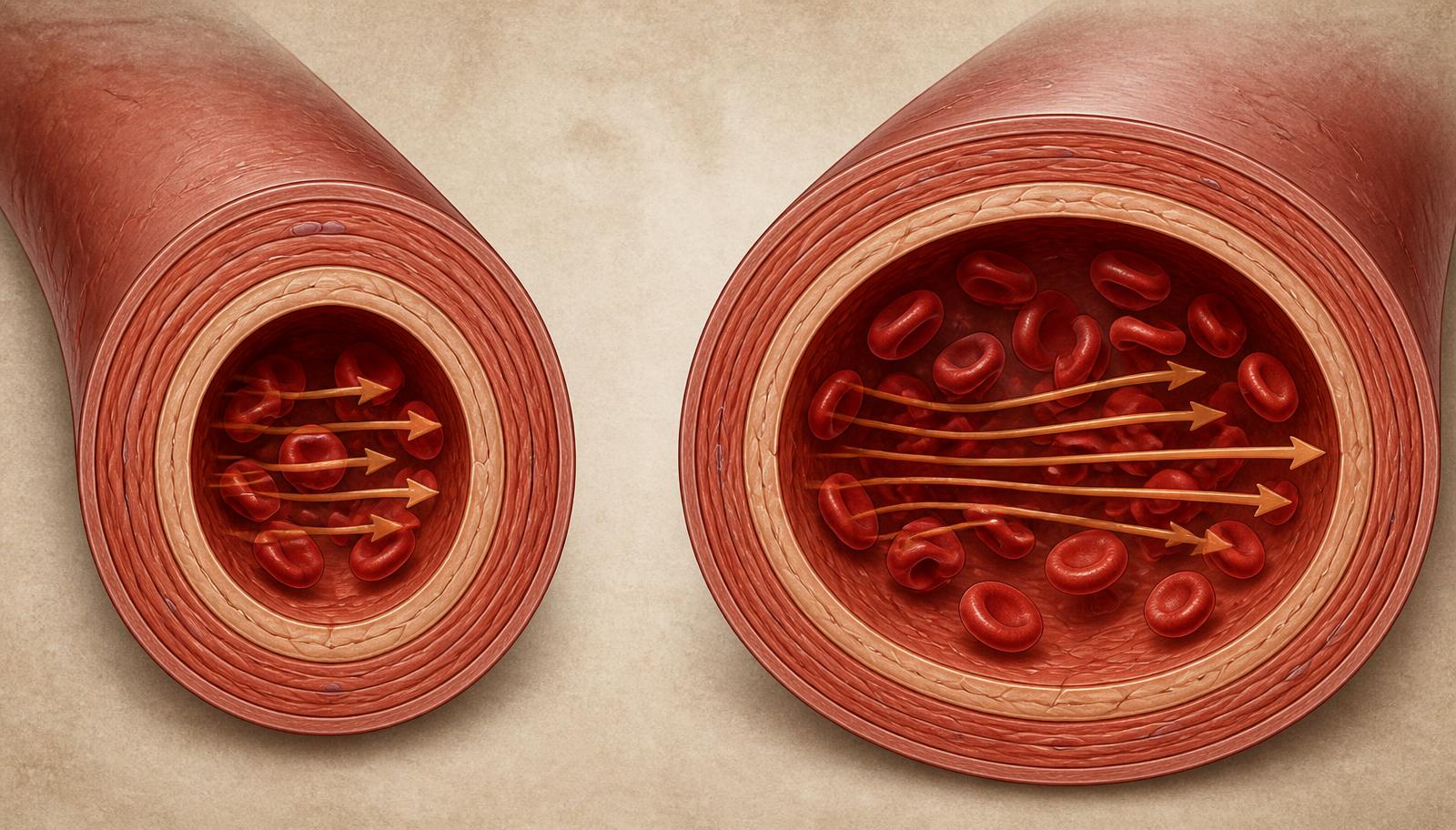
So Is Vasodilation Always Good?
No. That may sound surprising in an article about supporting healthy blood flow. But the goal of the cardiovascular system is not maximum vasodilation. It is appropriate vascular regulation.
Imagine that every blood vessel in your body suddenly dilated dramatically at the same time. Blood pressure could fall substantially. That would not be desirable. Your circulatory system needs to continuously decide:
- Where does blood need to go?
- How much is needed?
- What is blood pressure doing?
- Are muscles working?
- Are we hot, or cold?
- Are we resting, or digesting?
Vasodilation is best understood as one half of a dynamic regulatory system. Healthy vessels need to respond — not simply remain wide.
Who Tells a Blood Vessel to Relax?
There isn't one controller. Vascular tone is influenced by an extraordinary network of signals, including:
- signals from the nervous system
- hormones
- local metabolic changes
- temperature
- oxygen availability
- chemical substances released by endothelial cells
- mechanical forces created by blood flow itself
Nitric oxide is one particularly important member of this network. It provides a way for the inner endothelial lining of the blood vessel to communicate with the smooth muscle surrounding it. Think of it as a very short-distance message: "Relax."
How Can a Gas Relax a Blood Vessel?
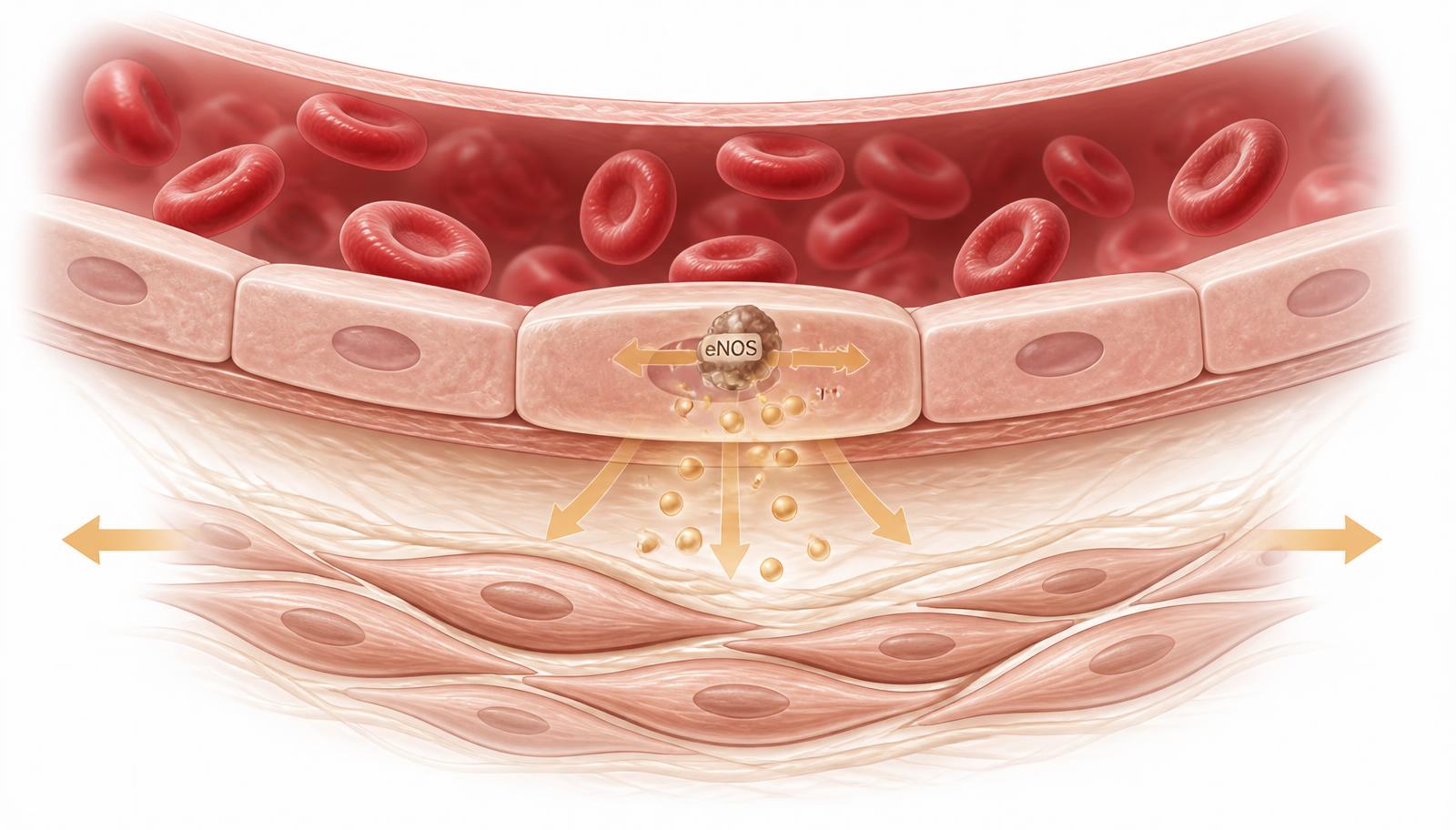
Nitric oxide is unusual. It is a gas. It is extremely small. And it can move readily across cell membranes. Inside endothelial cells is an enzyme called eNOS — endothelial nitric oxide synthase — which uses the amino acid L-arginine in the production of NO.
Once produced, NO does not need to travel through the bloodstream to find a distant destination. It acts locally. It diffuses from the endothelial cell into nearby vascular smooth-muscle cells. There it activates another enzyme, soluble guanylate cyclase — sGC — increasing production of a signaling molecule called cyclic guanosine monophosphate, or cGMP. cGMP then participates in processes that reduce smooth-muscle contraction. The muscle relaxes, and the vessel can widen. [1] [2]
The relaxation sequence
How Did Scientists Discover This?
The story is one of the great detective stories in cardiovascular science. Researchers had observed that blood vessels could relax in response to certain signals. But something strange happened experimentally: if the endothelial lining was removed from a blood vessel, some of those relaxation responses disappeared.
That suggested the endothelium was producing an unknown substance capable of telling vascular smooth muscle to relax. Researchers initially called it endothelium-derived relaxing factor — EDRF. Eventually, scientists discovered its identity. It was nitric oxide.
The importance of this discovery was recognized with the 1998 Nobel Prize in Physiology or Medicine, awarded to Robert F. Furchgott, Louis J. Ignarro and Ferid Murad for discoveries concerning nitric oxide as a signaling molecule in the cardiovascular system. [3] A gas once known mainly as an environmental molecule had turned out to be something the human body deliberately manufactures to regulate itself.
Why Does the Body Need Vessels to Dilate?
Because blood-flow requirements constantly change. Consider your leg muscles. While sitting quietly, their energy requirements are relatively low. Stand up and start walking briskly: muscle metabolism increases, oxygen demand increases, nutrient requirements change, local metabolic signals accumulate and blood flow needs to adapt.
Small arteries and arterioles supplying active muscle can dilate, reducing vascular resistance and allowing greater blood flow through the tissue. This is called functional hyperemia — one of the clearest examples of the circulation matching supply to demand.
What Happens When You Exercise?
Exercise is a wonderful demonstration of vasodilation in action. As muscles begin working:
- heart rate increases
- cardiac output rises
- blood-flow patterns change
- local metabolites accumulate
- vessels supplying active muscle adjust
Meanwhile, blood flowing more rapidly across the endothelial lining increases shear stress. Endothelial cells can sense that mechanical force, and shear stress can stimulate eNOS-related signaling and NO production. [4]
Your blood vessels are not simply carrying blood during exercise. They are actively responding to it.

Why Does Your Face Turn Red When You're Hot?
Here is vasodilation you can actually see. When body temperature rises, blood vessels near the skin can dilate. That increases blood flow near the body's surface, and heat can then be transferred from blood toward the environment. This is one reason your face may become flushed, your skin may appear pinker and you feel warmer at the surface during exercise or in hot conditions.
Vasodilation is therefore not just about delivering oxygen. It also participates in temperature regulation.
And Why Do Blood Vessels Constrict When You're Cold?
The opposite happens when the body needs to conserve heat. Blood vessels near the skin can constrict, reducing blood flow near the surface and helping limit heat loss.
- Hot → greater skin vasodilation
- Cold → greater skin vasoconstriction
Again, neither dilation nor constriction is inherently "better." The healthy response is the ability to adjust appropriately.
Does Vasodilation Lower Blood Pressure?
It can. Blood pressure is influenced by several factors, including:
- cardiac output
- blood volume
- arterial properties
- vascular resistance
When resistance vessels dilate, resistance to blood flow can decrease, and this can contribute to lower blood pressure. But blood-pressure regulation involves many interacting systems, and it would be misleading to reduce hypertension to "not enough vasodilation."
High blood pressure can have many contributing factors and should be appropriately evaluated and managed. Supporting normal endothelial function is part of cardiovascular wellness. It is not a substitute for blood-pressure treatment.
What Is "Vascular Tone"?
Blood vessels are rarely completely relaxed or maximally contracted. Instead, smooth muscle maintains a degree of ongoing contraction called vascular tone. Think of it as the vessel's adjustable starting position. Different signals can then shift that tone toward greater contraction or greater relaxation.
Nitric oxide is one of the important signals favoring relaxation. Other biological signals can promote constriction. The vessel continually integrates all of them. So cardiovascular health is not about turning vascular tone "off." It is about maintaining the ability to regulate it.
Do All Blood Vessels Dilate the Same Way?
No. Different vascular beds respond differently. Blood vessels supplying:
- skeletal muscle
- skin
- the brain
- the heart
- the kidneys
- digestive organs
have specialized regulatory characteristics. The brain maintains tightly controlled cerebral blood flow. The skin responds strongly to temperature. Working skeletal muscle responds strongly to metabolic demand. The coronary circulation must continually match blood supply to the metabolic needs of the heart itself.
The body therefore does not have one universal "vasodilation setting." It has many locally regulated vascular systems working simultaneously.
How Fast Can Vasodilation Happen?
Very fast. Nitric oxide is ideal for short-range signaling because it can diffuse rapidly across membranes. It does not need to be packaged into a vesicle, transported through a long nerve or carried to a distant organ. It can be produced locally and act nearby.
But NO is also short-lived. The body does not generally make a batch of endothelial NO and store it for next week. It makes it when needed. That is why supporting NO biology means supporting a production system, not filling an NO storage tank.
Does More Arginine Automatically Mean More Vasodilation?
Not necessarily. This is where simplistic supplement explanations break down. eNOS uses L-arginine as substrate, so arginine is unquestionably important to the pathway. But NO production also depends upon:
- eNOS activity
- oxygen
- enzyme cofactors
- cellular arginine availability
- oxidative conditions
- endogenous inhibitors
- other regulatory mechanisms
Simply increasing arginine intake does not mean vascular dilation will increase indefinitely. The pathway is regulated. That is a good thing.
Where Does Citrulline Fit?
L-citrulline takes a different route. After oral consumption, citrulline is efficiently absorbed and can be converted into L-arginine, importantly through metabolism involving the kidneys. Human pharmacokinetic studies have demonstrated that citrulline can increase circulating arginine availability. [5]
Arginine
Provides substrate already in the form used by eNOS.
Citrulline
Provides a complementary route toward replenishing arginine availability.
This is why using both amino acids can make biological sense when the objective is nutritional support of the natural NO-production pathway. It is not about forcing maximum vasodilation. It is about supporting substrate availability for a pathway the body regulates itself.
There Is Another Route to NO
Vegetables add another fascinating dimension. Leafy greens and beetroot can provide dietary nitrate, and the body can convert it through the nitrate–nitrite–NO pathway. [6] This pathway differs from the arginine/eNOS route and involves, among other things, nitrate-reducing bacteria in the mouth.
Both pathways can contribute to NO biology.
Is a "Pump" the Same Thing as Healthy Vasodilation?
Not exactly. In fitness marketing, nitric oxide is frequently associated with getting a bigger muscle "pump." During resistance exercise, blood flow and fluid distribution within working muscle change, which can temporarily increase muscle volume, and NO-related vascular signaling can participate in exercise blood-flow regulation.
But the size of someone's temporary workout pump is not a clinical measurement of endothelial health or NO production. And a larger pump does not automatically mean better cardiovascular health. That is a useful distinction between fitness terminology and vascular physiology.
What Can Interfere With Normal Endothelial Relaxation?
One important factor is reduced NO bioavailability. NO may be produced but rapidly consumed through reactions with reactive oxygen species. Superoxide, for example, can react with NO, reducing the amount available for normal vascular signaling. Endothelial function can also be influenced by:
- aging
- smoking
- high blood pressure
- metabolic dysfunction
- physical inactivity
- oxidative stress
- other cardiovascular factors
[7] This is why maintaining vascular responsiveness becomes increasingly relevant as we age.
What Does Aging Do to Vasodilation?
Healthy younger arteries generally demonstrate strong endothelial responsiveness. With advancing age, endothelial-dependent dilation tends to become less efficient, and reduced NO bioavailability is considered one important mechanism. [7]
But age is not the only influence. Regular exercise can help preserve endothelial function. Smoking avoidance matters. Blood-pressure and metabolic management matter. Diet matters. So while vascular aging is real, the trajectory is not entirely predetermined.
Can You Feel Vasodilation?
Usually not in a specific, reliable way. Warm skin during heat exposure can reflect increased cutaneous blood flow. Muscles may feel fuller during exercise. Some medications that cause vasodilation can produce noticeable sensations such as flushing or headache.
A sensation is not necessarily evidence of improved vascular physiology. Subjective feelings cannot tell you whether your endothelial function is healthy — worth remembering when evaluating products marketed around an immediate "NO feeling."
What Naturally Supports Healthy Vascular Responsiveness?
Instead of trying to keep blood vessels permanently dilated, support the systems that allow them to respond.
Move
Exercise changes blood flow and creates shear stress that stimulates endothelial signaling.
Eat vegetables
Leafy greens and beetroot can provide dietary nitrate.
Support good nutrition
Protein foods provide amino acids including arginine, while a varied diet provides nutrients important to overall vascular health.
Don't smoke
Smoking strongly works against endothelial function.
Manage cardiovascular risk
Blood pressure, blood glucose and blood lipids influence vascular health.
Keep using your vascular system
Regular physical activity gives blood vessels repeated reasons to respond and adapt.
The Point Is Responsiveness, Not Maximum Dilation
The objective of vascular health is not wide-open arteries all day long. Blood vessels need to constrict when appropriate and dilate when appropriate. They need to respond to exercise, temperature, posture, metabolic demand, neural signals and blood-pressure changes.
Healthy vascular function is best understood as the capacity to adapt. Nitric oxide helps make that adaptation possible.
Where ėNOS Fits Into the Vasodilation Story
The science of endothelial nitric-oxide production is central to the formulation philosophy behind ėNOS by Australiana Life. And the distinction between the two names is particularly relevant here: eNOS is endothelial nitric oxide synthase — the enzyme your body naturally uses to produce vascular NO. ėNOS is Australiana Life's nutritional formulation designed to support the body's natural nitric-oxide system.
At its center are L-arginine and L-citrulline. Arginine provides substrate directly relevant to the eNOS pathway. Citrulline takes a complementary metabolic route and can help replenish circulating arginine availability. That combination provides nutritional support for the body's normal NO-production pathway and vascular function.
Importantly, ėNOS is not intended to force blood vessels into continuous dilation. The body retains control of vascular tone. The nutritional objective is more intelligent: support the natural system responsible for producing one of the signals involved in healthy vascular responsiveness.
A Blood Vessel Is Always Listening
Perhaps the easiest way to understand vasodilation is to stop thinking about blood vessels as plumbing. An artery is alive. Its endothelial cells feel the blood passing over them. Its smooth muscle receives chemical messages. Its diameter changes. Its behavior changes with exercise, temperature, local oxygen demand, signals from the nervous system and signals from surrounding tissue.
Nitric oxide is one of the messages helping coordinate those responses. It is tiny. Short-lived. Invisible. Yet every time a healthy vessel responds appropriately to changing demand, you are seeing the outcome of an extraordinarily sophisticated biological conversation.
Your blood vessels don't simply carry blood. They continually decide how blood should flow.
Research Behind the Biology
Rather than treating these as promotional claims, the mechanisms described above are established areas of cardiovascular physiology.
[1] The obligatory role of endothelial cells in the relaxation of arterial smooth muscle by acetylcholine
Furchgott RF, Zawadzki JV. Nature. 1980;288:373–376. The landmark experiment demonstrating that an intact endothelium was necessary for certain forms of vascular relaxation.
PubMed / National Library of Medicine →[2] Endothelium-derived relaxing factor produced and released from artery and vein is nitric oxide
Ignarro LJ, Buga GM, Wood KS, Byrns RE, Chaudhuri G. Proceedings of the National Academy of Sciences. 1987;84:9265–9269. One of the pivotal papers identifying endothelium-derived relaxing factor as nitric oxide.
PubMed / National Library of Medicine →[3] The Nobel Prize in Physiology or Medicine 1998
Robert F. Furchgott, Louis J. Ignarro and Ferid Murad. Awarded for discoveries concerning nitric oxide as a signaling molecule in the cardiovascular system.
NobelPrize.org →[4] eNOS activation by physical forces: from short-term regulation of contraction to chronic remodeling of cardiovascular tissues
Balligand JL, Feron O, Dessy C. Physiological Reviews. 2009;89(2):481–534. Detailed review of blood flow, shear stress and endothelial NO signaling.
PubMed / National Library of Medicine →[5] Pharmacokinetic and pharmacodynamic properties of oral L-citrulline and L-arginine: impact on nitric oxide metabolism
Schwedhelm E, Maas R, Freese R, et al. British Journal of Clinical Pharmacology. 2008;65(1):51–59. Human research comparing citrulline and arginine metabolism.
PubMed / National Library of Medicine →[6] The nitrate–nitrite–nitric oxide pathway in physiology and therapeutics
Lundberg JO, Weitzberg E, Gladwin MT. Nature Reviews Drug Discovery. 2008;7:156–167. Major review of the complementary nitrate–nitrite–NO pathway.
PubMed / National Library of Medicine →[7] Aging and vascular endothelial function in humans
Seals DR, Jablonski KL, Donato AJ. Clinical Science. 2011;120(9):357–375. Review of aging, endothelial function and NO bioavailability.
PubMed / National Library of Medicine →
If You Want to Go Deeper
- How Your Body Makes Nitric Oxide →
Follow both major NO-production pathways from their starting materials to the final signaling molecule.
- What Is eNOS? The Enzyme Behind Natural Nitric Oxide Production →
Meet the endothelial enzyme responsible for producing vascular NO.
- The Endothelium: The Hidden Key to Healthy Blood Vessels →
Explore the living cellular surface that senses blood flow and communicates with the arterial wall.
- Nitric Oxide and Blood Flow: How Are They Connected? →
See how vascular regulation translates into changing blood flow throughout the body.
- L-Arginine + L-Citrulline: Two Pathways Supporting Nitric Oxide →
Understand why these two amino acids take different but complementary routes toward the NO system.
SUPPORT THE SIGNAL. LET YOUR BODY DO THE REGULATING.
ėNOS was formulated around the biology of the body's own nitric-oxide-production system — including the complementary roles of L-arginine and L-citrulline.
EXPLORE ĖNOS →This article is provided for informational purposes only and is not intended as medical advice or to diagnose, treat, cure or prevent disease. ėNOS is a dietary supplement formulated to support the body's natural nitric-oxide system and healthy vascular function. Dietary supplements should complement, rather than replace, appropriate nutrition, physical activity and medical care.
More in Circulation & Blood Flow
About Our Health & Science Content
Australiana Life Health & Science articles are based on published scientific research and written to make complex health and nitric oxide science easier to understand. Our educational content undergoes scientific review for accuracy and appropriate interpretation of the evidence and is updated as relevant scientific understanding evolves.