
L-Arginine + L-Citrulline: Two Pathways Supporting Nitric Oxide
Why These Two Amino Acids Are More Interesting Together Than They First Appear
L-arginine and L-citrulline are often mentioned in the same conversation.
- Both are amino acids.
- Both are involved in nitric-oxide biology.
- Both have been studied in cardiovascular and exercise research.
But they are not interchangeable. And they do not take the same route through the body.
That difference matters. If you are trying to understand how the body supports natural nitric-oxide production, the relationship between L-arginine and L-citrulline is one of the most useful pieces of the puzzle.
One provides the more direct substrate for nitric-oxide synthesis. The other takes a more indirect route — one that can help replenish the body's circulating arginine pool.
Sometimes two related nutrients are valuable not because they do the same job, but because they approach the same biological system from different directions.
Start With the End Point: Nitric Oxide
Nitric oxide — NO — is a signaling molecule involved in normal vascular function.
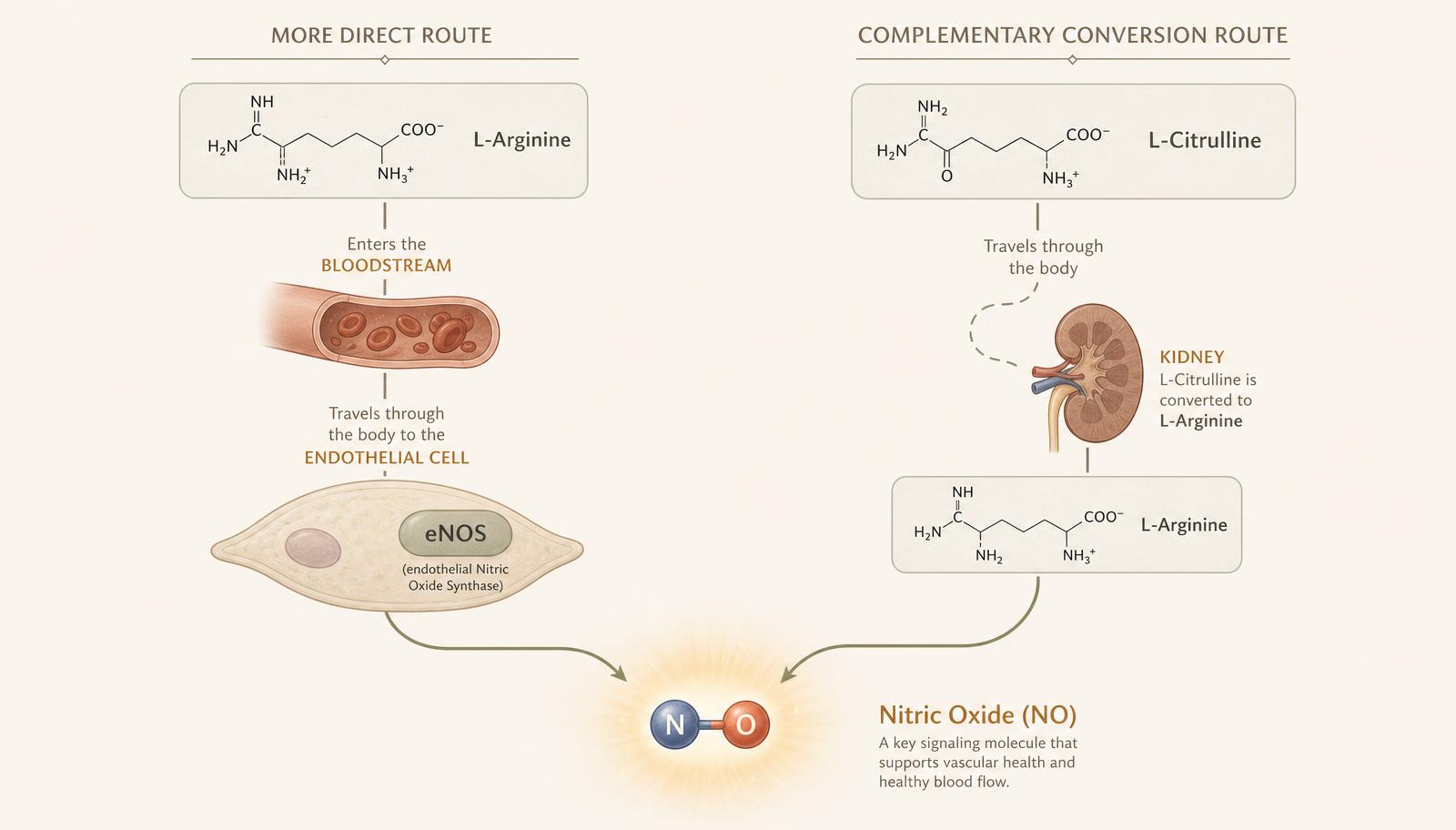
Within endothelial cells lining the blood vessels, an enzyme called endothelial nitric oxide synthase, or eNOS, uses L-arginine as a substrate in the production of NO.
That appears straightforward. But what happens before arginine reaches that pathway is where the story becomes more interesting.
Route One: L-Arginine
L-arginine is directly involved in nitric-oxide synthesis. That is its major relevance here. eNOS acts on arginine as part of the biochemical reaction that produces NO. So from a pathway perspective, arginine is the more direct nutritional precursor.
But oral arginine has an important limitation. After it is consumed, a meaningful portion can be metabolized in the gastrointestinal tract and liver before reaching the systemic circulation. This is commonly referred to as first-pass metabolism or presystemic metabolism.
Arginase enzymes in the intestine and liver metabolize part of orally consumed arginine into other compounds, including ornithine and urea. As a result, not every gram of arginine swallowed becomes circulating arginine available to peripheral tissues. [1][2]
That does not make arginine ineffective. It simply explains why how a nutrient is handled by the body matters as much as what the nutrient is called.
Direct Does Not Mean Simple
It would be easy to summarize the pathway like this: take arginine → make nitric oxide.
But physiology is rarely that simple. For eNOS to produce NO effectively, several things must be in place:
- arginine must be available
- the enzyme must be functioning appropriately
- essential cofactors must be present
- endothelial signaling must be intact
- oxidative conditions influence NO bioavailability
So arginine is an important raw material. It is not the entire system. That distinction becomes important when evaluating products that rely only on the presence of a single NO precursor.
Route Two: L-Citrulline
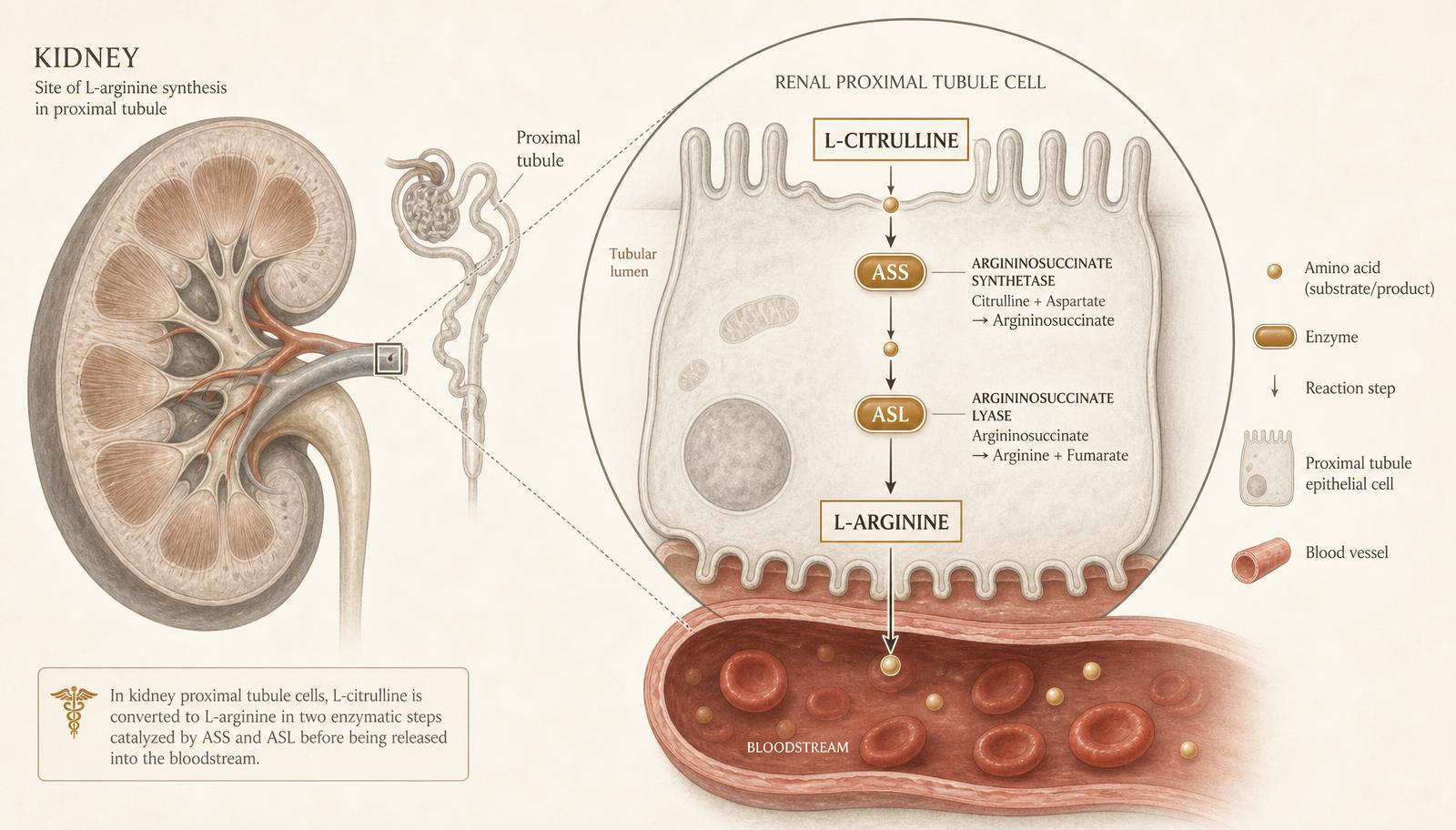
L-citrulline takes a very different journey. Unlike arginine, citrulline is not significantly metabolized by intestinal or hepatic arginase during first-pass metabolism. It is absorbed into the circulation and can then travel to the kidneys. There, enzymes convert citrulline into L-arginine. [2][3][4]
The kidney is a major organ involved in this endogenous arginine synthesis pathway. Human metabolic studies and reviews describe renal conversion of citrulline as an important contributor to circulating arginine availability. [3][4]
Why Citrulline Can Raise Arginine So Effectively
This is where controlled human research becomes especially useful. In a randomized, double-blind, placebo-controlled crossover study, researchers compared oral L-citrulline and L-arginine and measured their effects on circulating arginine and markers of nitric-oxide metabolism. [1]
One of the most interesting findings was that L-citrulline dose-dependently increased plasma L-arginine exposure and peak concentrations effectively, despite not itself being arginine. The study also found that higher-dose citrulline increased minimum circulating arginine concentrations and improved the arginine-to-ADMA ratio, while increasing urinary nitrate and cGMP markers associated with NO-dependent signaling. [1]
Sometimes supplying a precursor to a nutrient can be an efficient way of increasing the nutrient itself: citrulline → arginine → the NO pathway.
The Timing Is Different Too
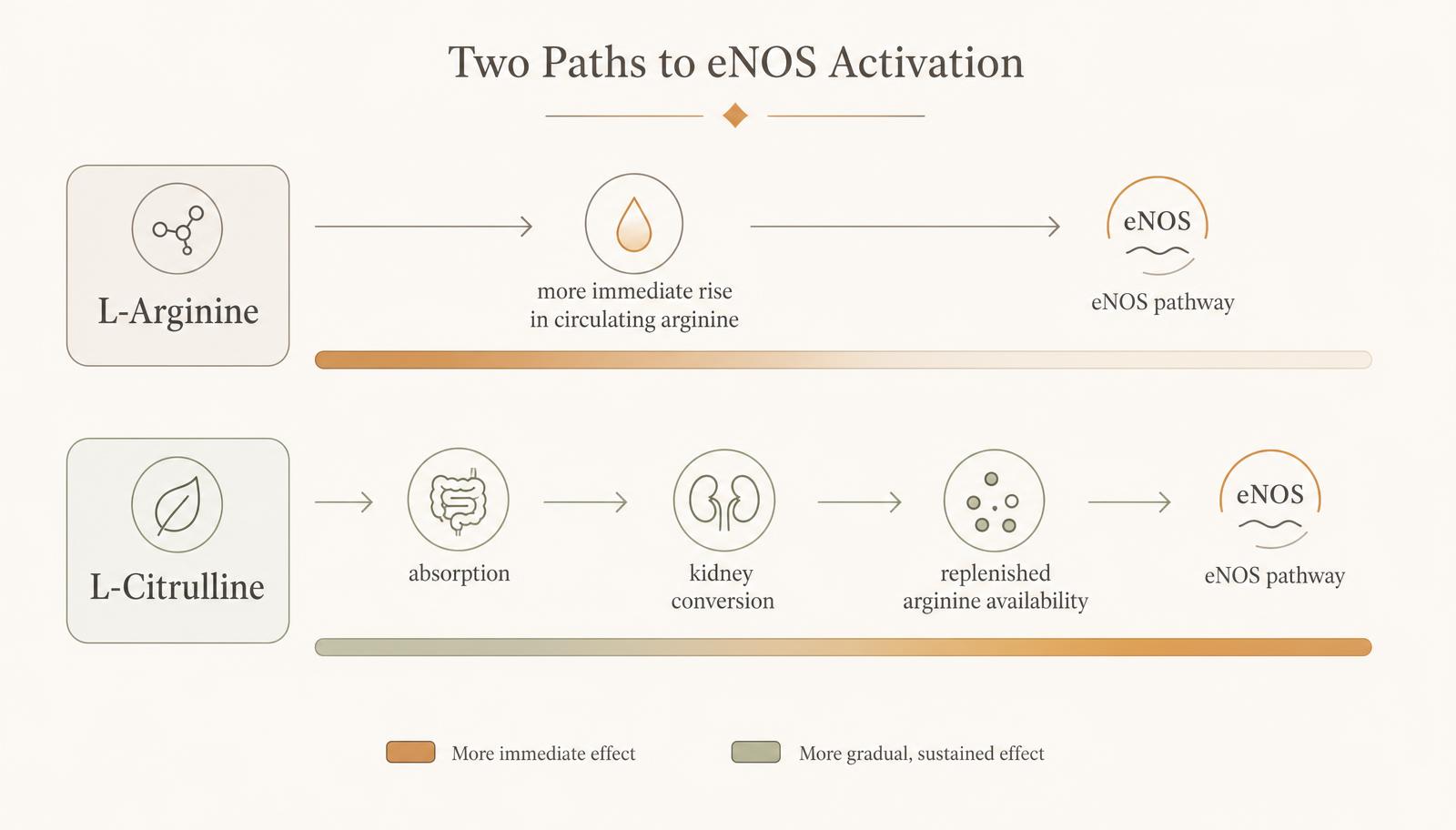
The distinction between arginine and citrulline is not only about where they are metabolized. Their timing differs. Immediate-release oral arginine can produce a relatively rapid rise in circulating arginine. Citrulline takes an additional step because it must first be converted into arginine. That gives the two routes different pharmacokinetic characteristics.
This is the basis for thinking about them as complementary:
- Arginine contributes more directly to available substrate.
- Citrulline helps replenish arginine through endogenous conversion.
The resulting concept is not "fast nitric oxide" versus "slow nitric oxide" in a literal timed-release sense. A more scientifically accurate description is: more immediate substrate availability + more sustained support for arginine availability.
Citrulline is not slowly releasing nitric oxide. It is supporting the body's ability to continue supplying arginine to the pathway from which NO can subsequently be produced.
Why Not Just Use Arginine Alone?
That is a reasonable question. If arginine is directly used by eNOS, why involve citrulline at all? The answer comes back to metabolism. Oral arginine is subject to more first-pass extraction. Citrulline largely avoids that route and can later be converted to arginine.
A 2018 review on L-citrulline and cardiometabolic health highlighted this distinction, noting that intestinal and hepatic arginase activity substantially reduces oral arginine availability, whereas citrulline is not handled the same way during first-pass metabolism and can be converted into arginine by the kidneys. [2]
This means the two amino acids approach the same nitric-oxide system differently. That can make the combination more biologically interesting than simply increasing the quantity of one ingredient.
Why Not Just Use Citrulline Alone?
The reverse question is equally valid. If citrulline can increase circulating arginine, why include arginine at all? Because the two serve different purposes. Arginine is already the substrate used by eNOS. Citrulline needs to be converted first.
So arginine can contribute directly to the available substrate pool while citrulline provides a complementary metabolic source of additional arginine. This creates a formulation rationale based on different routes and different timing, rather than duplication.
The Arginine–Citrulline Relationship Is a Cycle
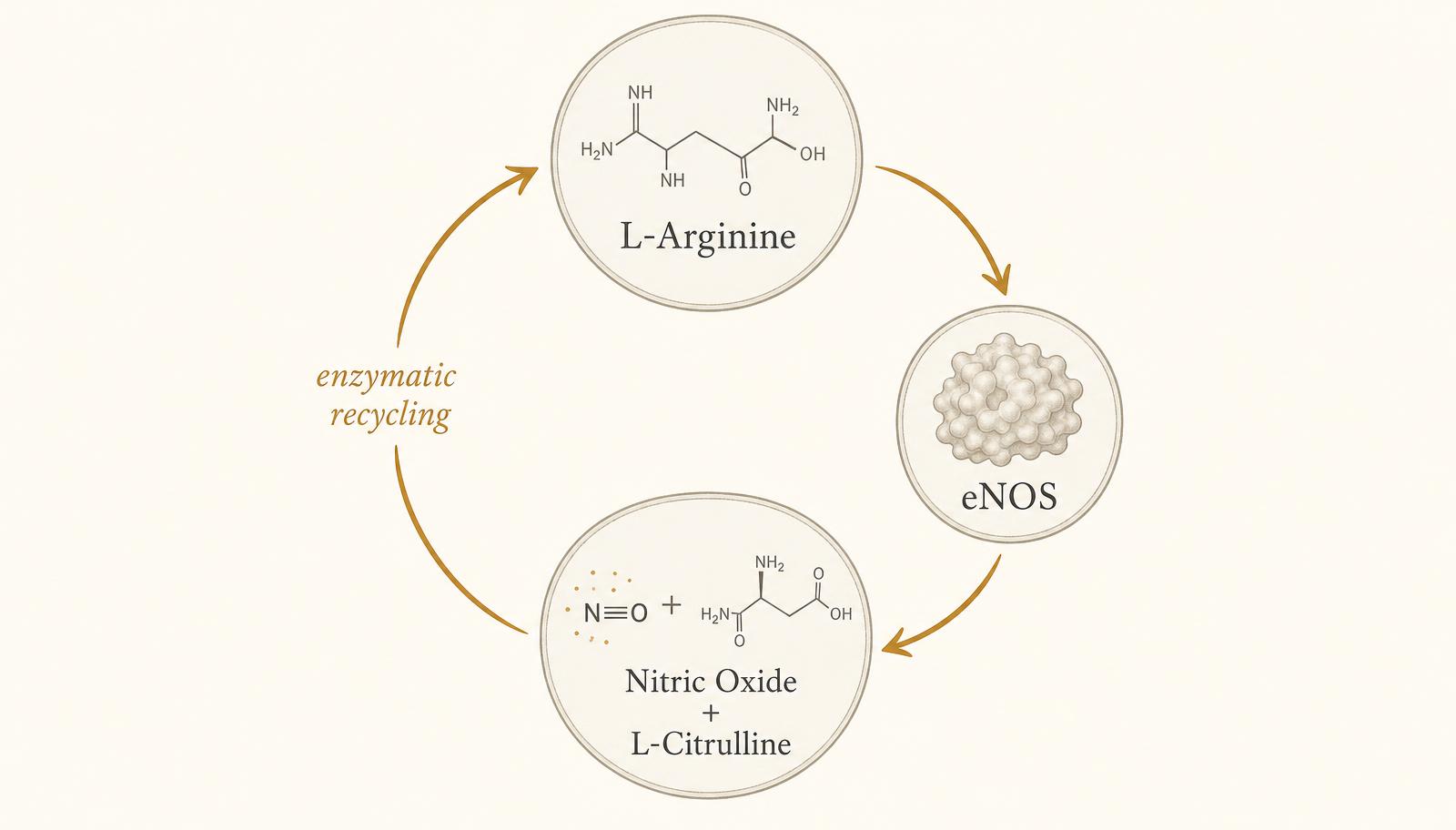
There is another layer to the biology. When eNOS uses arginine to produce nitric oxide, L-citrulline is also formed as a product of that reaction. Cells possess enzymes capable of recycling citrulline back toward arginine through the citrulline–NO cycle.
This reflects how tightly connected the two amino acids are in normal physiology. They are not simply two unrelated ingredients added to the same formula. They are metabolically linked within the body's nitric-oxide system.
There Is Another Important Player: ADMA
The nitric-oxide pathway has natural regulators. One of them is asymmetric dimethylarginine — ADMA. ADMA is an endogenous molecule that can inhibit nitric oxide synthase. Researchers therefore sometimes look not only at absolute arginine concentrations but also at the relationship between arginine and ADMA.
In the Schwedhelm study, higher-dose citrulline improved the arginine/ADMA ratio, one of the markers researchers use when studying substrate availability in relation to NOS activity. [1]
This is another reminder that the nitric-oxide pathway cannot be understood simply by asking, "How much arginine is present?" The biological context matters.
Food Sources: Where Do Arginine and Citrulline Come From?
Both amino acids occur naturally, but their food patterns differ.
Foods That Provide Arginine
- meat
- poultry
- fish
- dairy foods
- nuts
- seeds
- legumes
Seeds and nuts can be particularly rich sources.
Foods Associated With Citrulline
Citrulline is much less abundant in ordinary diets. The best-known natural food source is watermelon, which contains citrulline in both the flesh and rind. The name itself comes from Citrullus, the Latin-derived botanical association with watermelon.
Diet can therefore contribute to both amino acids, although the amounts obtained vary widely.
What the Research Does — and Does Not — Tell Us
Scientific credibility requires a distinction between mechanism and clinical outcome.
The metabolic relationship is well established:
- eNOS uses arginine as substrate
- oral citrulline can increase circulating arginine
- the kidney plays an important role in converting citrulline into arginine
- arginine and citrulline differ in first-pass metabolism
- human studies show changes in markers associated with NO metabolism
But that does not mean every study of arginine or citrulline produces the same physiological outcome. For example, in the Schwedhelm pharmacokinetic study, citrulline increased arginine availability and several NO-related biochemical markers, but the intervention did not produce a significant change in flow-mediated dilation in those healthy volunteers. [1]
That nuance matters. It tells us that improving substrate availability is not identical to guaranteeing a particular vascular outcome. Human physiology has many regulatory layers. This is exactly why a systems-based formulation philosophy makes more sense than promising that one amino acid automatically produces one result.
Why Dose and Formulation Matter
An ingredient list tells you what is present. It does not necessarily tell you whether the amount is meaningful. That is particularly relevant with amino acids because many nutritional studies use gram-level quantities rather than trace amounts.
When evaluating arginine- and citrulline-containing products, useful questions include:
- How much is actually present?
- Are both ingredients disclosed?
- Are they included for a defined metabolic reason?
- Does the formulation understand how they interact with the NO pathway?
More ingredients do not automatically mean more biological value. A smaller number of deliberately selected ingredients can represent a more coherent strategy than a very long ingredient list containing only token quantities.
Two Pathways, One Formulation Philosophy
The complementary relationship between L-arginine and L-citrulline is central to the formulation philosophy behind ėNOS by Australiana Life. The rationale is not simply "both are associated with nitric oxide, so include both." The rationale is metabolic.
L-Arginine
Provides substrate more directly available to the eNOS pathway.
L-Citrulline
Uses a complementary absorption and conversion pathway that can replenish circulating arginine.
Together they provide a more direct route + a replenishing route — or, stated another way, more immediate + more sustained support for arginine availability. That distinction is central to how ėNOS approaches nutritional support for the body's natural nitric-oxide system.
Why the Combination Fits a Broader NO Strategy
Arginine and citrulline are important, but they still do not operate in isolation. The body's NO system also depends upon:
- endothelial function
- eNOS activity
- appropriate cofactors
- oxidative balance
- blood-flow signaling
- exercise
- overall nutrition
- and additional pathways such as dietary nitrate
That is why ėNOS was designed around selected ingredients with defined roles rather than viewing nitric oxide as simply an "arginine problem." The amino-acid combination sits at the center of the formulation. But it sits within a broader systems approach.
What Makes These Two Amino Acids Worth Remembering?
If you remember only one thing from this article, make it this:
L-arginine and L-citrulline are not redundant ingredients. Arginine is directly involved in nitric-oxide synthesis. Citrulline takes another metabolic route and can be converted into arginine, particularly through renal metabolism.
That means the two can support the same biological pathway in different but complementary ways. One starts closer to the destination. The other helps replenish the road leading there.
That is what makes the combination scientifically interesting — and why the relationship between arginine and citrulline deserves more attention than simply listing both under the heading "nitric oxide ingredients."
Scientific References
[1] Pharmacokinetic and pharmacodynamic properties of oral L-citrulline and L-arginine: impact on nitric oxide metabolism
Schwedhelm E, Maas R, Freese R, et al. British Journal of Clinical Pharmacology. 2008;65(1):51–59. PMID: 17662090. Randomized, double-blind, placebo-controlled crossover study comparing oral L-citrulline and L-arginine and their effects on circulating arginine and markers of NO metabolism.
PubMed / National Library of Medicine →[2] L-Citrulline Supplementation: Impact on Cardiometabolic Health
Allerton TD, Proctor DN, Stephens JM, Dugas TR, Spielmann G, Irving BA. Nutrients. 2018;10(7):921. PMID: 30029482. Review discussing oral citrulline, first-pass arginine metabolism, renal conversion to arginine and potential cardiometabolic relevance.
PubMed / National Library of Medicine →[3] Renal arginine metabolism
Brosnan ME, Brosnan JT. Journal of Nutrition. 2004;134(10 Suppl):2791S–2795S. PMID: 15465786. Review describing the kidney's role in endogenous arginine synthesis from citrulline.
PubMed / National Library of Medicine →[4] Renal metabolism of amino acids: its role in interorgan amino acid exchange
van de Poll MCG, Soeters PB, Deutz NEP, Fearon KCH, Dejong CHC. American Journal of Clinical Nutrition. 2004;79(2):185–197. PMID: 14749222. Review of renal amino-acid metabolism, including conversion of citrulline to arginine.
PubMed / National Library of Medicine →
Related Reading
- What Is eNOS? The Enzyme Behind Natural Nitric Oxide Production →
Understand the enzyme that actually uses L-arginine to produce vascular nitric oxide.
- How to Increase Nitric Oxide Naturally →
Explore the wider role of diet, exercise, nitrate-rich vegetables and amino acids.
- The Endothelium: The Hidden Key to Healthy Blood Vessels →
See where the eNOS pathway operates and why endothelial function matters.
- Nitric Oxide and Blood Flow: How Are They Connected? →
Follow nitric-oxide signaling from the endothelial cell to vascular relaxation and changing blood flow.
- Nitric Oxide and Aging: What Changes After 40, 50 and Beyond? →
Learn why maintaining NO pathways becomes increasingly relevant with age.
- The Science Behind the ėNOS Amino-Acid Strategy →
Explore how the complementary metabolism of L-arginine + L-citrulline influenced the formulation philosophy behind ėNOS.
DISCOVER THE SCIENCE BEHIND ĖNOS
ėNOS pairs L-arginine and L-citrulline deliberately — a more direct route and a complementary conversion route toward the body's own nitric-oxide pathway.
EXPLORE ĖNOS →This article is provided for educational purposes only and is not intended as medical advice or to diagnose, treat, cure or prevent disease. ėNOS is a dietary supplement. Individual responses to amino acids and dietary supplements vary, and supplements should complement rather than replace appropriate nutrition, physical activity and medical care.
More in Nutrition & NO Support
- How to Increase Nitric Oxide Naturally
- Foods That Support Natural Nitric Oxide Production
- Arginine vs. Citrulline: What's the Difference?
- L-Citrulline Explained: From Citrulline to Arginine to Nitric Oxide
- L-Arginine & Nitric Oxide Explained
- Why Combine L-Arginine & L-Citrulline?
- Dietary Nitrates & the Nitrate–Nitrite–Nitric Oxide Pathway
- Nitric Oxide Supplements: What Should You Look For?
About Our Health & Science Content
Australiana Life Health & Science articles are based on published scientific research and written to make complex health and nitric oxide science easier to understand. Our educational content undergoes scientific review for accuracy and appropriate interpretation of the evidence and is updated as relevant scientific understanding evolves.