
The Endothelium: The Hidden Key to Healthy Blood Vessels
Meet the Remarkable Cellular Lining Inside Your Blood Vessels
You know your heart. You know your arteries. You've probably heard about cholesterol, blood pressure and circulation.
But there is another part of your cardiovascular system that receives far less attention — even though it is in constant contact with your blood every second of your life.
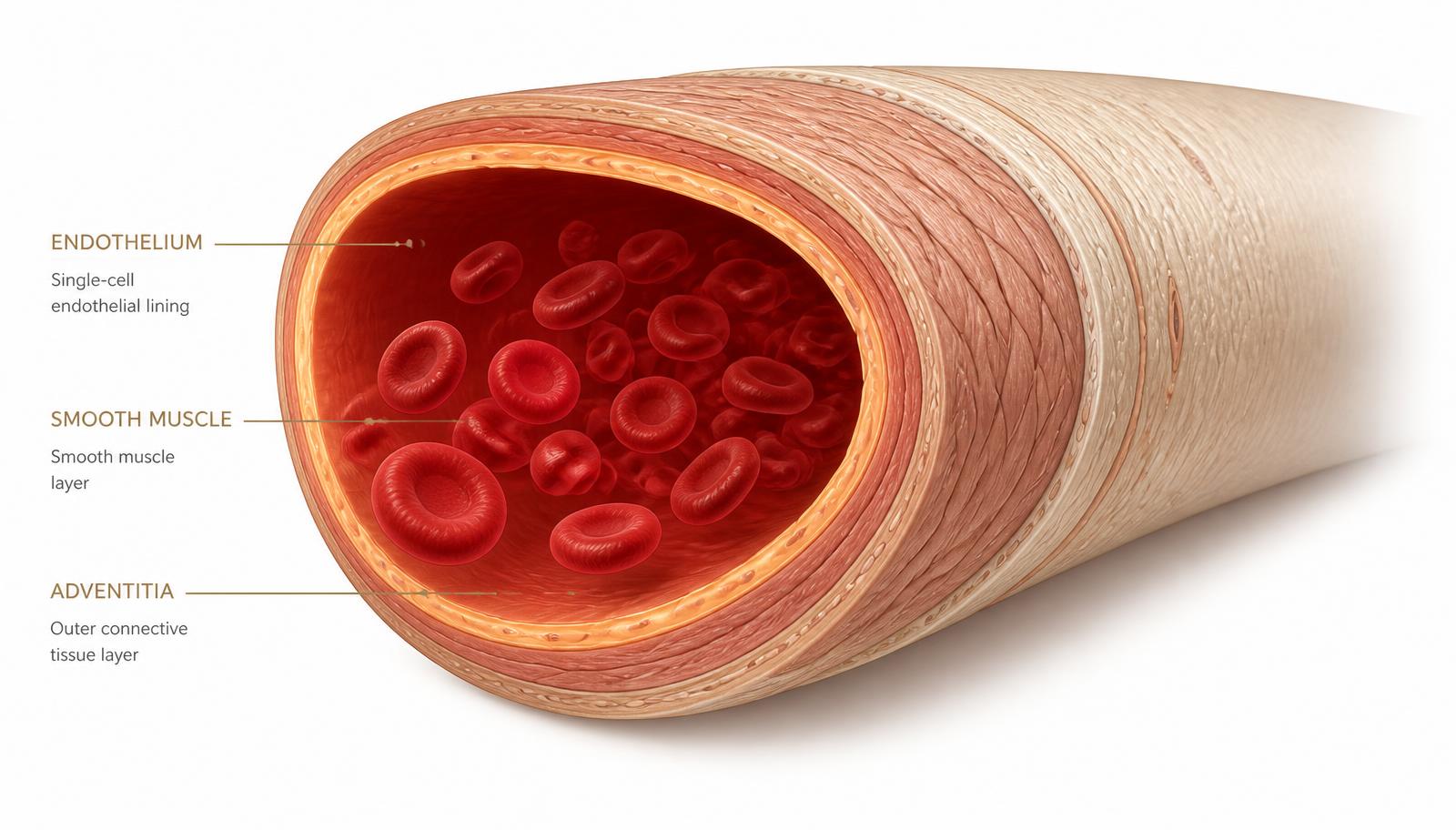
It's called the endothelium: an extraordinarily thin layer of specialized cells lining the inside of your blood vessels. It lines arteries. It lines veins. It lines the smallest capillaries. And despite being only a single-cell layer, it is anything but insignificant.
Modern cardiovascular science recognizes the endothelium as a highly active interface between circulating blood and the tissues of the vascular wall. It senses changes in blood flow, responds to chemical and mechanical signals, helps regulate vascular tone and produces substances that influence how blood vessels behave. [1][2]
One of the most important substances it produces is nitric oxide — NO. But nitric oxide is only part of the story. To understand healthy blood vessels, it helps to first meet the remarkable layer of cells that helps manage them.
ENDOTHELIUM — IN PLAIN ENGLISH
- What is it?
- A single-cell layer lining the inside of blood vessels.
- Where is it?
- Throughout the vascular system — arteries, veins and capillaries.
- What does it do?
- Senses what is happening in the bloodstream and sends biological signals that help regulate vascular function.
- Why does it matter?
- Healthy endothelial function is an important part of healthy blood-vessel function.
Imagine Looking Inside an Artery
Picture a healthy artery. There is blood flowing through the center. Around it is the arterial wall, including layers of smooth muscle and structural tissue.
But blood does not flow directly against that muscular wall. Between the blood and the rest of the vessel is an extremely thin cellular surface. That surface is the endothelium.
For many years, scientists largely viewed this layer as a passive barrier — something like a smooth biological coating that kept blood separated from the vessel wall. Research eventually revealed something much more interesting.
The endothelium is continuously sensing what is happening around it. How quickly is blood flowing? What mechanical forces are acting on the vessel? What chemical signals are present? What does the surrounding tissue need? Endothelial cells receive information and respond.
In that sense, your blood vessels aren't simply tubes. They are responsive biological structures — and the endothelium helps coordinate that responsiveness.
A One-Cell-Thick Control Surface
One reason the endothelium is so fascinating is the contrast between its appearance and its importance. It is extremely thin. Yet endothelial cells participate in regulating many aspects of vascular biology.
They release substances involved in:
- Vascular relaxation and constriction
- Blood-vessel responsiveness
- Interactions with circulating blood cells
- Coagulation and platelet-related processes
- Inflammatory signaling
- Growth and remodeling of blood vessels
- Movement of substances between blood and surrounding tissue
The endothelium is therefore not simply a wall. It is more like a living control surface. [1][2]
That doesn't mean it controls the cardiovascular system by itself. Many organs, hormones, nerves and cellular systems participate in vascular regulation. But the endothelium occupies a unique position: on one side is your blood, on the other is the blood-vessel wall — and endothelial cells are constantly communicating with both.
The Discovery That Changed the Way We See Blood Vessels
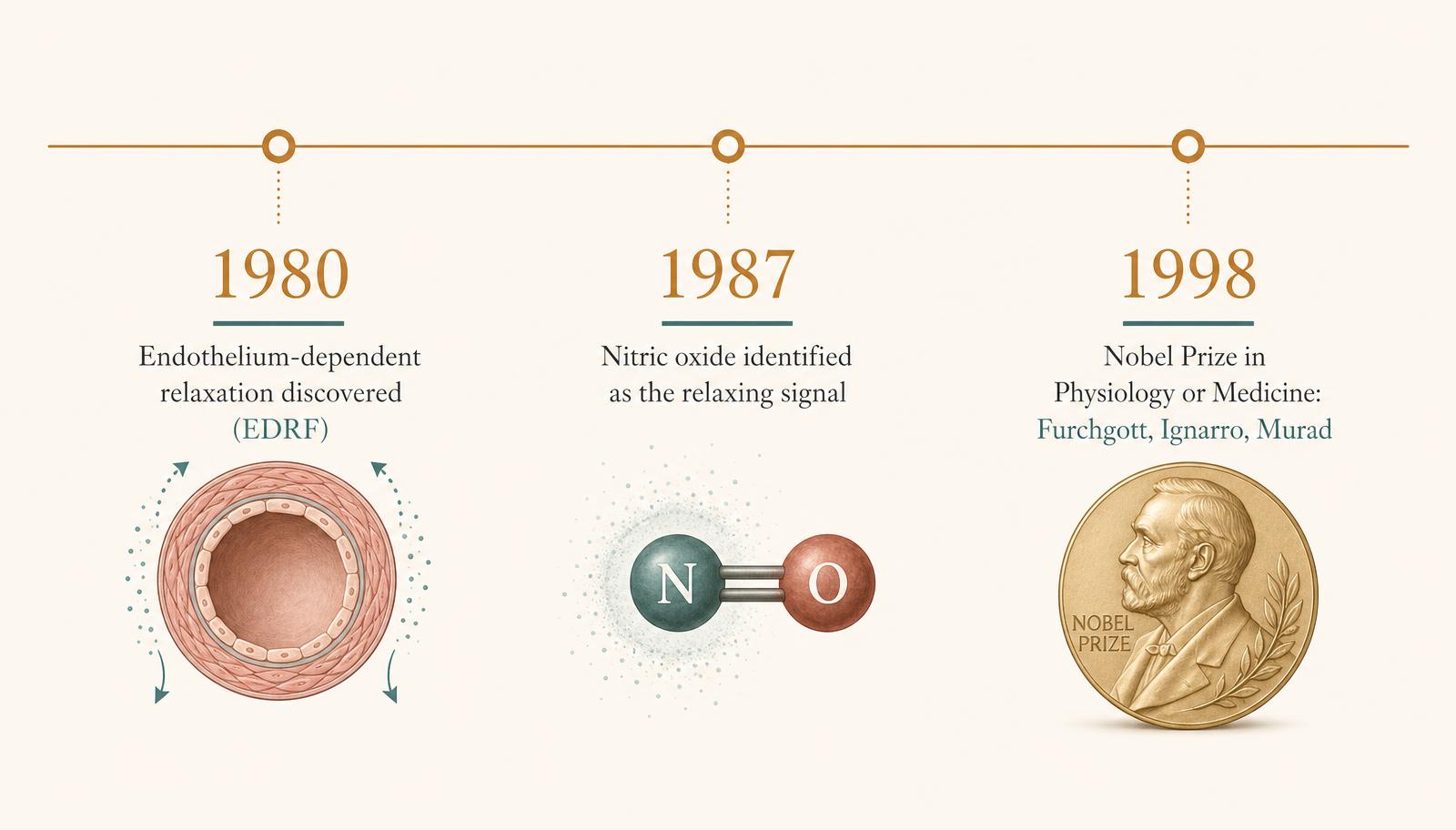
One experiment in 1980 fundamentally changed vascular science. Pharmacologist Robert F. Furchgott and researcher John V. Zawadzki were studying how arteries relax, and they discovered something unexpected: a substance called acetylcholine could cause an artery to relax — but only when the endothelial lining was intact. [3]
Remove the endothelial cells and the relaxation disappeared. Something in the endothelium was apparently telling the surrounding smooth muscle to relax. Scientists initially called the mysterious signal endothelium-derived relaxing factor — EDRF.
During the 1980s, researchers including Furchgott, Louis Ignarro, Salvador Moncada and their colleagues helped establish the answer: nitric oxide. [4][5]
FROM EDRF TO NITRIC OXIDE
- 1980Furchgott and Zawadzki show arterial relaxation requires an intact endothelium.
- The questionAn unknown signal is named endothelium-derived relaxing factor (EDRF).
- 1987EDRF is identified as nitric oxide.
- 1998The Nobel Prize in Physiology or Medicine recognises NO as a signaling molecule.
The Endothelium Has a Messenger: Nitric Oxide
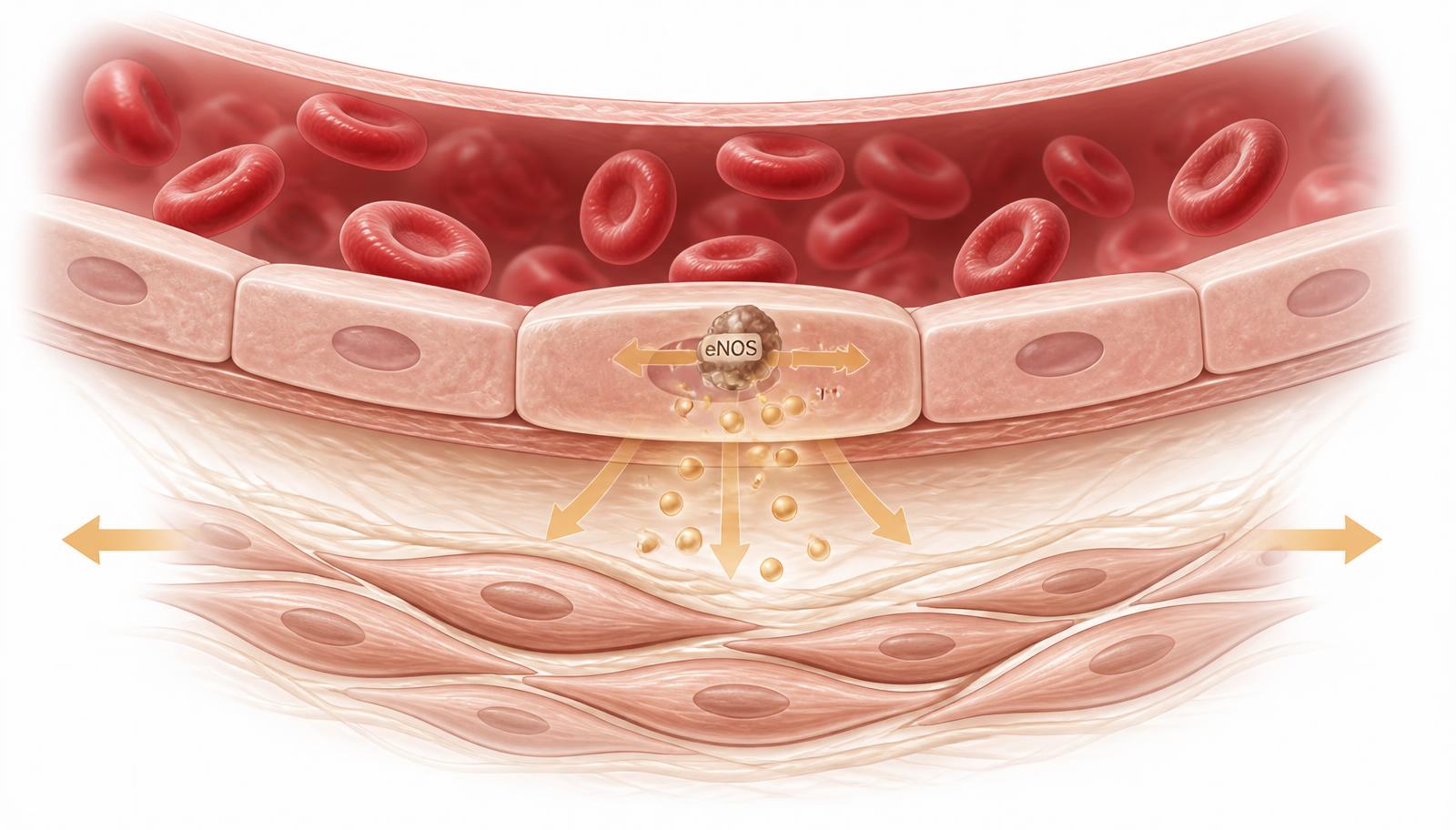
Nitric oxide — NO — is a small signaling molecule. Within endothelial cells, an enzyme called endothelial nitric oxide synthase, abbreviated eNOS, helps produce NO using L-arginine as a substrate.
The NO can then diffuse from the endothelial cells into nearby vascular smooth muscle, where it activates signaling that encourages the muscle to relax. As that muscle relaxes, the vessel can widen — vasodilation.
So when a healthy blood vessel needs to adjust its diameter, the endothelium is not merely watching the process happen. It is participating in the conversation.
Think of It This Way
What Does “Endothelial Function” Actually Mean?
This phrase appears frequently in cardiovascular research, but it can sound vague. At a basic level, endothelial function describes how effectively the endothelium performs its normal regulatory roles.
One of the functions scientists can study is the ability of a blood vessel to dilate in response to increased blood flow. A widely used research method is called flow-mediated dilation — FMD. Researchers typically use ultrasound to observe an artery and measure how its diameter changes after blood flow is temporarily altered. The resulting response provides information about endothelial-dependent vascular function. [6]
FMD is not a home health test and isn't something most consumers need to measure. Its importance is that it allows researchers to study something that would otherwise be invisible: how responsive the blood-vessel lining actually is.
Healthy Blood Vessels Are Responsive Blood Vessels
We often think about blood-vessel health structurally. Is an artery open? Is the vessel damaged? Is there plaque? Those questions are medically important. But there is another dimension: how well does the vessel function?
Healthy blood vessels must constantly adapt. Blood flow changes when you exercise. It changes after eating. It changes with temperature. It changes when you stand. It changes according to what different tissues require.
Your vascular system therefore isn't designed to remain in one fixed state. It is designed to respond — and the endothelium helps make that responsiveness possible.
Your Blood Talks to the Endothelium Through Movement
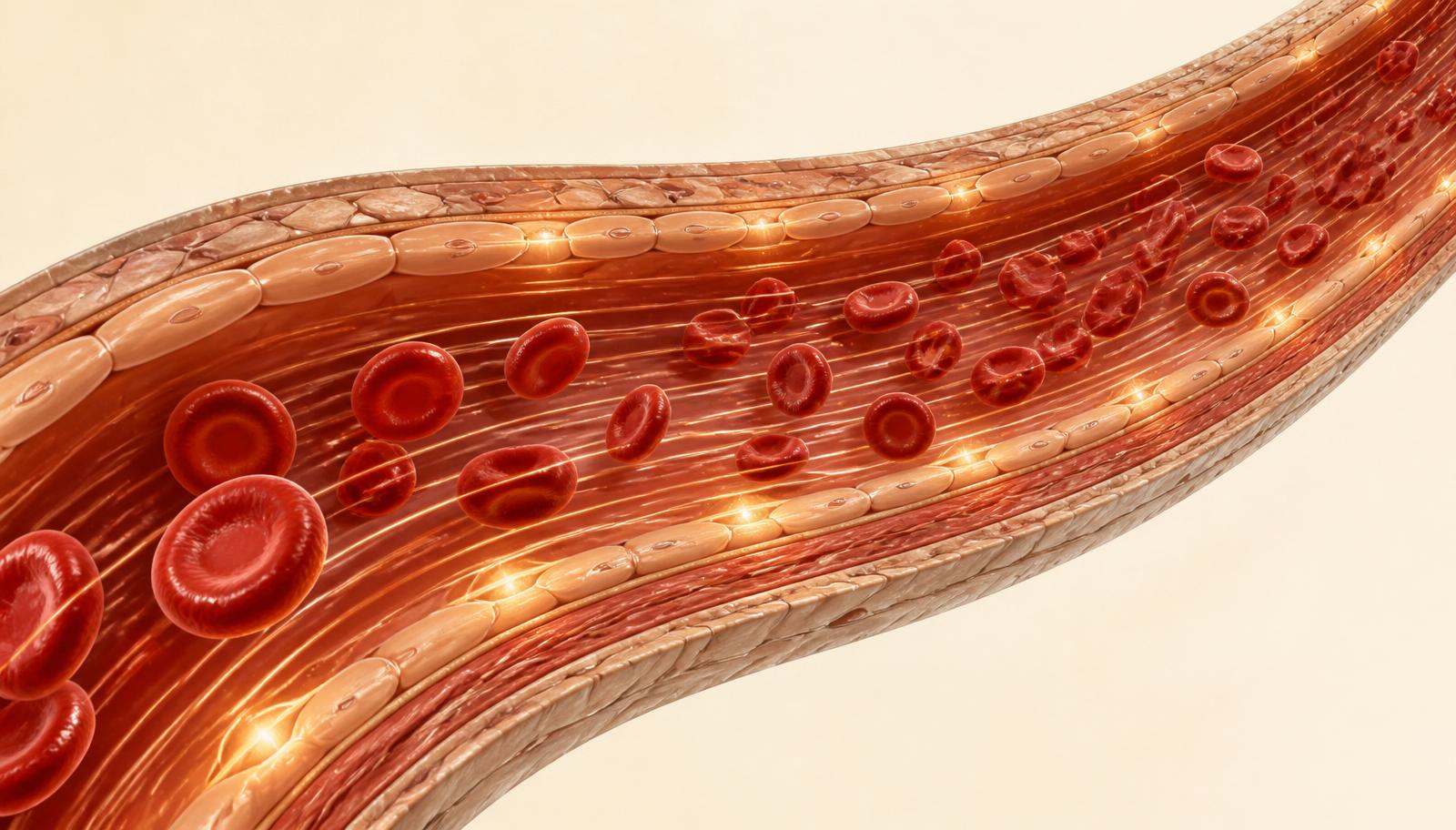
Here's one of the most remarkable aspects of endothelial biology: the endothelium can actually sense blood moving across it. As blood flows along the vessel wall, it creates a frictional mechanical force called shear stress, and endothelial cells detect this force.
When blood flow increases — during exercise, for example — shear stress changes. That mechanical stimulus triggers biological responses within the endothelial cells, including pathways associated with eNOS activation and nitric-oxide signaling. [7]
Blood flow itself sends a message to the vessel wall. Scientists call this mechanotransduction — the conversion of a mechanical force into a biological signal.
Why Exercise Is So Important to Endothelial Health
When you move, muscles require more oxygen. Blood flow increases. Greater flow changes shear stress at the endothelial surface. The endothelium responds. Repeated regularly, exercise provides an important physiological stimulus for vascular adaptation.
Human research has demonstrated that exercise training can improve measures of endothelial function in a variety of populations. [8]
This gives us a different way to think about exercise. A brisk walk isn't only exercising your legs. Cycling isn't only training your heart. Swimming isn't only improving endurance. Physical activity is also providing a stimulus to the cells lining your blood vessels — making movement one of the most accessible ways to support endothelial health naturally.
The Endothelium and Aging
Like many biological systems, endothelial function changes as we grow older. Research in humans has documented age-associated reductions in endothelium-dependent dilation and nitric-oxide bioavailability. [9]
Several factors appear to contribute:
- Oxidative stress tends to increase
- NO can become less biologically available
- eNOS signaling can become less efficient
- Large arteries tend to become stiffer
- Cardiovascular and metabolic risk factors may accumulate over decades
But chronological age does not tell the entire story. An active 70-year-old and a sedentary 70-year-old can have very different vascular characteristics. Long-term physical activity has been associated with more favorable endothelial function in older adults. [10]
The endothelium ages. But how we live can influence the environment in which it ages.
What Works Against Healthy Endothelial Function?
There isn't one single enemy of the endothelium. Instead, endothelial function reflects the cumulative vascular environment. Factors associated with impaired endothelial function include:
- Smoking
- Physical inactivity
- Aging
- Elevated blood pressure
- Abnormal blood glucose regulation
- Unfavorable blood lipid patterns
- Obesity and metabolic dysfunction
- Oxidative stress
Many of these factors interact. That is why endothelial health is best viewed as part of overall cardiovascular health rather than as something that can be addressed with one isolated intervention.
The Food–Endothelium Connection
The endothelium is also influenced by the nutritional environment. A plant-rich diet provides vitamins, minerals, polyphenols, flavonoids, anthocyanins and numerous other phytochemicals.
Some vegetables provide something else that is particularly interesting for nitric-oxide biology: dietary nitrate. Leafy green vegetables and beetroot can contain meaningful quantities of naturally occurring nitrate, and the body can process nitrate through a complementary pathway. [11]
Different routes. Same remarkable signaling molecule.
A Surprising Partner: Your Mouth
The nitrate pathway introduces an unexpected participant in vascular physiology: bacteria in your mouth. After nitrate is consumed and absorbed, some is concentrated into saliva. Certain bacteria on the tongue convert nitrate into nitrite. The nitrite is swallowed and can subsequently contribute to nitric-oxide formation. [12]
This creates what is known as the enterosalivary nitrate cycle. So the story of healthy blood vessels stretches surprisingly far: from vegetables, to your mouth, to your bloodstream, to the endothelium, to the smooth muscle of your arteries. Human physiology is highly interconnected.
Can You “Improve Endothelial Health”?
That is a reasonable question, but it deserves a careful answer. The endothelium is not something we can directly “clean,” and there is no single food or supplement that makes it healthy by itself. The stronger approach is to support the conditions associated with healthy vascular function — which means returning to some remarkably familiar fundamentals.
Move your body
Regular physical activity stimulates blood flow and endothelial shear stress.
Eat plants
Vegetables, fruits and other plant foods contribute a broad range of nutrients and phytochemicals.
Include nitrate-rich vegetables
Leafy greens and beetroot contribute to the nitrate–nitrite–NO pathway.
Don't smoke
Smoking is strongly associated with impaired endothelial function.
Maintain metabolic health
Blood pressure, blood glucose, blood lipids and body composition all matter to the vascular environment.
Sleep and recover
Cardiovascular health reflects the whole lifestyle, not simply what happens during exercise.
There is nothing exotic about that list. The interesting part is now understanding what those habits are supporting inside your blood vessels.
Why the Endothelium Changes the Way We Think About Heart Health
Heart health is often presented as though the heart is the entire cardiovascular story. It isn't. The heart pumps into an enormous living vascular network — a network that has to expand, contract, redirect blood and continually respond to changing demands. And lining that network is the endothelium.
Instead of asking only “How healthy is my heart?” we can also ask: “How healthy and responsive is the vascular system my heart is pumping into?” The two belong together.
A Closer Look at Nitric-Oxide Support
Because endothelial nitric oxide plays an important role in vascular function, nutrition researchers have studied ways of supporting the substrates and pathways involved in NO production. One important substrate is L-arginine, which eNOS uses directly in nitric-oxide synthesis.
Another amino acid, L-citrulline, takes a complementary route. Citrulline can be absorbed and subsequently converted into arginine, importantly through kidney metabolism. Human pharmacokinetic research has demonstrated that oral citrulline can increase circulating arginine concentrations and markers associated with NO-dependent signaling. [13]
- L-Arginine → more directly available to eNOS
- L-Citrulline → conversion to arginine → replenished arginine availability
But as the science of the endothelium makes clear, supplying substrate is only one piece of the picture. The health of the endothelial system itself matters.
The Endothelium and ėNOS
The science described in this article is part of the thinking that influenced the development of ėNOS by Australiana Life. An important distinction is worth making: eNOS is endothelial nitric oxide synthase — the natural enzyme involved in endothelial NO production. ėNOS is Australiana Life's nutritional formulation. The product is not the enzyme; its name reflects the biological system that inspired its formulation philosophy.
ėNOS combines L-arginine and L-citrulline as complementary nutritional approaches to arginine availability, together with additional selected nutrients and Australian plant ingredients. The objective is not to replace endothelial function or artificially control blood vessels. It is to nutritionally support the body's natural nitric-oxide system as part of a broader cardiovascular lifestyle.
Something Worth Remembering
You will probably never see your endothelium. You won't feel it working. Most people will go through their entire lives without even knowing its name.
Yet right now, endothelial cells are lining your blood vessels from the largest arteries to microscopic capillaries — sensing blood flow, responding to mechanical forces, exchanging signals, helping regulate vascular tone, producing nitric oxide and adapting continuously to what your body is asking the cardiovascular system to do.
Your blood vessels have a living inner surface. That surface isn't merely lining the circulation — it is participating in it. And taking care of your cardiovascular health means taking care of that hidden system too.
Scientific References
[1] The vascular endothelium and human diseases
Rajendran P, Rengarajan T, Thangavel J, et al. International Journal of Biological Sciences. 2013;9(10):1057–1069. Broad review of endothelial biology and its regulatory functions.
PubMed / National Library of Medicine →[2] Physiology of the endothelium
Galley HF, Webster NR. British Journal of Anaesthesia. 2004;93(1):105–113. Overview of endothelial regulation, signaling and vascular homeostasis.
PubMed / National Library of Medicine →[3] The obligatory role of endothelial cells in the relaxation of arterial smooth muscle by acetylcholine
Furchgott RF, Zawadzki JV. Nature. 1980;288:373–376. Landmark study demonstrating endothelium-dependent vascular relaxation.
PubMed / National Library of Medicine →[4] Nitric oxide release accounts for the biological activity of endothelium-derived relaxing factor
Palmer RMJ, Ferrige AG, Moncada S. Nature. 1987;327:524–526.
PubMed / National Library of Medicine →[5] Endothelium-derived relaxing factor produced and released from artery and vein is nitric oxide
Ignarro LJ, Buga GM, Wood KS, Byrns RE, Chaudhuri G. Proceedings of the National Academy of Sciences USA. 1987;84:9265–9269.
PubMed / National Library of Medicine →[6] Expert consensus and evidence-based recommendations for the assessment of flow-mediated dilation in humans
Thijssen DHJ, Bruno RM, van Mil ACCM, et al. European Heart Journal. 2019;40(30):2534–2547.
PubMed / National Library of Medicine →[7] eNOS activation by physical forces: from short-term regulation of contraction to chronic remodeling of cardiovascular tissues
Balligand JL, Feron O, Dessy C. Physiological Reviews. 2009;89(2):481–534.
PubMed / National Library of Medicine →[8] Exercise training and endothelial-dependent vascular function
Early and contemporary exercise research has consistently examined improvements in endothelial-dependent vascular function following regular physical activity and exercise training.
PubMed / National Library of Medicine →[9] Aging and vascular endothelial function in humans
Seals DR, Jablonski KL, Donato AJ. Clinical Science. 2011;120(9):357–375.
PubMed / National Library of Medicine →[10] Long-Term Aerobic Exercise Improves Vascular Function Into Old Age
Systematic review and meta-analysis comparing endothelial function among physically active and sedentary older adults. PMID: 30863313.
PubMed / National Library of Medicine →[11] Vascular effects of dietary nitrate via the nitrate-nitrite-nitric oxide pathway
Lidder S, Webb AJ. British Journal of Clinical Pharmacology. 2013;75(3):677–696. PMID: 22882425.
PubMed / National Library of Medicine →[12] The nitrate–nitrite–nitric oxide pathway in physiology and therapeutics
Lundberg JO, Weitzberg E, Gladwin MT. Nature Reviews Drug Discovery. 2008;7:156–167.
PubMed / National Library of Medicine →[13] Pharmacokinetic and pharmacodynamic properties of oral L-citrulline and L-arginine: impact on nitric oxide metabolism
Schwedhelm E, Maas R, Freese R, et al. British Journal of Clinical Pharmacology. 2008;65(1):51–59. PMID: 17662090.
PubMed / National Library of Medicine →
Where to Explore Next
- WHAT IS eNOS? →
Meet the enzyme inside endothelial cells that helps produce vascular nitric oxide.
- NITRIC OXIDE AND ARTERIAL HEALTH →
Explore what healthy vascular responsiveness means and how arteries change over time.
- NITRIC OXIDE AND BLOOD FLOW →
Follow the relationship between endothelial signaling, vessel diameter and changing blood-flow requirements.
- NITRIC OXIDE AND AGING →
Discover why endothelial function and NO availability become increasingly relevant with age.
- HOW TO INCREASE NITRIC OXIDE NATURALLY →
Explore the practical role of food, exercise, nitrate, arginine and citrulline.
EXPLORE THE SCIENCE BEHIND ĖNOS
Discover how understanding endothelial nitric-oxide biology helped shape the formulation philosophy of ėNOS.
EXPLORE ĖNOS →This article is provided for educational purposes only and is not intended as medical advice or to diagnose, treat, cure or prevent disease. ėNOS is a dietary supplement. Individual cardiovascular health varies, and dietary supplements should complement rather than replace appropriate nutrition, physical activity and medical care.
More in Heart & Arteries
About Our Health & Science Content
Australiana Life Health & Science articles are based on published scientific research and written to make complex health and nitric oxide science easier to understand. Our educational content undergoes scientific review for accuracy and appropriate interpretation of the evidence and is updated as relevant scientific understanding evolves.