
Nitric Oxide & Heart Health
Why a Tiny Signaling Molecule Matters to the Cardiovascular System
When people think about heart health, they naturally think about the heart itself.
But the heart does not work in isolation.
Every heartbeat depends upon an enormous network of blood vessels capable of carrying blood efficiently throughout the body and adapting continually to changing demands.
At the center of this relationship is one of the most important signaling molecules in cardiovascular biology: nitric oxide — NO.
Nitric oxide helps blood vessels relax and regulate vascular tone, supporting the circulation through which the heart delivers oxygen and nutrients throughout the body.
Understanding NO therefore changes the way we think about heart health. A healthy cardiovascular system requires both a healthy heart and blood vessels capable of responding appropriately to the body's needs.
A Nobel Prize Discovery That Changed Cardiovascular Science
The importance of nitric oxide to cardiovascular physiology was recognized with one of science's highest honors.
In 1998, Robert F. Furchgott, Louis J. Ignarro and Ferid Murad received the Nobel Prize in Physiology or Medicine for discoveries concerning nitric oxide as a signaling molecule in the cardiovascular system. [1]
Their work helped establish that blood vessels actively participate in regulating their own function.
This was a major change in cardiovascular science.
The vascular system wasn't simply plumbing through which the heart pumped blood. Blood vessels were biologically active structures capable of responding to signals — and nitric oxide was one of the key messengers involved.
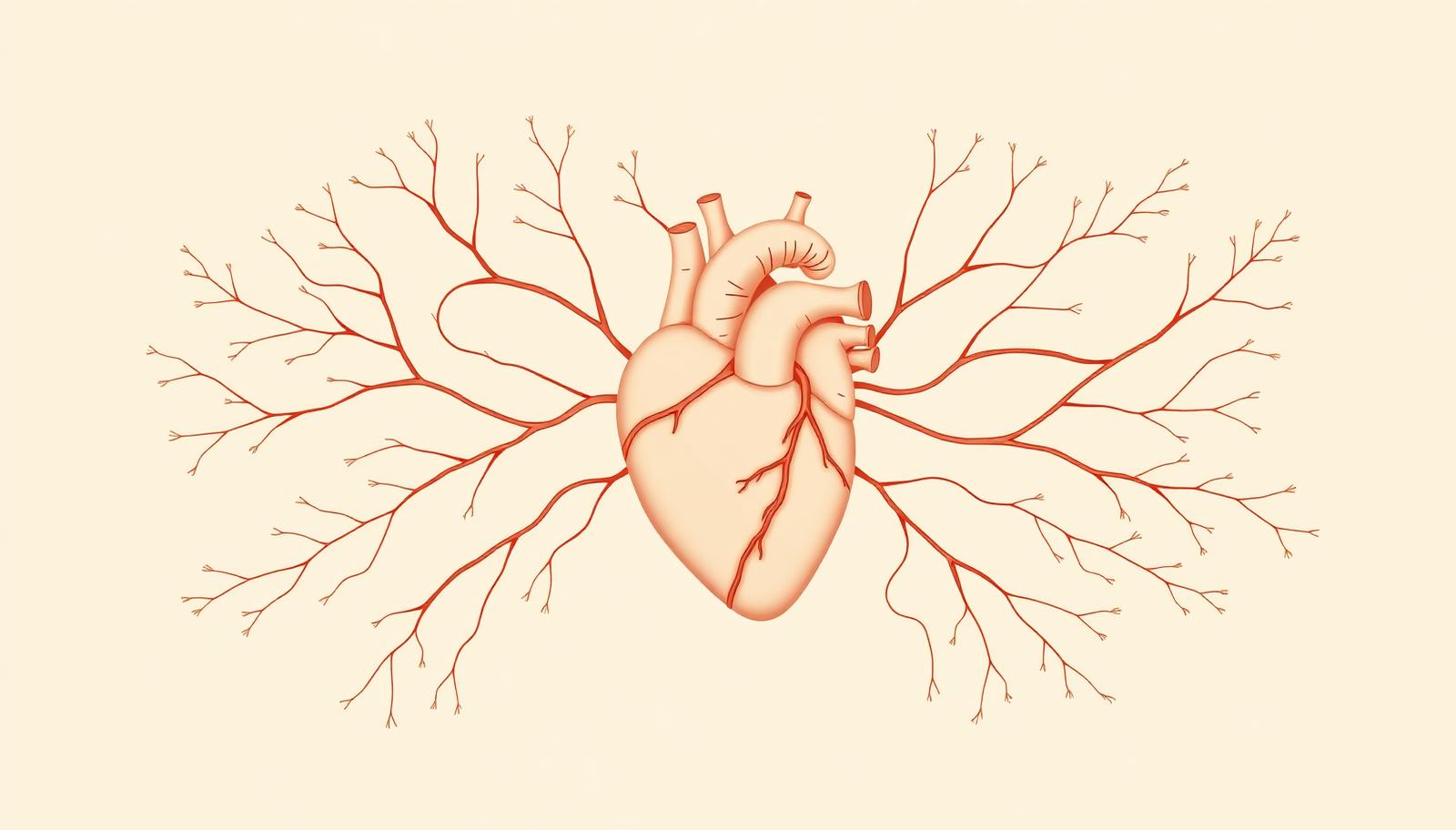
Your Heart and Blood Vessels Work as One System
The average human heart beats roughly 100,000 times during a typical day.
Every beat creates pressure that moves blood through arteries, smaller vessels and eventually the microscopic capillaries supplying the body's tissues.
But blood-flow requirements are constantly changing:
- When you exercise, working muscles need additional blood.
- After eating, digestive organs require increased circulation.
- Temperature changes alter blood flow to the skin.
- Standing up requires rapid cardiovascular adjustments.
Your cardiovascular system must respond continuously. One mechanism helping make these adjustments possible is the ability of blood vessels to relax and change their diameter. Nitric oxide participates in that process.
The Endothelium: The Heart's Vascular Partner
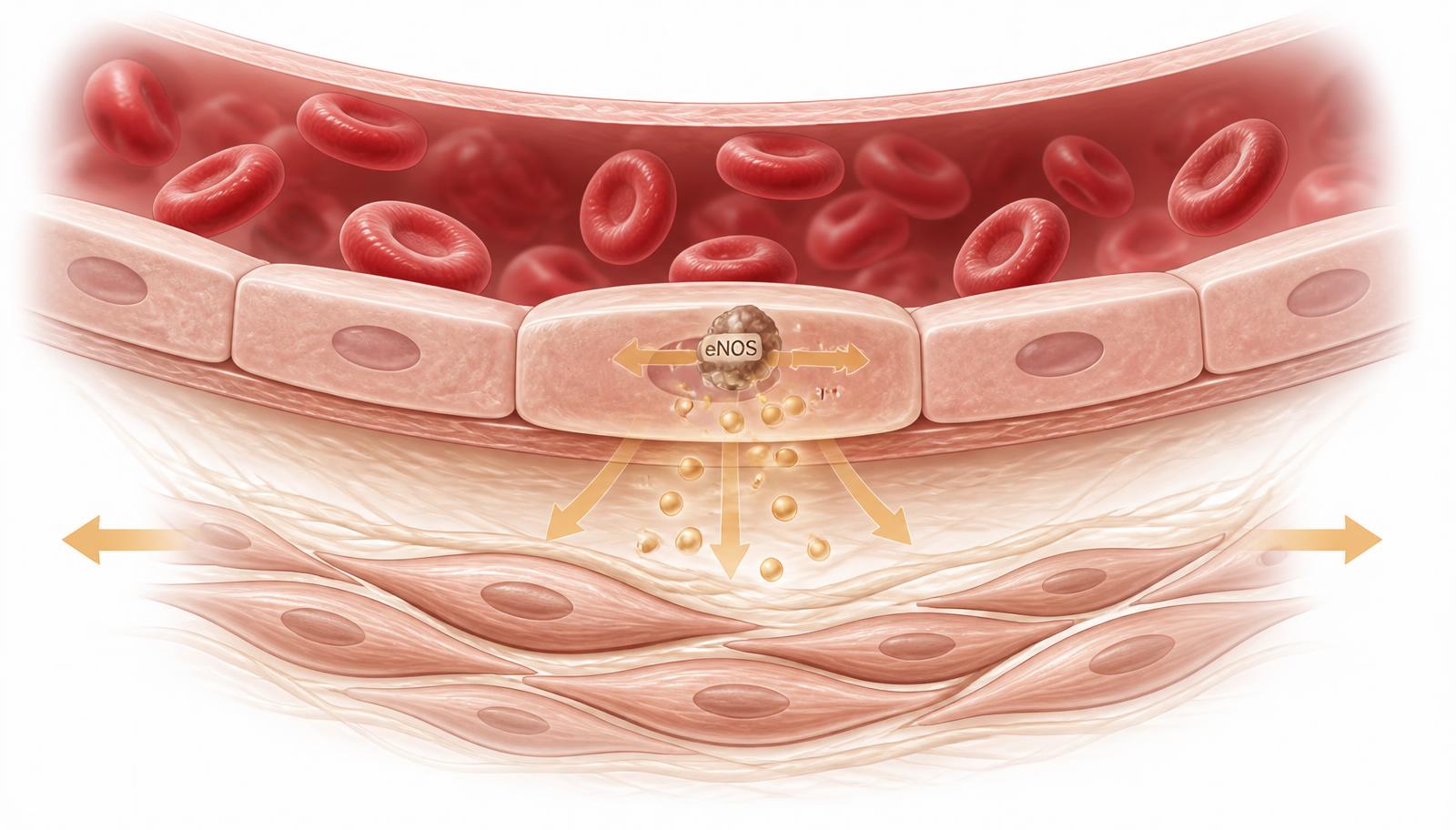
Inside your blood vessels is an extremely thin cellular lining called the endothelium.
Although only one cell thick, the endothelium is biologically active. Among its many functions, endothelial cells produce nitric oxide.
An enzyme called endothelial nitric oxide synthase — eNOS — uses the amino acid L-arginine as a substrate in the production of NO. In simplified form:
Once produced, nitric oxide moves into the smooth muscle surrounding the blood vessel. There it activates signaling that encourages the vessel to relax. This process is called vasodilation.
The ability of blood vessels to adjust their diameter helps the cardiovascular system direct blood according to the body's changing requirements.
Why Vascular Resistance Matters to the Heart
The heart must generate enough force to move blood through the vascular system.
How constricted or relaxed the blood vessels are influences the resistance against which the heart pumps. This relationship is one reason vascular tone is such an important component of cardiovascular physiology.
Nitric oxide is one of several biological regulators involved in maintaining normal vascular tone.
It would therefore be incomplete to think about heart wellness only in terms of the heart muscle. The environment into which the heart pumps matters too.
Nitric Oxide and Everyday Cardiovascular Demand
Consider what happens when you begin walking briskly.
- Muscles suddenly require more oxygen.
- Heart rate increases.
- Cardiac output rises.
- Blood flow must be redistributed.
- Blood vessels supplying active tissue respond to increased demand.
The heart and vascular system are working together. Nitric oxide participates in the vascular response that helps make increased blood flow possible.
This is one reason NO research intersects with cardiology, vascular medicine and exercise physiology.
Exercise Helps Train More Than the Heart
Exercise is famous for strengthening cardiovascular fitness. But exercise also directly challenges the vascular system.
As the heart pumps more blood during activity, increased flow creates a mechanical force along the inner surface of arteries known as shear stress. Endothelial cells detect that force. This stimulates signaling pathways associated with vascular adaptation and nitric-oxide production.
Regular physical activity therefore doesn't simply "exercise the heart." It exercises the vascular system too.
This provides another reason walking, cycling, swimming, resistance exercise and other regular physical activity are so important to long-term cardiovascular wellness.

Nitric Oxide, Aging and Heart Health
Cardiovascular physiology changes with age.
Research has associated aging with reduced endothelial function and lower nitric-oxide bioavailability. [2] Several mechanisms contribute, including changes in endothelial nitric-oxide production and increased oxidative stress.
This does not mean aging automatically leads to poor cardiovascular health. It does mean that supporting the vascular system becomes increasingly relevant as we grow older.
Exercise, nutrition, healthy body composition, avoiding smoking, appropriate sleep and management of cardiovascular risk factors all remain important.
Nutrition and the NO Pathway
The body produces nitric oxide through several biological routes. The classical endothelial pathway uses L-arginine:
L-citrulline provides a complementary nutritional route because the body can convert citrulline into arginine, helping replenish circulating arginine availability. Human research has demonstrated that oral citrulline can increase plasma arginine and markers of NO-dependent signaling. [3]
There is also another pathway:
Leafy green vegetables and beetroot are notable natural sources of dietary nitrate. Research into this nitrate–nitrite–NO pathway has further expanded scientific understanding of the relationship between food and cardiovascular physiology. [4]
Heart-Healthy Living Is Vascular-Healthy Living
The science of nitric oxide provides a useful way of connecting many familiar cardiovascular recommendations:
- Regular exercise challenges and conditions the vascular system.
- Vegetable-rich diets provide nitrate and numerous beneficial plant compounds.
- Maintaining a healthy weight reduces cardiovascular stress.
- Not smoking helps protect endothelial function.
- Managing blood pressure, cholesterol and blood glucose helps reduce important cardiovascular risk factors.
Good heart health therefore involves more than focusing on one organ. Protecting the cardiovascular system means protecting the heart and the vessels it depends upon.
From Cardiovascular Science to ėNOS
This systems perspective influenced the formulation philosophy behind ėNOS by Australiana Life.
Central to the formulation is the complementary relationship between L-arginine and L-citrulline.
- Arginine provides substrate directly available to the eNOS pathway.
- Citrulline follows a different metabolic route and can subsequently be converted into arginine, helping extend arginine availability.
- Other selected nutrients and Australian plant ingredients complement the broader nutritional approach.
The objective is not to replace the body's natural nitric-oxide system. It is to nutritionally support the system the body already possesses.
ėNOS is designed to complement — not replace — exercise, good nutrition and other heart-healthy lifestyle practices.
Scientific References
[1] The Nobel Prize in Physiology or Medicine 1998
Robert F. Furchgott, Louis J. Ignarro and Ferid Murad. Awarded for discoveries concerning nitric oxide as a signaling molecule in the cardiovascular system. Nobel Assembly at Karolinska Institutet.
NobelPrize.org →[2] Aging and vascular endothelial function in humans
Seals DR, Jablonski KL, Donato AJ. Clinical Science. 2011;120(9):357–375.
PubMed / National Library of Medicine →[3] Pharmacokinetic and pharmacodynamic properties of oral L-citrulline and L-arginine: impact on nitric oxide metabolism
Schwedhelm E, Maas R, Freese R, et al. British Journal of Clinical Pharmacology. 2008;65(1):51–59. PMID: 17662090.
PubMed / National Library of Medicine →[4] Vascular effects of dietary nitrate via the nitrate–nitrite–nitric oxide pathway
Lidder S, Webb AJ. British Journal of Clinical Pharmacology. 2013;75(3):677–696. PMID: 22882425.
PubMed / National Library of Medicine →
Continue Exploring
- Healthy Circulation & Nitric Oxide →
How the body regulates blood flow from head to toe, and what healthy circulation looks like.
- Healthy Arteries & Nitric Oxide →
What keeps arteries flexible and responsive, and the role nitric oxide plays in arterial tone.
- What Is Nitric Oxide and Why Does It Matter? →
A plain-English introduction to the signalling molecule behind vascular health.
- Nitric Oxide and Aging: What Changes After 40, 50 and Beyond? →
Why endothelial function and NO bioavailability become more relevant with each decade.
DISCOVER THE SCIENCE BEHIND ĖNOS
ėNOS combines L-arginine + L-citrulline with deliberately selected complementary nutrients and Australian plant ingredients to support the body's natural nitric-oxide system, healthy circulation and cardiovascular wellness.
EXPLORE ĖNOS →This information is provided for educational purposes and is not intended as medical advice. ėNOS is a dietary supplement and is not intended to diagnose, treat, cure or prevent any disease. Consult an appropriate healthcare professional regarding individual health concerns or before making significant changes to your diet, exercise or supplement program.
More in Heart & Arteries
About Our Health & Science Content
Australiana Life Health & Science articles are based on published scientific research and written to make complex health and nitric oxide science easier to understand. Our educational content undergoes scientific review for accuracy and appropriate interpretation of the evidence and is updated as relevant scientific understanding evolves.