
Heart Health vs. Cardiovascular Health: What's the Difference?
Why Caring for Your Heart Also Means Caring for the Arteries, Circulation and Vascular System Around It
Most people say: “I want to keep my heart healthy.”
That is a worthwhile goal.
But there is a broader term that describes what most people are really trying to protect: cardiovascular health.
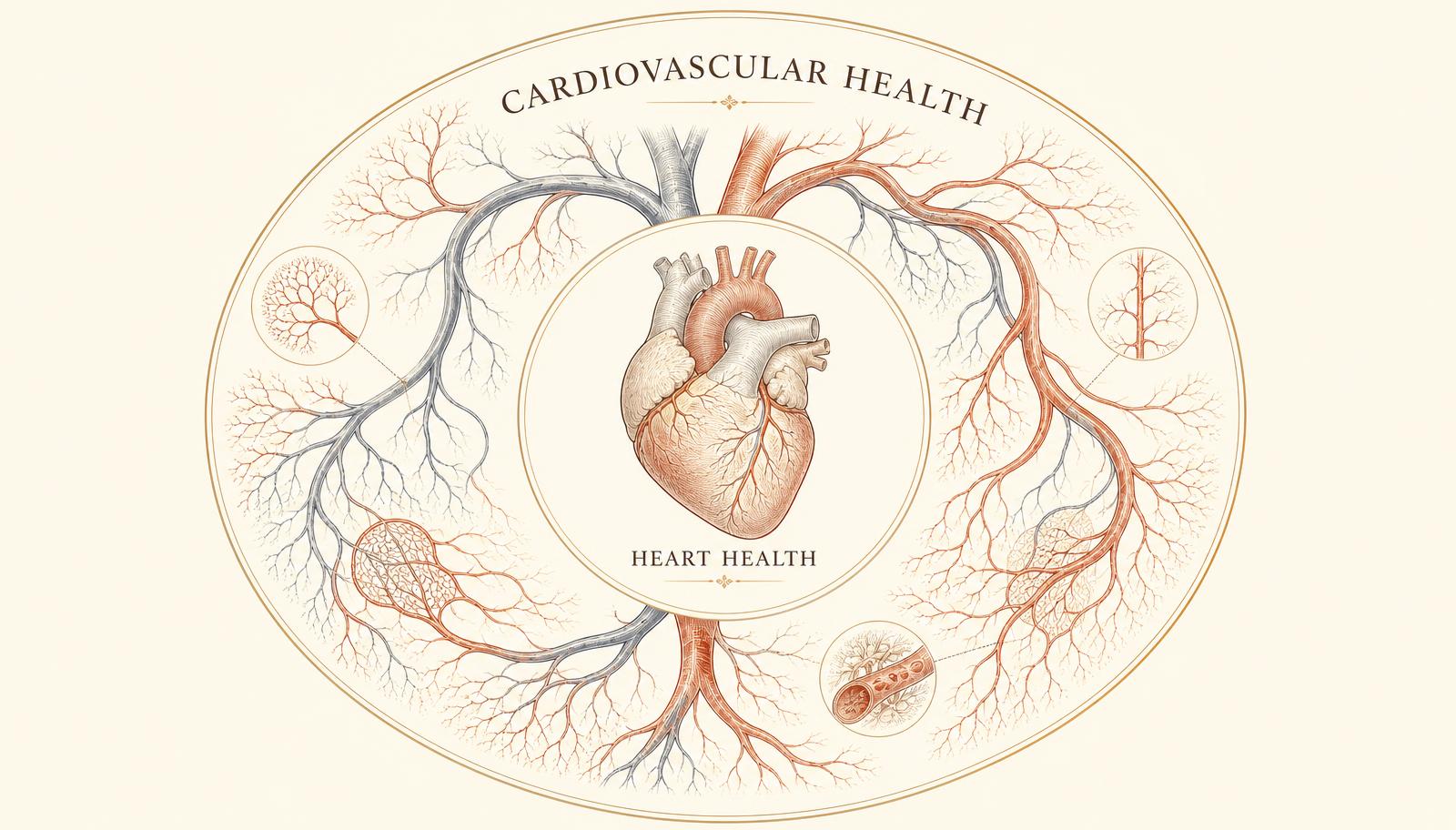
Heart health and cardiovascular health overlap, but they are not exactly the same.
Heart health focuses primarily on the heart itself — its muscle, rhythm, valves, pumping ability and blood supply.
Cardiovascular health includes all of that plus the arteries, smaller blood vessels, capillaries, veins, circulation and vascular signaling systems that allow the heart to do its job.
Your heart is the pump. Your cardiovascular system is the entire network. And especially after 50, taking care of the network becomes increasingly important.
Heart Health Is Part of Cardiovascular Health
The heart does not operate in isolation.
Every heartbeat sends blood into an enormous vascular system extending throughout the body. Blood leaves the heart through arteries. Those arteries branch into progressively smaller vessels. Eventually blood reaches microscopic capillaries where oxygen and nutrients can move toward tissues. Veins then return the blood toward the heart. Then the cycle repeats.
So heart health asks: how well is the pump working? Cardiovascular health asks: how well are the pump, vessels and circulation working together?
That second question gives us a much more complete picture.
What Exactly Is “Heart Health”?
The heart has several jobs that need to happen correctly.
The Heart Muscle Must Contract
The heart is a muscular pump. With each contraction, it generates the force required to move blood.
The Heart Rhythm Must Be Coordinated
Its electrical system coordinates the timing of each beat.
The Valves Must Direct Blood
Four valves help keep blood moving through the chambers in the correct direction.
The Heart Needs Its Own Blood Supply
The coronary arteries deliver oxygenated blood to heart muscle.
The Heart Must Adjust to Demand
A resting heart does not need to pump the same amount of blood as a heart during brisk exercise. A healthy cardiovascular system can increase output when activity requires it.
Those are all legitimate aspects of heart health. But the moment blood leaves the heart, another enormous part of the story begins.
Cardiovascular Health Includes the Arteries
The heart pumps blood into arteries. But arteries are not simply pipes.
Their walls are living structures containing:
- Endothelial cells
- Smooth muscle
- Elastic tissue
- Connective tissue
- Nerves
- Multiple signaling systems
A healthy artery can respond. It can adjust its diameter. It can accommodate the pressure wave created by a heartbeat. It can participate in controlling blood flow. It can communicate with the bloodstream.
That means arterial health is cardiovascular health.
Cardiovascular Health Includes the Microcirculation
Large arteries attract attention because they are easier to imagine. But much of the actual delivery work occurs much farther downstream.
At the capillary level, oxygen and nutrients can move between the bloodstream and tissues. Your brain, muscles, skin, kidneys, digestive organs and every other living tissue depend upon this delivery network.
A strong heartbeat alone is not enough. The blood has to reach the destination.
Cardiovascular Health Includes the Veins Too
After blood has moved through tissues, it must return. Veins perform that job.
Movement helps. When leg muscles contract during walking, they compress nearby veins and help propel blood upward. This is sometimes referred to as the skeletal-muscle pump.
Cardiovascular health involves an interesting partnership: the heart pumps blood outward, while movement helps circulation return it. Another reason why staying active matters so much as we age.
The Difference in One Table
| Heart Health | Cardiovascular Health |
|---|---|
| Heart muscle | Heart muscle |
| Heart rhythm | Heart rhythm |
| Heart valves | Heart valves |
| Coronary circulation | Coronary circulation |
| Pumping performance | Pumping performance |
| — | Arteries |
| — | Arterioles |
| — | Capillaries |
| — | Veins |
| — | Endothelial function |
| — | Vascular tone |
| — | Blood-flow regulation |
| — | Nitric-oxide signaling |
The cardiovascular system therefore contains the heart — but extends far beyond it.
Why the Difference Matters More After 50
For many younger adults, cardiovascular health is largely invisible. The system just works.
You walk upstairs. Blood flow increases. Your heart beats faster. Working muscles receive more oxygen. You cool yourself when you're hot. You stand up without thinking about blood-pressure regulation.
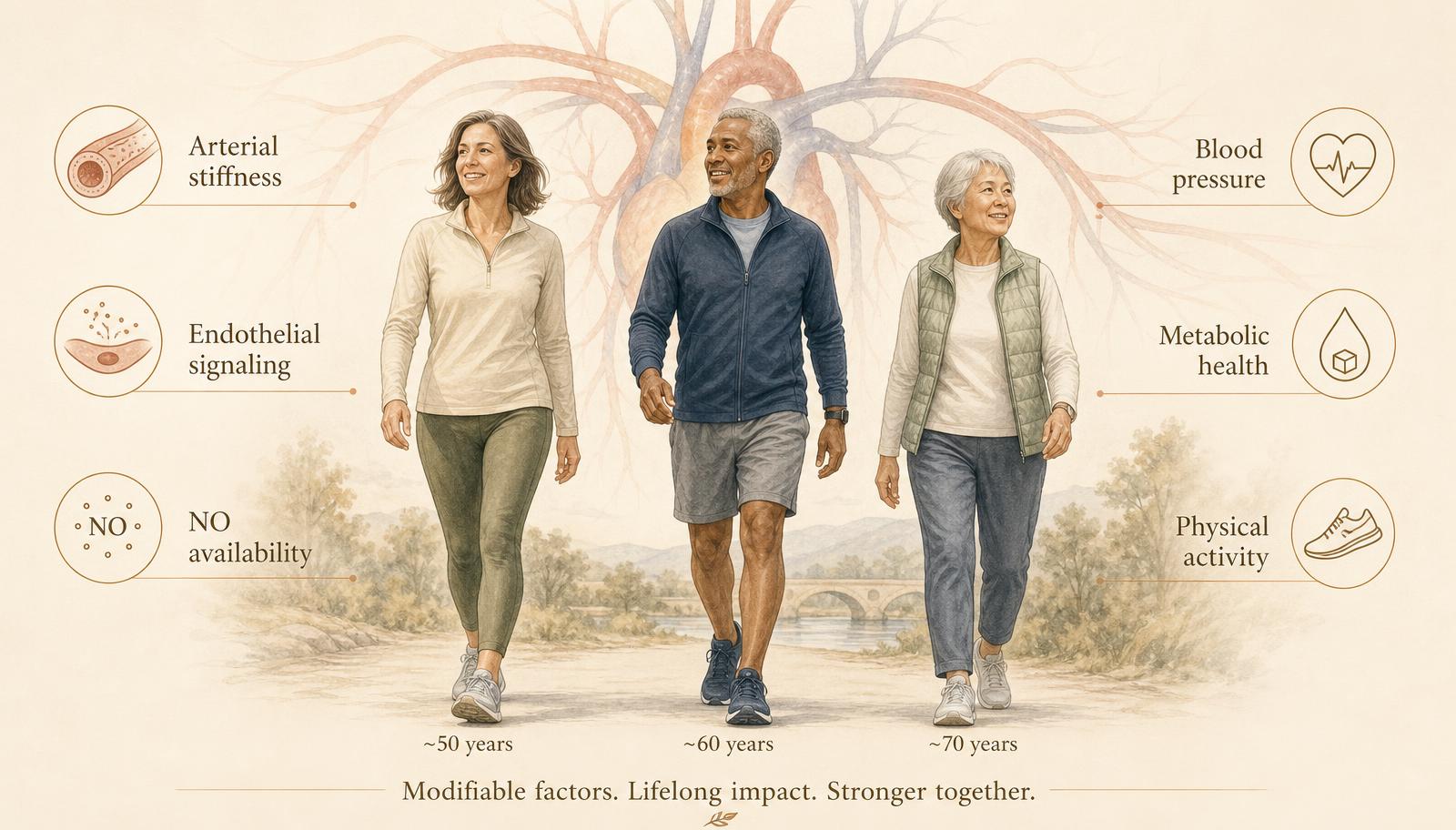
But with age, the cardiovascular system gradually changes.
- Large arteries tend to become stiffer
- Endothelial function can decline
- Nitric-oxide bioavailability tends to decrease
- Oxidative stress can increase
- Blood-pressure, glucose and cholesterol issues become more common
A 2025 review of cardiovascular aging identified reduced nitric-oxide availability, oxidative stress and impaired NO-synthase activity among important contributors to vascular aging. [3]
A major 2026 review describes vascular aging as involving arterial stiffening and changes in vascular regulation, emphasizing that blood-vessel aging influences healthy longevity well beyond the heart itself. [4]
This is why heart health over 50 should really be thought of as cardiovascular health over 50.
Aging Does Not Mean Cardiovascular Decline Is Inevitable
This is important. Age matters. But age is not destiny.
The American Heart Association emphasizes healthy diet, regular physical activity, management of blood pressure, cholesterol and other cardiovascular risk factors throughout life — and notes that these become particularly important in the 50s and beyond. [1]
Exercise remains especially interesting. Recent meta-analyses of randomized trials in middle-aged and older adults report that isometric exercise training improved measures of central arterial stiffness and endothelial function, and that aerobic exercise, walking and resistance training were each associated with favorable vascular adaptations in adults over 60 — although no single exercise type was universally superior. [4]
Your cardiovascular system therefore retains the ability to adapt. That is encouraging.
The Endothelium Connects Heart Health to Vascular Health
Inside every blood vessel is a thin layer of specialized cells called the endothelium. It is only one cell thick. Yet it helps regulate vascular behavior.
Endothelial cells can sense changes in blood flow and release signaling molecules affecting surrounding vascular smooth muscle. One of the most important is nitric oxide — NO.
This is where heart health, circulation and vascular physiology begin to connect at a molecular level.
Nitric Oxide Helps Blood Vessels Respond
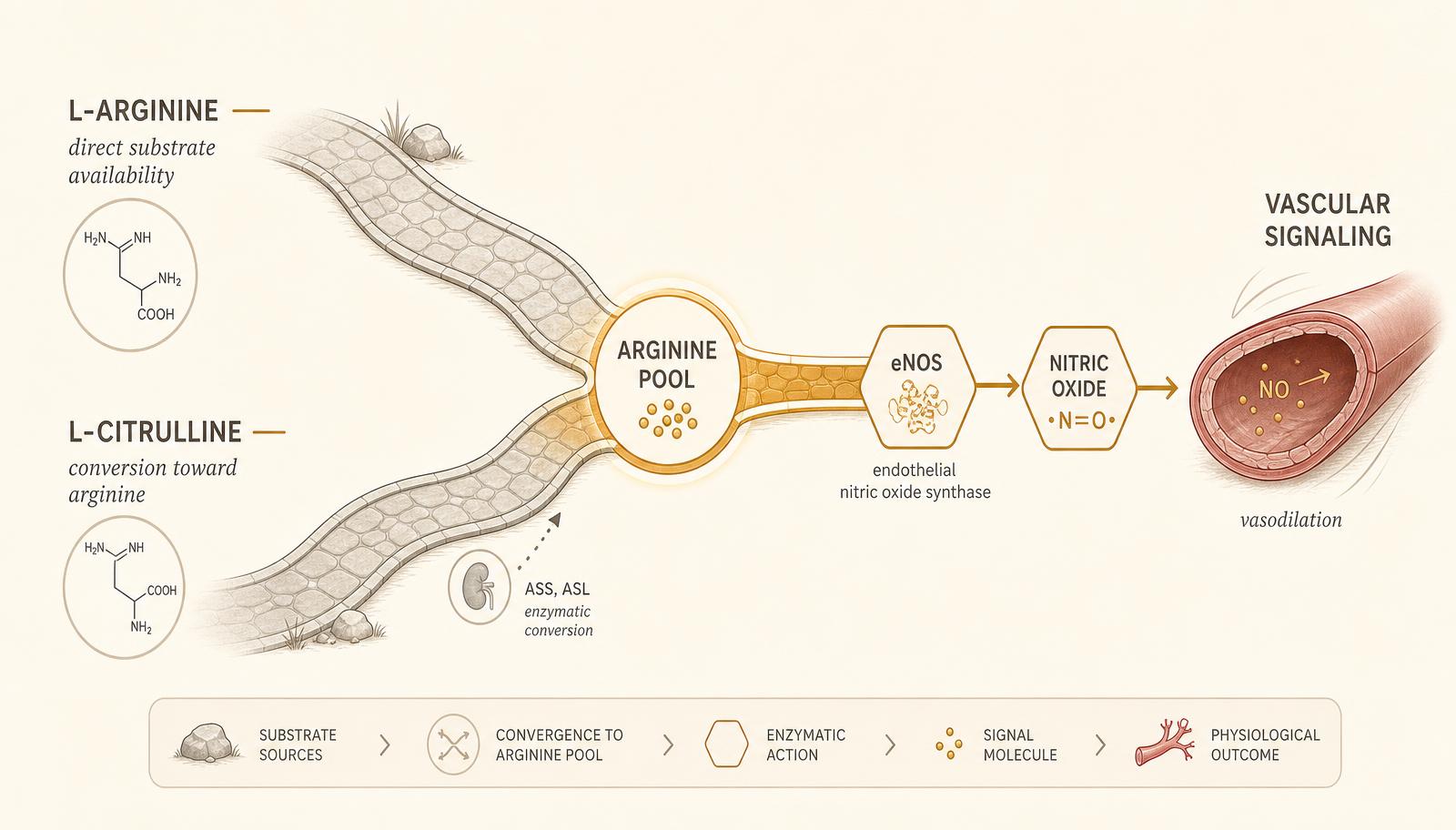
Inside endothelial cells is an enzyme called eNOS — endothelial nitric oxide synthase. One of its jobs is to use the amino acid L-arginine in the production of NO.
NO can then signal nearby vascular smooth muscle. One downstream result is smooth-muscle relaxation and the ability of a vessel to adjust its diameter. That contributes to healthy vascular tone, normal endothelial function and appropriate regulation of blood flow.
This doesn't mean the healthiest artery is the widest artery. Healthy vessels need to respond appropriately — relaxing or constricting according to physiological demand.
Why Nitric Oxide Is a Cardiovascular Story More Than Just a Heart Story
Nitric oxide certainly matters to the heart. The heart exists inside the same vascular system and has its own coronary circulation. But much of NO's best-known cardiovascular physiology takes place in the blood-vessel wall. That includes:
- Endothelial signaling
- Vascular relaxation
- Blood-flow regulation
- Responsiveness to exercise
So if someone asks, “Is nitric oxide good for heart health?” the more precise answer is: nitric oxide is an important part of cardiovascular physiology — including the vascular system upon which the heart depends.
The Heart Pumps Against the Vascular System
There is another reason heart and vascular health cannot be separated. The heart does not pump into empty space. It pumps against the resistance of the circulatory system.
Changes in arterial stiffness, vascular tone, blood pressure and peripheral resistance can influence cardiac workload.
Large arteries also help buffer the pressure created by each heartbeat. As they become stiffer with age, that buffering function can decline. Current reviews of arterial stiffness describe vascular aging as involving both structural and functional changes that can influence the heart, microcirculation and other organs. [4]
The pump-and-pipes analogy isn't perfect. But it demonstrates the principle: the condition of the delivery network affects the work required of the pump.
What Does Good Cardiovascular Health Look Like?
It is tempting to define health simply as “nothing is wrong.” But healthy physiology is more than absence of disease. A capable cardiovascular system can:
- Increase cardiac output during exercise
- Redirect blood toward active muscle
- Adjust vascular tone
- Deliver oxygen
- Support brain circulation
- Regulate temperature
- Respond to changing posture
- Transport nutrients
- Return blood efficiently
That word — capability — is useful. Cardiovascular health is partly about maintaining the ability of the system to respond to life.
What Should You Pay More Attention to After 50?
There is no single cardiovascular number that tells the whole story. But several factors become increasingly important.
Blood pressure
Elevated blood pressure affects both heart and blood vessels.
Blood lipids
Cholesterol and related lipoproteins influence long-term arterial health.
Blood glucose
Metabolic and cardiovascular health are closely connected.
Physical activity
Regular movement supports cardiac conditioning and vascular function.
Muscle
Maintaining muscle supports activity, glucose metabolism and functional independence.
Diet
Healthy dietary patterns contribute to multiple cardiovascular systems simultaneously.
Smoking
Avoiding tobacco remains one of the most important cardiovascular-health decisions.
Sleep
Adequate sleep is part of the American Heart Association's Life's Essential 8 framework.
Sleep, diet, activity, nicotine avoidance, body weight, blood lipids, blood glucose and blood pressure together form the American Heart Association's current cardiovascular-health framework, Life's Essential 8. [2]
Nutrition Does More Than “Feed the Heart”
This is where thinking in cardiovascular terms becomes useful. Different nutrients support different physiological functions.
- Some participate in energy metabolism
- Some contribute to muscle and nerve function
- Some supply antioxidant and phytonutrient compounds
- Some interact more directly with the nitric-oxide pathway
A thoughtful cardiovascular nutritional strategy therefore doesn't need every ingredient to perform the same job. It needs them to have purpose.
L-Arginine: Directly Connected to the NO Pathway
L-arginine is an amino acid. Its particular relevance to cardiovascular NO biology is that eNOS uses L-arginine as substrate. That gives arginine a direct biochemical connection to natural endothelial NO production.
But oral arginine is also subject to metabolism before all of it reaches systemic circulation. This is one reason another amino acid has become important in NO research.
L-Citrulline: Another Route Toward Arginine
L-citrulline behaves differently after ingestion. It is efficiently absorbed and can subsequently be converted into L-arginine, importantly through metabolism involving the kidneys.
So these amino acids are complementary. L-arginine provides more directly available substrate. L-citrulline provides another metabolic route toward replenishing arginine availability.
A randomized study directly compared 2 g of arginine, 2 g of citrulline and 1 g of each together. The combined arginine + citrulline treatment increased plasma arginine more efficiently than the same total quantity of either alone under the study conditions. [5]
That does not prove that every arginine/citrulline supplement produces superior cardiovascular outcomes. But it provides a strong biological rationale for combining them.
Magnesium Supports a Different Part of Cardiovascular Physiology
Magnesium is not an NO precursor. And that is precisely why it is useful to distinguish its role. According to the NIH Office of Dietary Supplements, magnesium acts as a cofactor in more than 300 enzyme systems and contributes to normal: [6]
- Muscle function
- Nerve function
- Energy metabolism
- Blood-pressure regulation
- Electrolyte transport
- Heart rhythm
So magnesium occupies a broader cardiovascular and metabolic role. It complements an NO-centered formulation rather than duplicating arginine or citrulline.
Plant Ingredients Add Another Layer
The cardiovascular system also exists inside a broader nutritional and oxidative environment. That is where plant ingredients can contribute differently.
Kakadu Plum and Davidson's Plum, for example, should not be described as direct NO precursors. They are not substitutes for arginine or citrulline. Their contribution is broader — providing plant-derived nutrients and phytonutrients within the overall formula.
This illustrates an important formulation principle: not every ingredient needs to do the same thing. A coherent cardiovascular formula can combine direct NO-pathway support with broader nutritional support.
Where ėNOS Fits: More Cardiovascular Than Merely “Heart”
First, remember the naming difference:
- eNOS is the natural enzyme endothelial nitric oxide synthase
- ėNOS is Australiana Life's nutritional supplement
The product is designed around the physiology of the larger cardiovascular system. Its central story is not “make the heart pump harder.” It is: support the body's natural nitric-oxide system and healthy circulation within the cardiovascular network the heart depends upon.
That is why describing ėNOS simply as a “heart supplement” would be incomplete.
How ėNOS Relates to the Issues We've Just Discussed
Issue — NO production requires arginine.
ėNOS provides L-arginine.
Issue — Oral arginine availability is influenced by metabolism.
ėNOS also provides L-citrulline, offering a complementary route toward circulating arginine.
Issue — Cardiovascular physiology is broader than NO alone.
ėNOS includes magnesium to contribute to normal muscle, nerve, metabolic and cardiovascular physiology.
Issue — Cardiovascular nutrition occurs within a broader plant-nutrient environment.
ėNOS includes Australian plant ingredients such as Kakadu Plum and Davidson's Plum.
The formula therefore reflects the fact that cardiovascular health itself is multi-system.
Why This Makes Particular Sense After 50
Advancing age can bring:
- Declining NO bioavailability
- Greater arterial stiffness
- Changes in endothelial function
- Greater oxidative pressure
- Lower physical activity
- Increasing cardiovascular risk factors
None of those changes means supplementation replaces exercise, vegetables or medical care. [3] But they do make consistent nutritional support more valuable.
A younger vascular system may tolerate years of inconsistent lifestyle choices with few obvious consequences. After 50, supporting cardiovascular physiology deliberately becomes increasingly sensible.
ėNOS provides one practical part of that strategy: consistent daily nutritional support centered on the natural NO-production pathway and healthy circulation.
Food and Supplements Are Partners, Not Competitors
A cardiovascular supplement should never become an excuse to eat poorly. The American Heart Association continues to emphasize vegetables, fruits, whole grains, nuts, legumes, appropriate proteins and other healthy dietary patterns as part of cardiovascular prevention. [1]
But supplements can provide something food does not always deliver consistently: specific ingredients in a repeatable daily formulation.
Food provides the foundation. Targeted supplementation can reinforce it.
ėNOS Does Not Need to Replace the Basics to Be Valuable
The best role for ėNOS is alongside:
- Regular exercise
- Healthy body composition
- Good nutrition
- Adequate sleep
- Blood-pressure awareness
- Healthy glucose and lipid management
- Appropriate medical care
That does not diminish the value of supplementation. It defines it accurately. The formula has a specific nutritional purpose: support the natural NO system and the broader cardiovascular environment in which that system operates.
That's a meaningful role — especially as the body's own vascular efficiency changes with age.
Heart Health Is the Doorway. Cardiovascular Health Is the Bigger Picture.
Most people will continue saying: “I want to keep my heart healthy.” There is nothing wrong with that. But understanding cardiovascular health changes the way you think about the goal.
You are not only protecting a pump. You are supporting:
- The arteries that receive each heartbeat
- The smaller vessels that distribute blood
- The capillaries that deliver oxygen
- The veins that bring blood home
- The endothelium that senses circulation
- The signaling molecules — including nitric oxide — that help regulate the entire network
A healthy heart is important. But the heart performs at its best when it is working inside a healthy, responsive cardiovascular system.
Scientific References
[1] How to Help Prevent Heart Disease at Any Age
American Heart Association. The AHA emphasizes healthy nutrition, physical activity and management of cardiovascular risk factors throughout life, with additional attention to these factors beginning in the 50s and beyond.
American Heart Association →[2] Life's Essential 8: Updating and Enhancing the American Heart Association's Construct of Cardiovascular Health
Lloyd-Jones DM, Allen NB, Anderson CAM, et al. Circulation. 2022. The contemporary AHA cardiovascular-health framework encompasses diet, physical activity, nicotine exposure, sleep, body mass index, blood lipids, blood glucose and blood pressure.
PubMed / National Library of Medicine →[3] Declining nitric oxide bioavailability in cardiovascular aging: mechanistic insights and emerging interventions
Patel P, et al. 2025. PMID: 41953454. Recent review describing impaired NO signaling, oxidative stress and NOS-related changes in cardiovascular aging.
PubMed / National Library of Medicine →[4] Vascular Aging
Wang R, et al. Circulation. 2026. PMID: 42081599. Current review describing arterial stiffening and dysregulated vascular control as important features of vascular aging that influence healthy longevity well beyond the heart itself.
PubMed / National Library of Medicine →[5] The effects on plasma L-arginine levels of combined oral L-citrulline and L-arginine supplementation in healthy males
Suzuki T, Morita M, Hayashi T, Kamimura A. Bioscience, Biotechnology, and Biochemistry. 2017;81(2):372–375. PMID: 27667025. Human randomized research demonstrating greater plasma arginine elevation from combined L-arginine + L-citrulline than the same total dose of either alone under the study conditions.
PubMed / National Library of Medicine →[6] Magnesium: Fact Sheet for Health Professionals
NIH Office of Dietary Supplements. Updated 2026. Magnesium participates in more than 300 enzyme systems and contributes to muscle and nerve function, energy metabolism, blood-pressure regulation and normal cardiac rhythm.
NIH Office of Dietary Supplements →
Continue Exploring Cardiovascular Health
- What Is Cardiovascular Health? Heart, Arteries and Circulation Explained →
Explore how the complete cardiovascular system works together.
- What Is Nitric Oxide and Why Does It Matter? →
Meet one of the signaling molecules helping blood vessels respond.
- Why Nitric Oxide Production Changes With Age →
Go deeper into the mechanisms that make NO support increasingly relevant after 50.
- Healthy Circulation After 50: Why Blood Flow Matters →
See why maintaining circulation and vascular responsiveness supports active aging.
- Why Combine L-Arginine and L-Citrulline? →
Explore the human research behind the complementary amino-acid strategy used in ėNOS.
SUPPORT THE HEART BY SUPPORTING THE SYSTEM AROUND IT
ėNOS combines L-arginine + L-citrulline with deliberately selected supporting nutrients, including magnesium and Australian plant ingredients, to provide consistent nutritional support for the body's natural nitric-oxide system, healthy circulation and cardiovascular wellness — particularly relevant to adults over 50 who want to support not merely the heart, but the cardiovascular system that allows the heart to do its job.
EXPLORE ĖNOS →This article is provided for informational purposes only and is not intended as medical advice or to diagnose, treat, cure or prevent disease. Cardiovascular health is influenced by many factors including blood pressure, blood lipids, blood glucose, smoking, physical activity, diet, age, genetics and medical conditions. ėNOS is a dietary supplement formulated to support the body's natural nitric-oxide system, healthy circulation and cardiovascular wellness. It should complement, rather than replace, appropriate nutrition, physical activity, cardiovascular risk management or medical care.
More in Heart & Arteries
About Our Health & Science Content
Australiana Life Health & Science articles are based on published scientific research and written to make complex health and nitric oxide science easier to understand. Our educational content undergoes scientific review for accuracy and appropriate interpretation of the evidence and is updated as relevant scientific understanding evolves.