
Nitric Oxide and Oxidative Stress
When a Helpful Vascular Signal Meets Reactive Chemistry
Nitric oxide has a problem.
Your body can successfully produce it — and still lose much of its biological benefit.
Why?
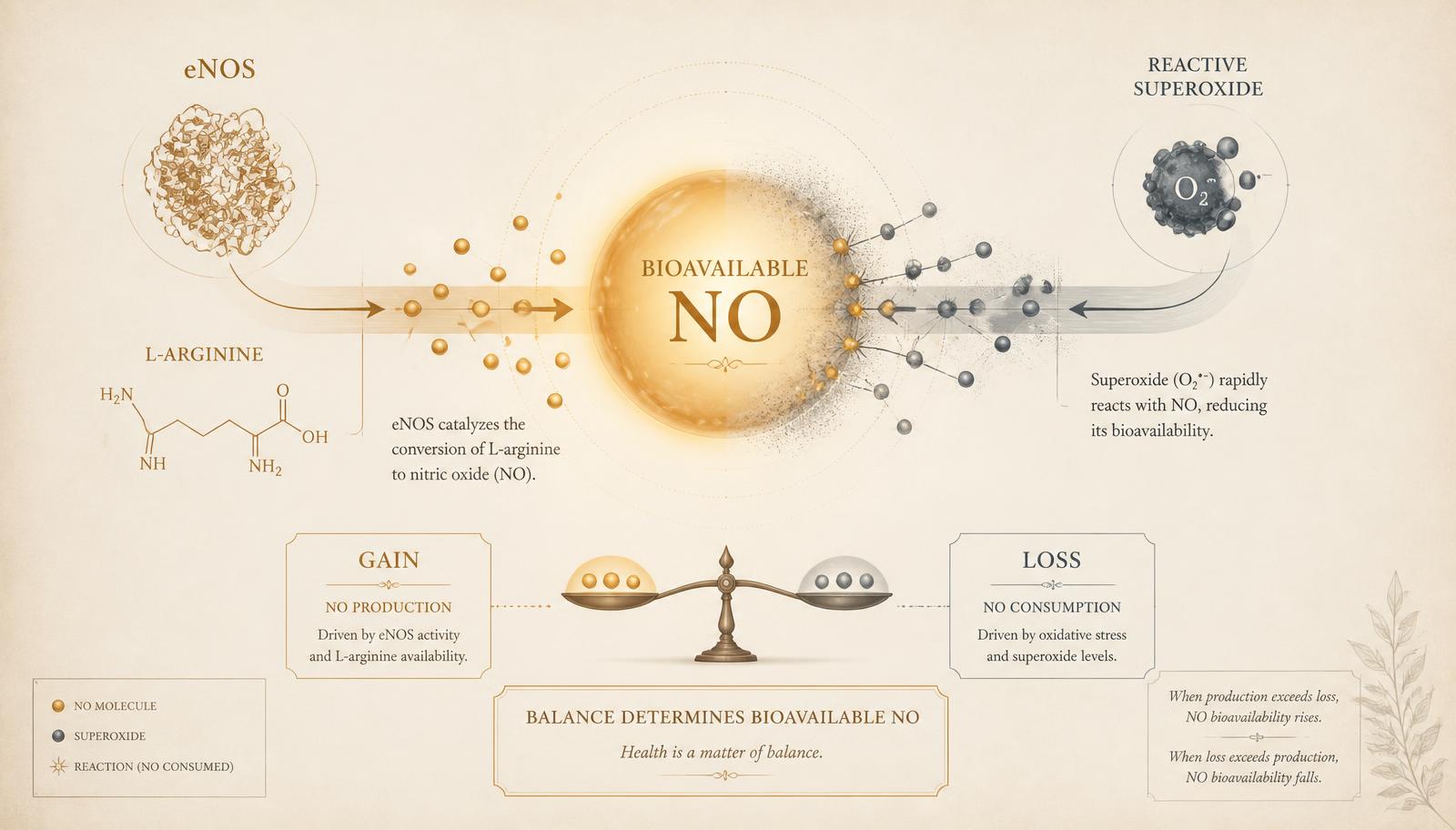
Because nitric oxide exists inside a chemical environment filled with other highly reactive molecules. One of the most important is superoxide. When superoxide encounters nitric oxide, the two can react extremely rapidly.
The result is a double loss:
- Less nitric oxide remains available for normal vascular signaling
- And a powerful reactive molecule called peroxynitrite can be formed
This is one of the key connections between oxidative stress, endothelial function and nitric-oxide biology. And it changes the way we should think about supporting NO.
Producing nitric oxide is important. Preserving its availability is equally important.
The Nitric Oxide Story Has Two Sides
Most discussions of nitric oxide concentrate on production: how much NO can the body make?
But vascular physiology depends on a balance.
NO Production
eNOS uses L-arginine to generate nitric oxide.
NO Loss
Reactive oxygen species can consume NO before it performs normal signaling.
So a more useful equation is:
NO produced − NO lost = NO bioavailability
This is why researchers frequently use the term nitric oxide bioavailability rather than simply nitric-oxide production. The distinction is fundamental.
What Is Oxidative Stress?
The word oxidative can make the subject sound more mysterious than it is. Cells naturally produce chemically reactive molecules collectively described as reactive oxygen species — ROS. These include:
- Superoxide
- Hydrogen peroxide
- Hydroxyl radicals
- And related molecules
ROS are not automatically harmful. At controlled concentrations, reactive oxygen species participate in normal cellular signaling, and the body possesses antioxidant systems designed to regulate them.
Problems can arise when the balance shifts toward excessive reactive species relative to the body's ability to control them. That condition is broadly described as oxidative stress.
The objective is not to eliminate oxidation from the body — that would be neither possible nor desirable. The objective is redox balance.
The Collision: Superoxide Meets Nitric Oxide
Now we arrive at one of the most important chemical reactions in vascular biology. Nitric oxide can react rapidly with superoxide (O₂⁻) to produce peroxynitrite (ONOO⁻).
When that happens, nitric oxide is no longer available to perform the same vascular signaling role it otherwise could have performed. So excessive superoxide can effectively reduce NO bioavailability. This is one mechanism linking oxidative stress with impaired endothelial function. [1][2]
Why Peroxynitrite Matters
Peroxynitrite is a strong oxidizing and nitrating species. It can react with:
- Proteins
- Lipids
- Enzymes
- DNA
- And important cellular cofactors
One particularly important target in the NO story is BH4 — tetrahydrobiopterin. BH4 is an essential cofactor used by endothelial nitric oxide synthase. When oxidative conditions reduce the availability of functional BH4, eNOS itself can begin behaving differently. [1]
And this is where the story takes an unexpected turn.
The Enzyme That Makes NO Can Begin Making Superoxide Instead
Under healthy conditions, eNOS performs an elegantly coordinated reaction. It uses:
- L-arginine
- Oxygen
- BH4
- NADPH
- And other cofactors
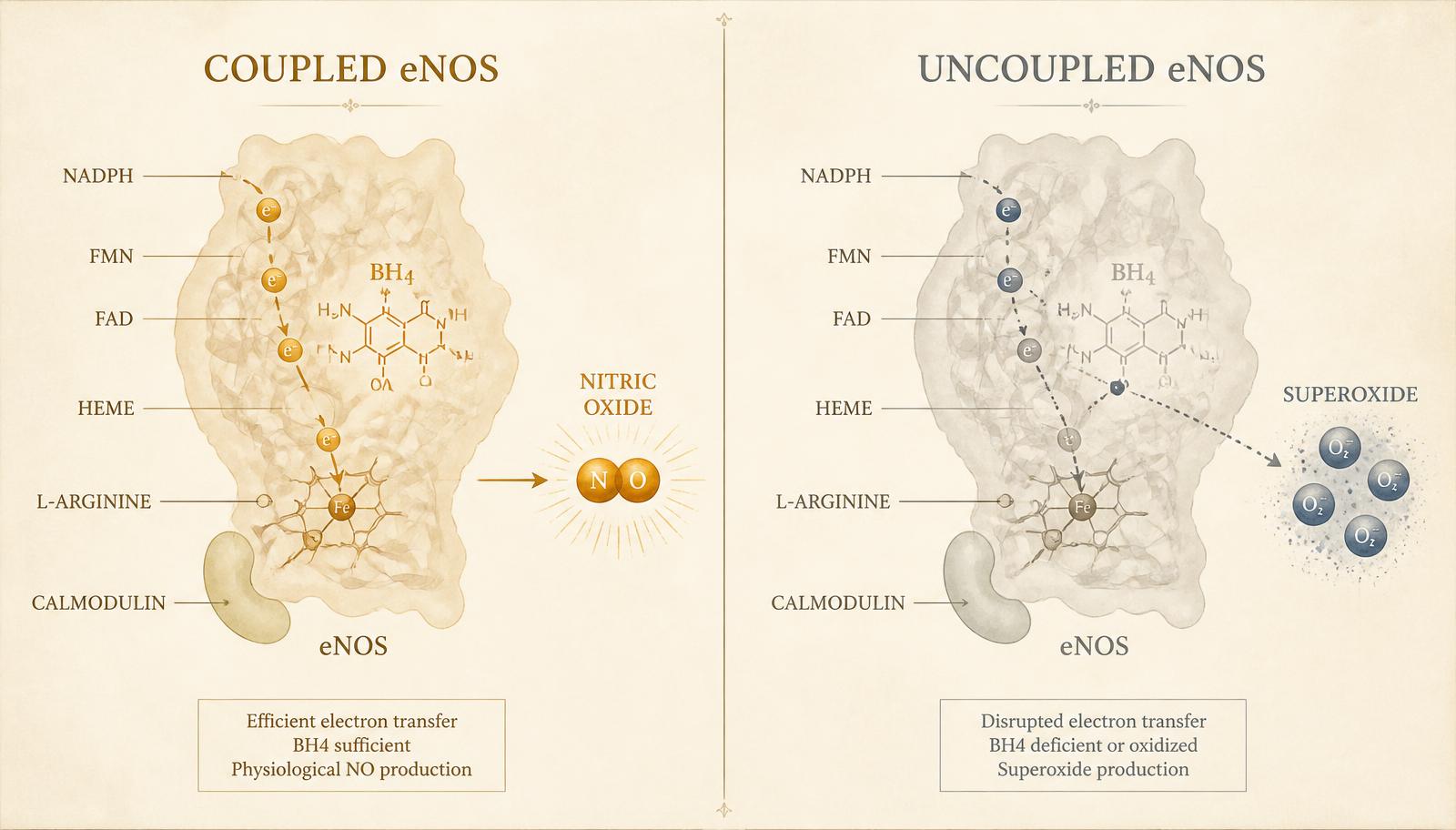
to help generate nitric oxide. Researchers describe this normal state as coupled eNOS.
But when the biochemical environment becomes unfavorable — particularly when BH4 availability is compromised — the enzyme can become uncoupled. Electron transfer within eNOS no longer results efficiently in NO production. Instead, the enzyme can begin generating more superoxide.
Coupled eNOS
eNOS → nitric oxide
Uncoupled eNOS
eNOS → more superoxide, less nitric oxide
This is one of the most important mechanisms connecting oxidative stress with endothelial dysfunction. Modern reviews describe eNOS uncoupling as a major contributor to reduced vascular NO bioavailability. [4][5]
A Vicious Cycle Can Develop
This is where oxidative stress becomes particularly damaging to NO biology. Follow the sequence:
- Oxidative stress increases
- More superoxide is present
- Superoxide consumes NO
- Peroxynitrite forms
- BH4 can be oxidized
- eNOS becomes less efficiently coupled
- eNOS produces more superoxide and less NO
- Oxidative stress increases further
The enzyme that should be helping produce a protective vascular signal can therefore become part of the oxidative problem. Researchers sometimes describe this as part of a feed-forward cycle of endothelial dysfunction. [4]
This Is Why "Just Make More NO" Is Too Simple
Imagine a bathtub. You can increase the water flowing from the faucet. But if the drain is also becoming larger, the water level may not rise very much.
NO biology can work in a similar way. You might support substrate availability for nitric-oxide production. But if oxidative stress is simultaneously consuming NO rapidly, increasing production alone may not completely solve the problem.
That doesn't make substrate support unimportant. It means a more complete strategy considers production and preservation.
Where Does the Oxidative Stress Come From?
There is no single source. Cells intentionally generate reactive oxygen species through several enzyme systems and metabolic processes. In vascular tissue, important contributors can include:
- NADPH oxidases
- Mitochondria
- Uncoupled eNOS itself
- Xanthine oxidoreductase
- And other oxidant-generating systems
Several cardiovascular risk factors are associated with increased vascular oxidative stress, including smoking, hypertension, diabetes, dyslipidemia and aging. [1][3]
This helps explain why the same conditions associated with cardiovascular risk so often appear in discussions of endothelial dysfunction.
Oxidative Stress and Endothelial Dysfunction Are Closely Connected
A healthy endothelium helps regulate:
- Vascular tone
- Blood flow
- Platelet activity
- Inflammatory signaling
- And other aspects of vascular homeostasis
Nitric oxide is one important part of that system. When NO bioavailability falls, the balance of endothelial signaling can change. Modern descriptions of endothelial dysfunction therefore frequently include reduced NO production, reduced NO bioavailability, or reduced responsiveness to NO-related signaling. [7]
This is why oxidative stress is not merely an abstract chemistry problem. It can alter how blood vessels function.
Aging Makes This Story More Important
Oxidative stress tends to become increasingly relevant with advancing age. At the same time:
- Endothelial NO bioavailability tends to decline
- eNOS regulation can become less efficient
- Arteries become less responsive
- And cardiovascular risk factors become more common
This does not mean everyone over 50 has "oxidative damage." Nor does oxidative stress explain every aspect of vascular aging. But the interaction between aging, oxidative stress, BH4 availability and NO signaling is an important area of cardiovascular research.
Research in postmenopausal women, for example, has demonstrated relationships among oxidative stress, BH4 deficiency, reduced NO bioavailability and impaired endothelial function. [6]

What Is BH4, and Why Have Most People Never Heard of It?
BH4 stands for tetrahydrobiopterin. It is not a famous consumer supplement ingredient. But biochemically, it is extremely important.
BH4 acts as an essential cofactor for nitric oxide synthase enzymes. In functioning eNOS, BH4 helps keep electron transfer properly coupled to the oxidation of L-arginine and the production of NO. When BH4 becomes oxidized toward BH2, the ratio of functional BH4 to BH2 can decline — making eNOS uncoupling more likely. [1]
So when people talk about natural NO production as though only arginine matters, they are missing much of the machinery. The pathway requires:
Substrate + enzyme + cofactors + a favorable redox environment.
Arginine Still Matters
None of this makes L-arginine less important. Arginine remains the substrate used by eNOS. But substrate availability is only one factor determining NO production. The system is also influenced by:
- BH4
- Oxygen
- eNOS regulation
- Arginase
- ADMA
- Oxidative stress
- And cellular transport
This gives us a more sophisticated understanding of NO support. Arginine supplies a key raw material. The endothelial environment determines how effectively the machinery can use it.
Citrulline Adds Another Layer
L-citrulline can help replenish circulating arginine through conversion, importantly involving the kidneys. That makes the arginine + citrulline relationship particularly useful nutritionally. Instead of relying entirely on oral arginine, L-arginine supplies more directly available substrate while L-citrulline provides a complementary route toward replenishing arginine.
But again, neither amino acid eliminates oxidative stress. Their role is to support the substrate side of the NO-production equation — and that distinction actually strengthens the scientific case for a broader formulation strategy.
What About ADMA?
Another player is asymmetric dimethylarginine — ADMA. ADMA occurs naturally in the body and inhibits nitric oxide synthase. Oxidative stress may influence pathways regulating ADMA, while a reduced arginine-to-ADMA relationship can contribute to impaired NOS activity. [1]
So the endothelial NO system is being influenced simultaneously by:
- The substrate
- The enzyme
- Cofactors
- Endogenous inhibitors
- And reactive oxygen species
Human biology rarely has one lever.
Antioxidants: A Word That Needs Better Definition
If oxidative stress reduces NO bioavailability, it is tempting to conclude: "take antioxidants." The reality is more complicated.
The body has endogenous antioxidant systems including:
- Superoxide dismutase
- Catalase
- Glutathione-related enzymes
- And other defenses
Food also provides compounds that participate in the broader redox environment. But high-dose isolated antioxidant supplementation has not consistently produced the cardiovascular benefits one might expect from simple free-radical theory.
For example, vascular research has sometimes demonstrated acute improvement in endothelial function with high local doses of vitamin C, while large cardiovascular trials of routine high-dose antioxidant vitamins have generally failed to show the dramatic disease prevention once anticipated. [3]
Redox biology is regulation — not simply good antioxidants fighting bad oxidants.
Food Still Matters
None of that diminishes the value of a plant-rich diet. Vegetables and fruits provide:
- Vitamin C
- Polyphenols
- Flavonoids
- Anthocyanins
- Carotenoids
- Minerals and fiber
- And thousands of phytochemicals consumed within a complex food matrix
Rather than trying to extinguish every reactive molecule, a healthy dietary pattern contributes to the broader nutritional environment associated with vascular wellness. This is one reason colorful whole foods make more sense as a foundation than chasing enormous doses of one isolated antioxidant.
Australian Plant Foods Fit the Broader Redox Story
Australian fruits such as Kakadu Plum and Davidson's Plum are interesting because of their naturally occurring plant compounds. Kakadu Plum is particularly known for its vitamin C content, while both fruits contain various polyphenolic and phytonutrient compounds.
Their role should not be exaggerated. They do not directly "neutralize every free radical," and they do not substitute for eNOS or manufacture nitric oxide. Their relevance is better understood as contributing to the broader phytonutrient and antioxidant character of a cardiovascular-supportive nutritional strategy. That is a more scientifically credible role.
Exercise Creates Oxidants Too — and That's Not Necessarily Bad
Here's an apparent contradiction. Exercise can temporarily increase production of reactive oxygen species. Yet exercise is one of the best-supported strategies for improving endothelial function.
Because moderate physiological oxidative signals can participate in adaptation:
- Exercise challenges cells
- Antioxidant defenses can adapt
- eNOS signaling can improve
- Mitochondria adapt
- And the cardiovascular system becomes more capable
This is called hormesis in broader biological contexts: a manageable stress stimulates adaptation. So the goal should not be to avoid all oxidative stress. It should be to avoid chronic excessive oxidative stress while preserving normal adaptive signaling.
Smoking Is a Very Different Kind of Oxidative Exposure
Exercise-generated signaling is controlled and transient. Cigarette smoke is not. Smoking exposes the vascular system to an enormous mixture of oxidants and reactive compounds and is strongly associated with endothelial dysfunction.
From the standpoint of NO biology, supporting nitric-oxide nutrition while continuing to smoke is working against yourself. No supplement can reasonably be expected to cancel out that vascular exposure. Avoiding tobacco remains one of the most consequential decisions for cardiovascular health.
Blood Sugar and Metabolic Health Matter Too
Hyperglycemia and insulin resistance can contribute to increased oxidative stress and impaired endothelial signaling. This helps explain why metabolic health and vascular health are closely connected. NO biology does not exist separately from:
- Blood glucose
- Blood pressure
- Lipids
- Body composition
- Physical activity
- Or overall cardiovascular risk
Supporting nitric oxide should therefore be viewed as one part of a broader strategy.
The "Antioxidant Supplement" Trap
Suppose a product lists blueberry powder, grape extract, green tea, 20 berries, 15 vegetables, six botanical extracts and several vitamins. That creates a very impressive-looking panel. But it does not automatically tell you:
- How much of each ingredient is present
- Whether the amounts are meaningful
- Whether the ingredients have been standardized
- Or whether the formula materially changes endothelial oxidative stress
A sophisticated formulation should not rely on ingredient-count theater. It should select ingredients for a defined reason — and that principle applies just as strongly to antioxidant ingredients as it does to NO substrates.
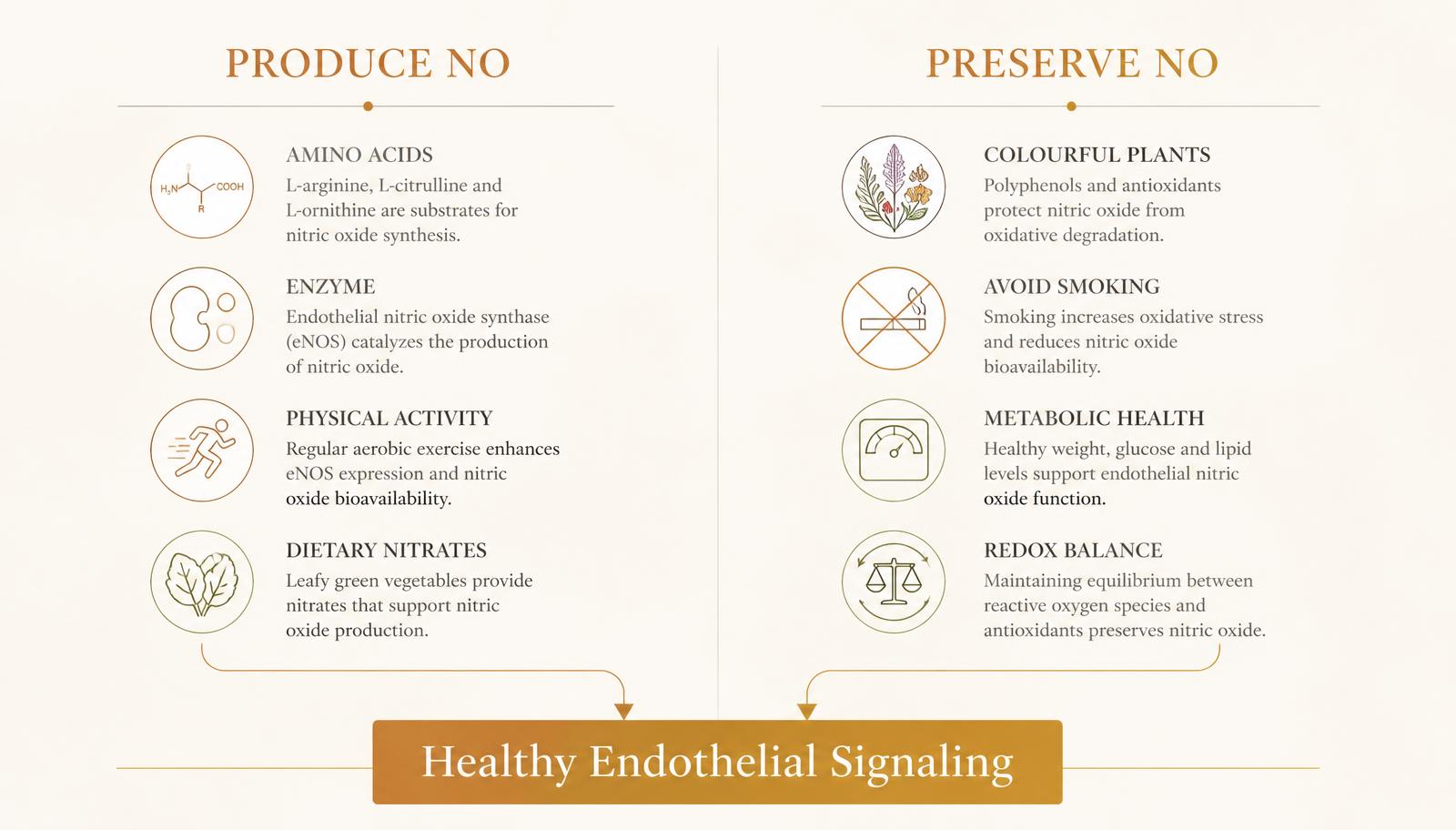
A More Useful Model: Support Both Sides of the Equation
Instead of looking for one "NO booster," consider the NO system as two objectives.
Objective 1 — Support Production
Provide appropriate substrate and support the natural pathways the body uses to make NO.
- L-arginine
- L-citrulline
- Dietary nitrate
- Physical activity
Objective 2 — Support the Environment
Promote the broader cardiovascular conditions in which healthy NO signaling occurs.
- A high-quality diet
- Avoiding smoking
- Remaining physically active
- Supporting metabolic health
- Managing blood pressure appropriately
- A broad spectrum of plant nutrients
This is a much more realistic model than trying to maximize one molecule.
Why This Matters After 50
After midlife, several things can begin moving in the wrong direction simultaneously. Endothelial NO bioavailability can decline. Oxidative stress may rise. Physical activity may decrease. Metabolic risk may increase. eNOS can become less efficient.
This creates a strong rationale for becoming more deliberate about NO support, not less. That includes:
- Regular movement
- Nitrate-rich vegetables
- Adequate nutrition
- Arginine and citrulline availability
- Cardiovascular risk management
- And targeted supplementation when appropriate
Supplementation becomes particularly valuable because it can provide consistent nutritional support even when diet and lifestyle are not perfectly uniform from day to day.
Where ėNOS Fits Into the Redox Picture
The formulation philosophy behind ėNOS by Australiana Life makes more sense when NO is viewed as an entire system rather than a single ingredient. At the center of the formula are L-arginine and L-citrulline.
Arginine supplies substrate directly relevant to the endothelial eNOS pathway. Citrulline provides a complementary route that can help replenish circulating arginine availability. That gives ėNOS a strong foundation for supporting the production side of natural NO biology.
The formulation also includes deliberately selected additional nutrients and Australian plant ingredients, including Kakadu Plum and Davidson's Plum, contributing to its broader nutritional and phytonutrient profile. This matters because cardiovascular nutrition is not simply about supplying more arginine. It is about supporting the biological environment in which natural NO production occurs.
ėNOS should not be portrayed as a treatment for oxidative stress or as something that can "neutralize" vascular disease. Its benefit is more credible: a deliberately formulated nutritional strategy supporting natural nitric-oxide production, healthy circulation and the broader nutritional environment associated with cardiovascular wellness.
For adults over 50 — when NO bioavailability can become increasingly challenged — that comprehensive approach has particular relevance.
The Most Important NO May Be the NO You Don't Lose
For years, the popular nitric-oxide conversation has revolved around one question: how do I make more? The deeper science asks another: how do I maintain an environment in which the NO I make remains biologically useful?
That takes us beyond amino acids, beyond beetroot, beyond "NO boosters." It takes us into:
- Redox balance
- Endothelial health
- BH4
- Superoxide
- eNOS coupling
- Metabolic health
- Exercise and nutrition
The lesson is surprisingly simple. Producing nitric oxide matters. Protecting normal nitric-oxide biology matters too.
The healthiest vascular system is not the one producing the most NO at all costs. It is the one capable of producing the right signal, in the right place, in the right biochemical environment.
Scientific References
[1] Endothelial dysfunction due to eNOS uncoupling: molecular mechanisms as potential therapeutic targets
Janaszak-Jasiecka A, Płoska A, Wierońska JM, et al. Cellular & Molecular Biology Letters. 2023;28. Comprehensive contemporary review of BH4 depletion, L-arginine/ADMA balance, oxidative stress and eNOS uncoupling.
PubMed / National Library of Medicine →[2] Endothelial nitric oxide synthase in vascular disease: from marvel to menace
Förstermann U, Münzel T. Circulation. 2006;113:1708–1714. Foundational discussion of NO, oxidative stress and the conversion of eNOS from an NO-producing to a superoxide-producing enzyme under uncoupled conditions.
PubMed / National Library of Medicine →[3] Oxidative stress and endothelial dysfunction in hypertension
Schulz E, Gori T, Münzel T. Hypertension Research and related vascular literature. The relationship among cardiovascular risk factors, NADPH oxidases, reactive oxygen species and endothelial function is extensively established.
PubMed / National Library of Medicine →[4] eNOS uncoupling in cardiovascular diseases — the role of oxidative stress and inflammation
Karbach S, Wenzel P, Waisman A, Münzel T, Daiber A. Current Pharmaceutical Design. 2014. Review of the redox mechanisms contributing to eNOS uncoupling, including BH4 depletion, ADMA and oxidative modifications.
PubMed / National Library of Medicine →[5] Pharmacological prevention of eNOS uncoupling
Li H, Förstermann U. Current Pharmaceutical Design. Review of vascular oxidative stress, BH4 oxidation and eNOS uncoupling.
PubMed / National Library of Medicine →[6] Role of BH4 deficiency as a mediator of oxidative stress-related endothelial dysfunction in menopausal women
DuBose LE, et al. American Journal of Physiology — Heart and Circulatory Physiology. 2022. Human research connecting oxidative stress, reduced BH4 availability and impaired NO-dependent endothelial function after menopause.
PubMed / National Library of Medicine →[7] Nitric oxide signalling in cardiovascular health and disease
Farah C, Michel LYM, Balligand JL. Nature Reviews Cardiology. 2018;15:292–316. Broad review of endothelial nitric-oxide signaling and cardiovascular physiology.
PubMed / National Library of Medicine →[8] Nitric oxide synthases: regulation and function
Förstermann U, Sessa WC. European Heart Journal. 2012;33:829–837. Comprehensive review of NOS enzymes, NO production and endothelial regulation.
PubMed / National Library of Medicine →
Continue Into the Deeper NO Science
- What Affects Nitric Oxide Production? →
See how age, exercise, substrate availability, oral bacteria and endothelial health influence natural NO biology.
- What Is eNOS? The Enzyme Behind Natural Nitric Oxide Production →
Explore the enzyme that can either produce NO efficiently — or become uncoupled under unfavorable conditions.
- The Endothelium: The Hidden Key to Healthy Blood Vessels →
Understand the living cellular environment where vascular NO signaling begins.
- L-Arginine and Nitric Oxide Explained →
Follow the substrate used directly by eNOS.
- Nitric Oxide and Aging: What Changes After 40, 50 and Beyond? →
Explore why oxidative stress and declining NO bioavailability become increasingly relevant with age.
DISCOVER THE SYSTEM-BASED SCIENCE BEHIND ĖNOS
Supporting NO means supporting a system. ėNOS combines L-arginine + L-citrulline with deliberately selected complementary nutrients and Australian plant ingredients as part of a broader strategy to support the body's natural nitric-oxide system, healthy circulation and cardiovascular wellness.
EXPLORE ĖNOS →This article is provided for informational purposes only and is not intended as medical advice or to diagnose, treat, cure or prevent disease. Oxidative stress and endothelial dysfunction are complex biological processes and should not be self-diagnosed from symptoms. ėNOS is a dietary supplement formulated to support the body's natural nitric-oxide system, healthy circulation and cardiovascular wellness. Dietary supplements should complement, rather than replace, appropriate nutrition, physical activity, cardiovascular risk management and medical care.
More in Nitric Oxide Science
About Our Health & Science Content
Australiana Life Health & Science articles are based on published scientific research and written to make complex health and nitric oxide science easier to understand. Our educational content undergoes scientific review for accuracy and appropriate interpretation of the evidence and is updated as relevant scientific understanding evolves.