
L-Arginine and Nitric Oxide Explained
Why This Amino Acid Sits at the Beginning of One of the Body's Most Important Vascular Signaling Pathways
L-arginine occupies an unusual place in nutrition.
It is an amino acid. It helps build proteins. It participates in the urea cycle. It contributes to creatine synthesis and other metabolic processes.
But one particular role transformed scientific understanding of cardiovascular physiology:
L-arginine is the substrate the body uses to produce nitric oxide through nitric oxide synthase enzymes.
That gives us one of the most important relationships in nitric-oxide biology: L-Arginine → Nitric Oxide.
The actual chemistry is more complicated, of course. And understanding that complexity helps explain both the importance of arginine — and why simply consuming more arginine does not automatically mean producing unlimited nitric oxide.
First: What Is L-Arginine?
L-arginine is one of the amino acids naturally present in the human body. Amino acids are often described as the building blocks of protein, but that definition only tells part of the story. Many amino acids also participate in metabolic pathways, and arginine is particularly versatile.
It contributes to:
- protein synthesis
- the urea cycle and nitrogen disposal
- creatine production
- polyamine synthesis
- and nitric-oxide production
The body can make arginine, and we also obtain it from food. [1] [2] For healthy adults, arginine is generally described as a conditionally essential amino acid, because under certain physiological circumstances the body's requirements can exceed endogenous production.
But for our purposes, its most interesting destination is the endothelial cell.
The Reaction That Changed Cardiovascular Science
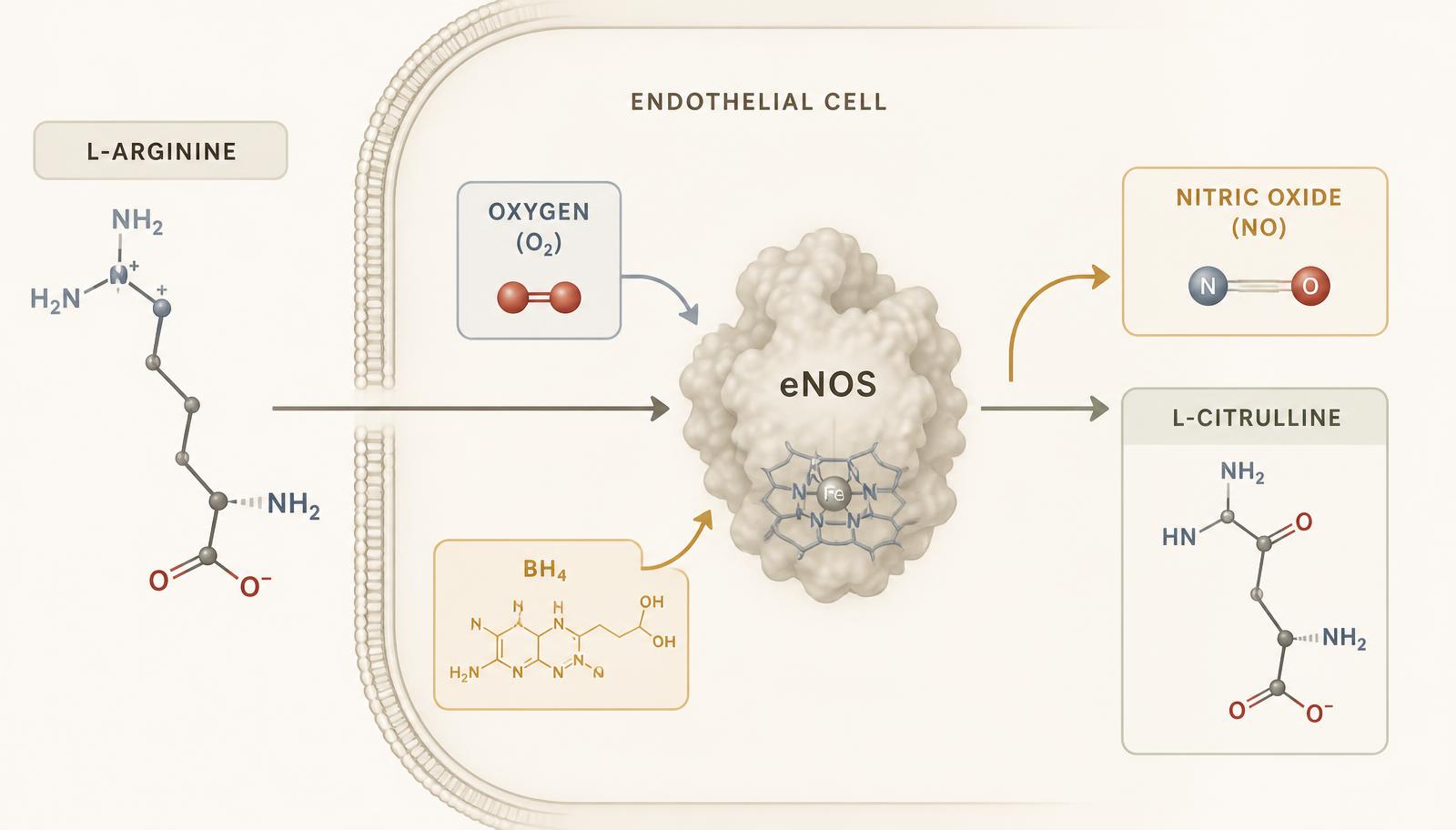
Inside blood vessels is an extremely thin cellular lining called the endothelium. Endothelial cells contain an enzyme called eNOS — endothelial nitric oxide synthase. eNOS can use L-arginine to produce nitric oxide.
But let's look one level deeper. Nitric oxide synthase catalyzes the oxidation of L-arginine through an intermediate called Nω-hydroxy-L-arginine, eventually generating nitric oxide + L-citrulline. [1] The reaction also depends upon oxygen, NADPH and several enzyme-associated cofactors.
So arginine is essential to the reaction. But it is one member of an entire biochemical system.
What Happens to the Nitric Oxide?
Once eNOS produces NO, the molecule can diffuse from the endothelial cell into nearby vascular smooth muscle. There it activates soluble guanylate cyclase, which increases cyclic GMP — cGMP. The resulting signaling contributes to smooth-muscle relaxation and regulation of vascular tone. [3]
It supplies the starting material for a fundamental vascular signaling pathway.
Does That Mean Arginine Is a Vasodilator?
Not exactly. This distinction matters.
Arginine is not nitric oxide. And arginine itself should not simply be described as a substance that "opens arteries." It is a substrate. The body can use it within the NOS pathway to produce nitric oxide, and the resulting NO participates in vascular signaling.
That is a more accurate description than saying "arginine dilates your blood vessels." The body remains in control of the pathway.
Where Does Your Arginine Come From?
There are three broad contributors to the body's arginine supply.
1. Food
Protein-containing foods provide arginine.
2. Protein turnover
When the body breaks down its own proteins as part of normal protein metabolism, amino acids — including arginine — can be released.
3. Endogenous synthesis
The body can produce arginine, importantly through metabolism involving citrulline. That third source is particularly interesting because it connects two amino acids central to NO nutrition: citrulline and arginine.
Foods Naturally Containing Arginine
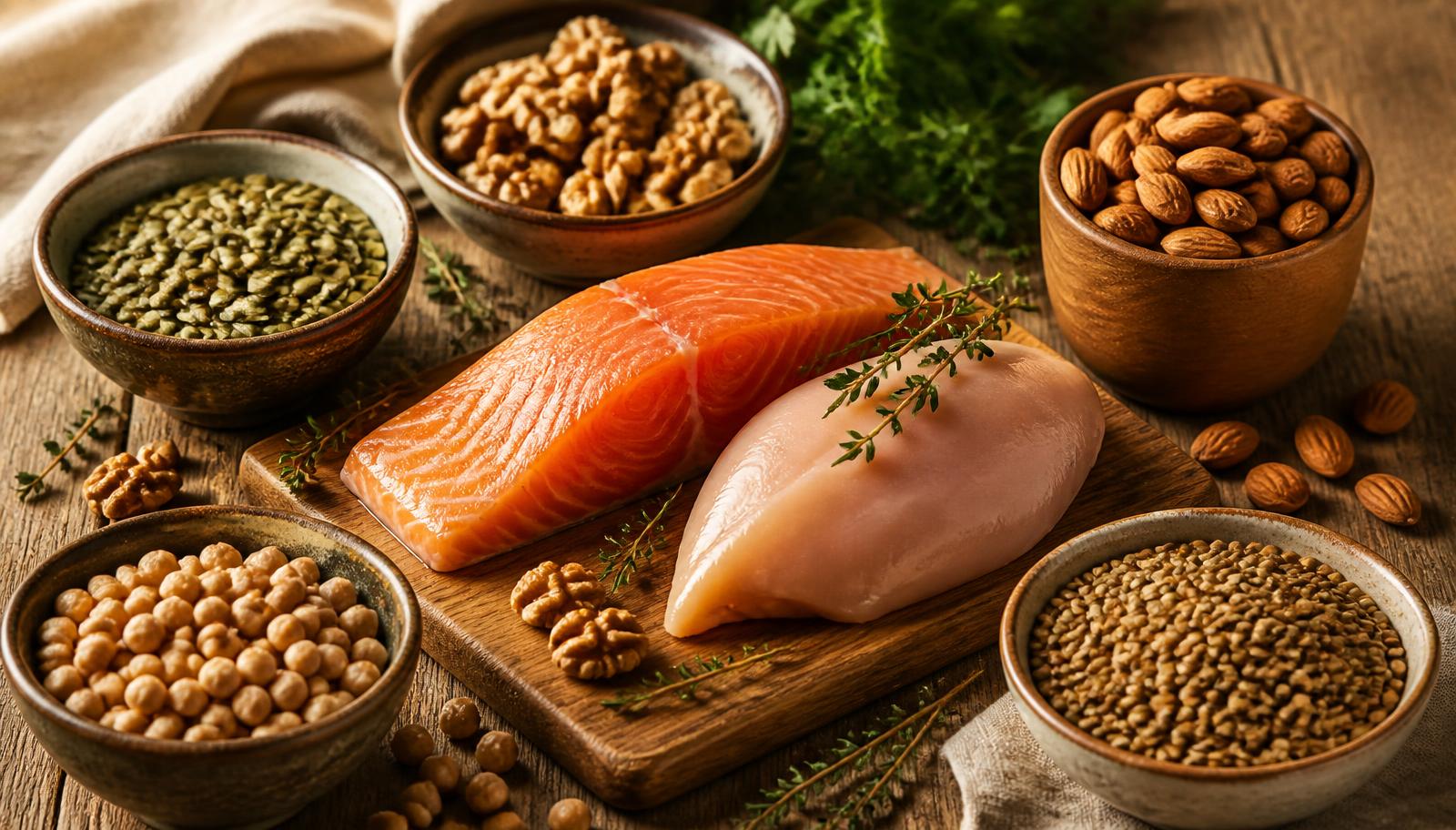
Arginine occurs widely in protein foods. Sources include:
- pumpkin seeds
- sesame seeds
- peanuts
- walnuts and other nuts
- legumes
- soy foods
- fish
- poultry
- meat
- and dairy products
So most people consuming an adequate mixed diet already ingest arginine every day. That leads to an obvious question: if arginine is already present in food and blood, why has supplemental arginine been studied so extensively? The answer leads us to one of the most interesting puzzles in NO science.
The L-Arginine Paradox
Scientists discovered something unexpected. Under normal physiological conditions, the concentration of arginine inside endothelial cells can already appear high enough to supply eNOS. Based purely on enzyme chemistry, adding more arginine should therefore sometimes make little difference.
Yet in some experimental and clinical circumstances, additional extracellular L-arginine has been observed to influence NO-dependent vascular responses. This became known as the L-arginine paradox: how can extra substrate affect an enzyme that should theoretically already have enough substrate?
Several explanations have been proposed. [4] [5] They include:
- cellular compartmentalization
- arginine transport
- competition with endogenous NOS inhibitors
- local arginine availability near eNOS
- arginase activity
- and coupling between arginine transport and NO production
The amount of a nutrient present in the bloodstream does not necessarily tell us how much is available to a particular enzyme in a particular cellular location. Human metabolism is organized, compartmentalized and regulated.
Arginine Has Competition
Another molecule complicates the picture: ADMA — asymmetric dimethylarginine. ADMA occurs naturally in the body and can inhibit nitric oxide synthase.
Because arginine is the substrate for NOS while ADMA can interfere with NOS activity, researchers have studied the relationship between the two. In some research contexts, the L-arginine / ADMA ratio has been examined as an indicator related to NO substrate availability. [6]
This again shows why NO production cannot be reduced to "more arginine in → more nitric oxide out." There are regulators in between.
Another Competitor: Arginase
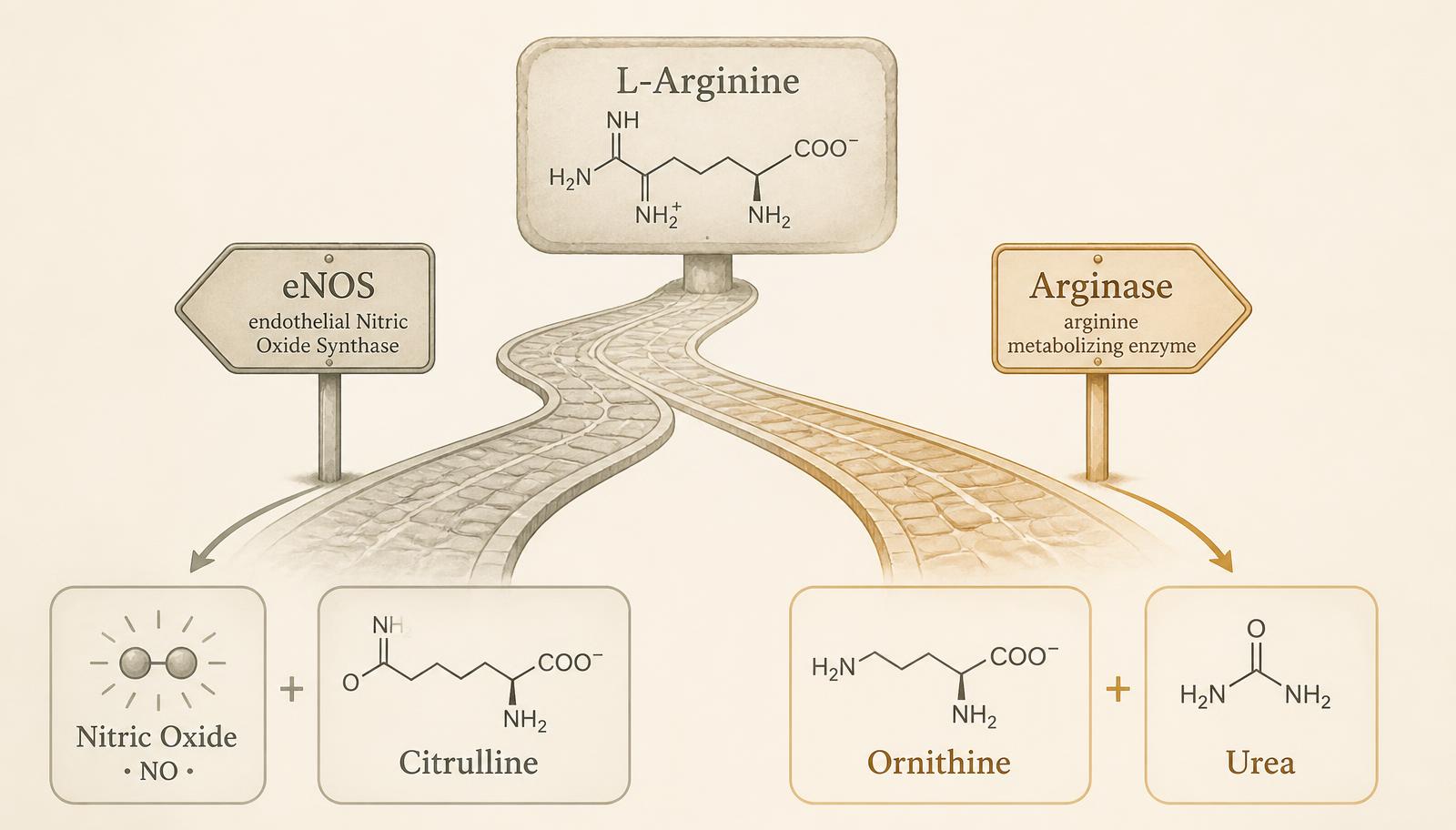
Nitric oxide synthase is not the only enzyme interested in arginine. Another enzyme called arginase also uses L-arginine. Instead of producing NO, arginase converts arginine toward ornithine + urea.
That means arginase and nitric oxide synthase can effectively compete for the same amino-acid substrate. Increased arginase activity can reduce arginine availability for NOS under certain physiological conditions. [7]
Think of arginine standing at a metabolic fork:
The amount of arginine present is only part of the story. Where it goes matters too.
What Happens to Arginine When You Swallow It?
Dietary or supplemental L-arginine is absorbed in the gastrointestinal tract. But not all orally consumed arginine reaches systemic circulation unchanged. The intestinal wall and liver participate in substantial first-pass metabolism of arginine. [8]
Arginine consumed is not necessarily equal to arginine reaching systemic circulation.
This is one reason oral doses can produce variable changes in circulating arginine. And it helps explain why researchers became interested in another amino acid: L-citrulline.
The Citrulline Connection
Citrulline follows different pharmacokinetics. Unlike arginine, citrulline largely avoids significant intestinal and hepatic first-pass metabolism. It is absorbed and enters systemic circulation. The kidneys then play an important role in converting citrulline into L-arginine.
Human research has demonstrated that oral citrulline can effectively increase circulating arginine concentrations. [8] Arginine provides the substrate directly; citrulline helps replenish the arginine pool through another metabolic route.
Arginine vs Citrulline Is the Wrong Question
Nutrition discussions often ask which is better — arginine or citrulline. That makes for an attractive headline. Biologically, it can be the wrong way to frame the issue.
They are connected. Arginine is directly used by nitric oxide synthase. Citrulline can be converted into arginine. And when NOS uses arginine to make NO, citrulline is produced again.
Rather than competitors, they can be understood as complementary participants in arginine/NO metabolism.
What Does Human Research Say About Arginine Supplementation?
L-arginine has been studied extensively in:
- vascular physiology
- endothelial function
- blood pressure
- exercise
- metabolic conditions
- and other cardiovascular contexts
Some controlled trials and meta-analyses have reported improvements in particular vascular or blood-pressure outcomes with oral L-arginine supplementation. [9] [10] Other studies have produced neutral results. Effects vary according to population, baseline health, dose, duration, and the outcome being measured.
That means it would be inappropriate to say "L-arginine improves circulation in everyone." But it would be equally inaccurate to dismiss arginine as irrelevant. Its biological role as the substrate for NOS is firmly established.
The question is not whether arginine participates in NO production — it unquestionably does. The question is whether additional oral arginine meaningfully changes a particular physiological outcome in a particular person. Those are different questions.
An Important Safety Lesson From Arginine Research
Good ingredient authority also means discussing research that isn't commercially convenient. One clinical trial deserves particular attention.
The VINTAGE MI study examined L-arginine supplementation following acute myocardial infarction. The trial did not demonstrate the anticipated vascular benefit and raised safety concerns, with more deaths occurring in the arginine group. The investigators concluded that L-arginine should not be recommended following acute myocardial infarction. [11]
This does not mean ordinary dietary arginine is dangerous, nor does it erase the established physiological role of arginine. It demonstrates something more important: a nutrient with a normal and beneficial role in human physiology is not automatically appropriate as a supplement in every medical circumstance.
People with cardiovascular disease — particularly following a heart attack — should discuss supplement use with their healthcare professional. Scientific credibility requires saying that clearly.
Arginine and Exercise: Biology vs Marketing
Arginine became enormously popular in sports nutrition because the logic appeared straightforward: arginine → NO → blood flow → better exercise performance. But performance research has been much less straightforward. Studies of oral arginine in healthy and trained individuals have produced inconsistent exercise-performance results. [12]
One reason may be that healthy active people already possess effective vascular NO systems. Another may be oral arginine's first-pass metabolism. And exercise performance depends on far more than one vascular pathway.
So arginine's role in NO biology is much stronger scientifically than the claim that taking arginine necessarily makes someone faster, stronger or more powerful.
What About Arginine and Aging?
With advancing age, endothelial NO bioavailability tends to decline. Several mechanisms can contribute:
- oxidative stress
- altered eNOS function
- changes in vascular signaling
- metabolic factors
- and potentially changes in substrate handling
That makes maintaining healthy endothelial biology increasingly relevant through midlife and beyond. [13] But again, supplying more arginine addresses only one part of the system. Healthy NO production also depends upon:
- functional eNOS
- appropriate cofactors
- healthy endothelial cells
- physical activity
- metabolic health
- and control of oxidative stress
Arginine matters. The environment in which arginine is used matters too.
A Useful Way to Think About L-Arginine
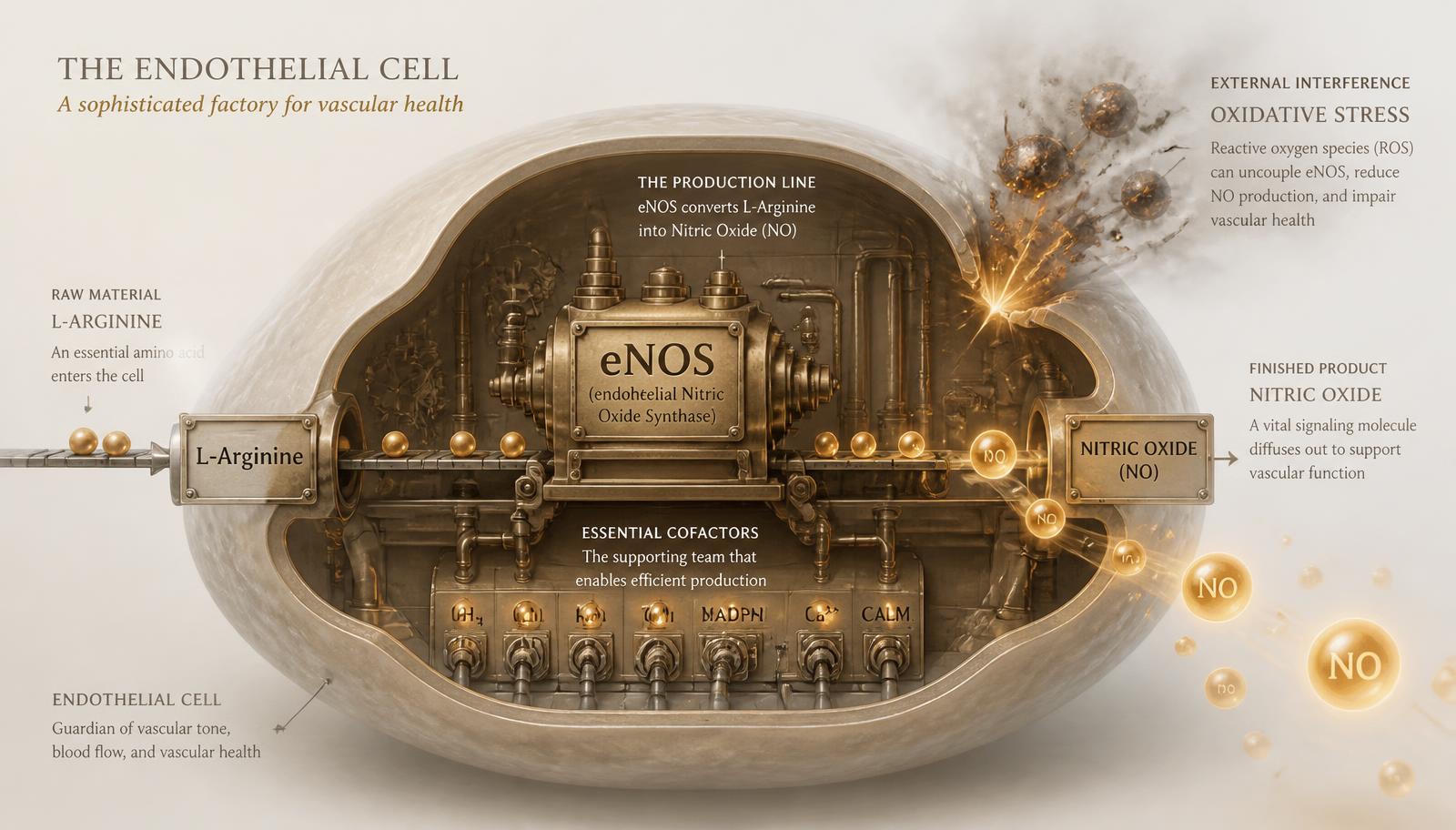
Forget the idea that arginine is a switch that turns nitric oxide on. A better analogy is:
- Arginine is raw material.
- eNOS is the machinery.
- Cofactors help the machinery operate.
- The endothelial cell is the factory.
- Blood-flow signals help determine production.
- Oxidative stress can reduce the usable product.
- And the finished signaling molecule is NO.
Giving a factory more raw material can be useful when substrate availability matters. But raw material alone cannot guarantee how efficiently the entire factory operates. That is a much more accurate picture of L-arginine biology.
Why Arginine Remains Fundamental to NO Science
After decades of research, one fact remains unchanged: the classical nitric-oxide synthase pathway begins with L-arginine. That makes arginine fundamental to understanding endothelial function, vascular tone, blood-flow regulation, exercise physiology, NO metabolism and cardiovascular signaling.
But modern research has made the story more sophisticated. We now understand:
- arginine transport matters
- arginase competes for substrate
- ADMA can inhibit NOS
- citrulline can replenish arginine
- eNOS requires an appropriate biochemical environment
- and NO bioavailability depends upon both production and destruction
That isn't a weakness in the arginine story. It makes the story more interesting.
Why ėNOS Uses L-Arginine — But Doesn't Stop There
L-arginine has an important place in the formulation of ėNOS by Australiana Life for a straightforward scientific reason: arginine is the substrate directly used by eNOS in natural endothelial nitric-oxide production.
But understanding arginine metabolism also explains why the ėNOS formulation does not rely on arginine alone. ėNOS combines L-arginine with L-citrulline. The two approach arginine availability differently: arginine provides substrate more directly, while citrulline is absorbed, converted toward L-arginine and helps replenish arginine availability.
That complementary approach is particularly relevant because oral arginine and citrulline have different metabolic characteristics. Rather than treating the ingredients as competitors, ėNOS uses both as part of a coordinated nutritional strategy supporting the body's natural NO-production system. Additional deliberately selected nutrients and Australian plant ingredients complement that broader cardiovascular-wellness approach.
The benefit is a formulation built around how the pathway actually works, rather than simply adding an ingredient because "arginine equals nitric oxide." For people interested in supporting healthy circulation, endothelial function and cardiovascular wellness — particularly as they remain active through midlife and beyond — that is a scientifically rational nutritional strategy.
One Amino Acid. A Much Bigger Story.
At first, L-arginine seems simple. It's an amino acid. Then you follow it. Into the bloodstream. Into the endothelial cell. Past competing metabolic pathways. Toward eNOS. Through an enzyme reaction. And finally: nitric oxide.
But even then the story isn't finished. Citrulline is produced. NO travels to another cell. Vascular signaling begins. Citrulline can eventually help regenerate arginine. And the cycle continues.
L-arginine deserves more than the familiar label "an NO booster." It is one of the fundamental raw materials from which the human body builds nitric oxide.
The Research Behind L-Arginine
[1] Arginine metabolism: nitric oxide and beyond
Wu G, Morris SM Jr. Biochemical Journal. 1998;336:1–17. Foundational review of arginine metabolism, including nitric-oxide production and the urea cycle.
PubMed / National Library of Medicine →[2] Arginine metabolism: boundaries of our knowledge
Morris SM Jr. Journal of Nutrition. 2007;137:1602S–1609S. Overview of the multiple metabolic roles of arginine.
PubMed / National Library of Medicine →[3] Nitric oxide synthases: regulation and function
Förstermann U, Sessa WC. European Heart Journal. 2012;33:829–837. Comprehensive review of NOS enzymes and endothelial NO signaling.
PubMed / National Library of Medicine →[4] The pharmacodynamics of L-arginine
Böger RH. Journal of Nutrition. 2007;137:1650S–1655S. Discussion of arginine, endothelial NO production and the L-arginine paradox.
PubMed / National Library of Medicine →[5] A caveolar complex between the cationic amino acid transporter 1 and endothelial nitric-oxide synthase may explain the “arginine paradox”
McDonald KK, Zharikov S, Block ER, Kilberg MS. Journal of Biological Chemistry. 1997;272:31213–31216.
PubMed / National Library of Medicine →[6] Asymmetric dimethylarginine (ADMA): a novel risk marker in cardiovascular medicine and beyond
Böger RH. Annals of Medicine. 2006;38:126–136. Review of ADMA as an endogenous inhibitor of nitric oxide synthase.
PubMed / National Library of Medicine →[7] Arginase: a critical regulator of nitric oxide synthesis and vascular function
Durante W, Johnson FK, Johnson RA. Clinical and Experimental Pharmacology and Physiology. 2007;34:906–911. Review of competition between arginase and NOS for L-arginine.
PubMed / National Library of Medicine →[8] Pharmacokinetic and pharmacodynamic properties of oral L-citrulline and L-arginine: impact on nitric oxide metabolism
Schwedhelm E, Maas R, Freese R, et al. British Journal of Clinical Pharmacology. 2008;65:51–59. Human study comparing oral citrulline and arginine pharmacokinetics and their effects on NO-related metabolism.
PubMed / National Library of Medicine →[9] Effect of oral L-arginine supplementation on blood pressure: a meta-analysis of randomized, double-blind, placebo-controlled trials
Dong JY, Qin LQ, Zhang Z, et al. American Heart Journal. 2011;162:959–965. Meta-analysis reporting reductions in systolic and diastolic blood pressure across included trials, while individual responses and populations varied.
PubMed / National Library of Medicine →[10] Increase in fasting vascular endothelial function after short-term oral L-arginine is effective when baseline flow-mediated dilation is low
Bai Y, Sun L, Yang T, Sun K, Chen J, Hui R. American Journal of Clinical Nutrition. 2009;89:77–84. Meta-analysis of randomized controlled trials in which outcomes differed according to baseline endothelial function.
PubMed / National Library of Medicine →[11] L-Arginine Therapy in Acute Myocardial Infarction: The VINTAGE MI Randomized Clinical Trial
Schulman SP, Becker LC, Kass DA, et al. JAMA. 2006;295:58–64. Important safety trial demonstrating why arginine supplementation should not be assumed appropriate in every cardiovascular circumstance.
PubMed / National Library of Medicine →[12] Effects of arginine supplementation on athletic performance based on energy metabolism: a systematic review and meta-analysis
Viribay A, Burgos J, Fernández-Landa J, Seco-Calvo J, Mielgo-Ayuso J. Nutrients. 2020;12:1300. Review of arginine supplementation and exercise-performance outcomes.
PubMed / National Library of Medicine →[13] Aging and vascular endothelial function in humans
Seals DR, Jablonski KL, Donato AJ. Clinical Science. 2011;120:357–375. Review of endothelial NO bioavailability and vascular aging.
PubMed / National Library of Medicine →
Where to Go From Here
- L-Citrulline Explained: From Citrulline to Arginine to Nitric Oxide →
Follow the complementary route through absorption, renal conversion and replenishment of circulating arginine.
- Arginine vs. Citrulline: What's the Difference? →
Compare their metabolism and understand why “which is better?” may be the wrong question.
- L-Arginine + L-Citrulline: Two Pathways Supporting Nitric Oxide →
See why combining the two creates a different nutritional strategy from relying on arginine alone.
- How Your Body Makes Nitric Oxide →
Follow the complete pathway from raw materials to vascular signaling.
- What Is eNOS? The Enzyme Behind Natural Nitric Oxide Production →
Explore the enzyme that converts arginine toward nitric oxide.
SUPPORT THE PATHWAY AT ITS FOUNDATION
L-arginine sits at the beginning of the endothelial nitric-oxide pathway. ėNOS combines L-arginine with complementary L-citrulline as part of a broader formulation designed to nutritionally support the body's natural NO-production system, healthy circulation and cardiovascular wellness.
EXPLORE ĖNOS →This article is provided for informational purposes only and is not intended as medical advice or to diagnose, treat, cure or prevent disease. ėNOS is a dietary supplement formulated to support the body's natural nitric-oxide system, healthy circulation and cardiovascular wellness. People with cardiovascular disease, those who have experienced a heart attack, or those taking prescription medications should discuss dietary-supplement use with an appropriate healthcare professional.
More in Nutrition & NO Support
- How to Increase Nitric Oxide Naturally
- Foods That Support Natural Nitric Oxide Production
- L-Arginine + L-Citrulline: Two Pathways Supporting Nitric Oxide
- Arginine vs. Citrulline: What's the Difference?
- L-Citrulline Explained: From Citrulline to Arginine to Nitric Oxide
- Why Combine L-Arginine & L-Citrulline?
- Dietary Nitrates & the Nitrate–Nitrite–Nitric Oxide Pathway
- Nitric Oxide Supplements: What Should You Look For?
About Our Health & Science Content
Australiana Life Health & Science articles are based on published scientific research and written to make complex health and nitric oxide science easier to understand. Our educational content undergoes scientific review for accuracy and appropriate interpretation of the evidence and is updated as relevant scientific understanding evolves.