
Nitric Oxide Research: From Discovery to the Nobel Prize
How a Mysterious Blood-Vessel Signal Became One of the Most Important Discoveries in Cardiovascular Science
For most of scientific history, nitric oxide — NO — seemed an unlikely candidate for one of the body's most important signaling molecules.
It is tiny. It is a gas. It is highly reactive. It survives only briefly in biological tissue. And it was once known primarily as an atmospheric pollutant and laboratory chemical.
Yet by the end of the twentieth century, nitric oxide had transformed scientists' understanding of how blood vessels communicate and regulate themselves.
In 1998, Robert F. Furchgott, Louis J. Ignarro and Ferid Murad were jointly awarded the Nobel Prize in Physiology or Medicine “for their discoveries concerning nitric oxide as a signalling molecule in the cardiovascular system.” [1]
The story behind that Nobel Prize is more than scientific history. It explains why nitric oxide remains so important today in research involving:
- Heart and cardiovascular health
- Arterial function
- Healthy circulation
- Blood-flow regulation
- Exercise physiology
- Aging
- Brain signaling
It also explains why supporting the body's own ability to produce nitric oxide has become such an interesting area of nutritional science.
The Discovery Did Not Happen All at Once
There was no single experiment in which someone suddenly announced: “We have discovered nitric oxide.” Instead, several apparently unrelated scientific discoveries gradually converged.
One scientist was investigating how certain cardiovascular drugs worked. Another was trying to understand a puzzling response in isolated arteries. Another was attempting to identify an unknown substance produced by the endothelium.
Piece by piece, those findings revealed a completely new principle in biology: a gas produced by one cell could act as a messenger to another cell. The Nobel Committee later described this as an entirely new principle for biological signaling. [1]
1977: Ferid Murad and the First Major Clue
The story begins before scientists knew that human endothelial cells produced NO. For many years physicians had used nitroglycerin and related nitrate medications to help relieve angina. They knew the drugs could relax blood vessels. But the molecular explanation was incomplete.
Ferid Murad and colleagues were studying an intracellular signaling enzyme called guanylate cyclase. In 1977, they published research demonstrating that nitric oxide could activate guanylate cyclase and increase levels of cyclic GMP — cGMP — in multiple tissues. [2]
The Nobel Committee later credited Murad's work with showing that nitroglycerin and related compounds act through the release of NO, and with recognizing the possibility that this unusual gas might have biological signaling functions. [1]
But there was still a major missing piece. No one had yet demonstrated that the vascular system itself was deliberately producing nitric oxide.
1980: An Experiment That Changed the Way Scientists Saw Blood Vessels
Robert Furchgott was studying how arteries responded to drugs such as acetylcholine. His experiments produced a frustrating contradiction. Sometimes acetylcholine caused an artery to relax. Sometimes it did not. Why?
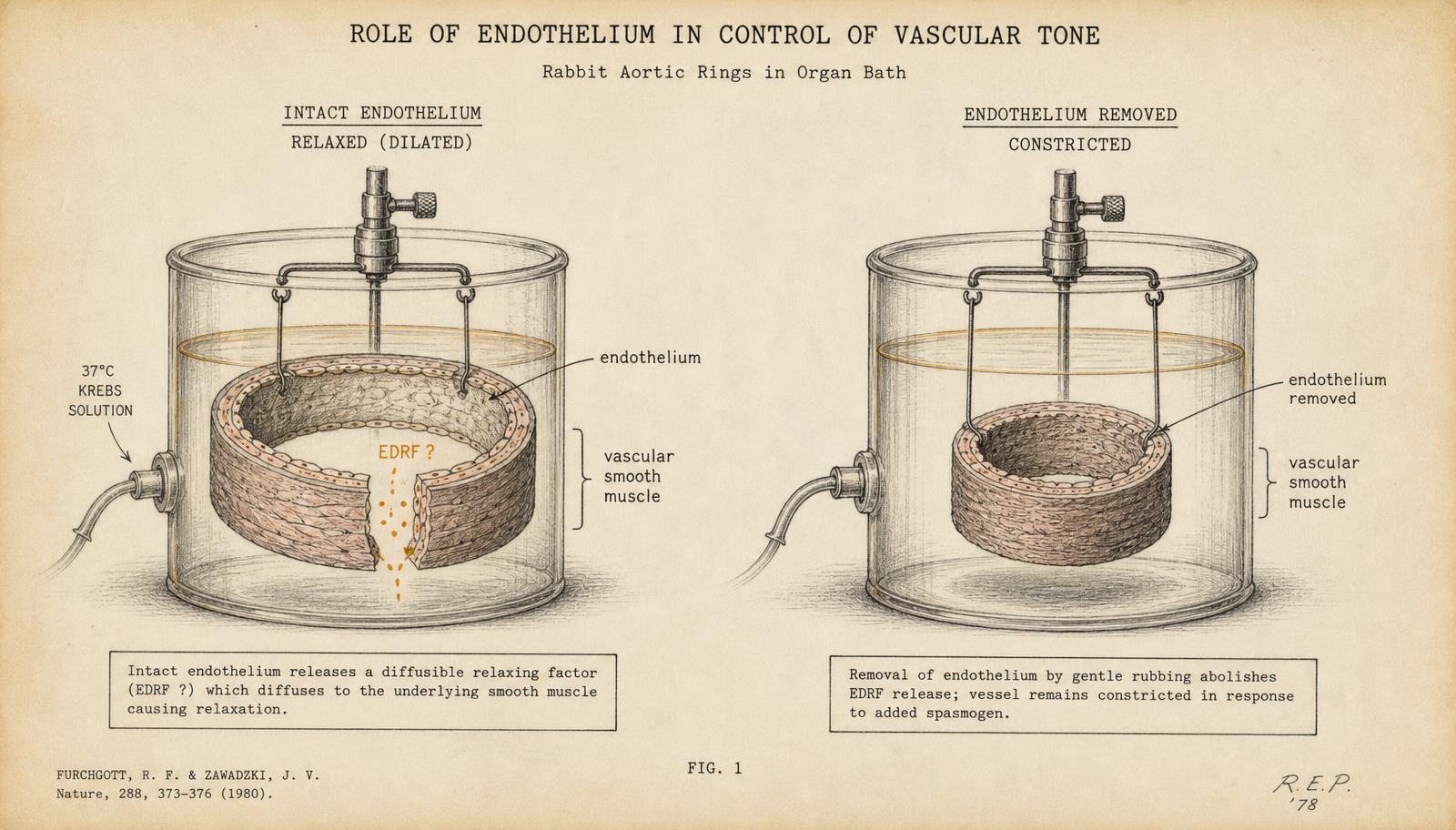
Eventually Furchgott and John Zawadzki discovered that the difference depended upon something that could easily be damaged while preparing the artery for an experiment: the endothelial lining.
When the endothelial cells remained intact, acetylcholine could produce relaxation. When that delicate inner surface had been rubbed away, the response disappeared. Their landmark 1980 Nature paper demonstrated that arterial relaxation required endothelial cells and proposed that those cells released a substance capable of signaling the vascular smooth muscle to relax. [3]
That was revolutionary. The endothelium had often been regarded largely as a passive inner lining. Furchgott's work suggested something very different: the endothelium was actively communicating with the rest of the artery.
The Mystery Substance Gets a Name: EDRF
Scientists did not initially know what the endothelial cells were releasing. So the mysterious substance became known as EDRF — Endothelium-Derived Relaxing Factor.
The name described what scientists knew. It came from the endothelium. And it caused vascular smooth muscle to relax. What they did not know was its chemical identity.
For several years, EDRF became one of the great puzzles in cardiovascular pharmacology.
- Researchers knew the signal was extremely short-lived
- They knew it could diffuse from the endothelium toward vascular smooth muscle
- They knew it affected cGMP signaling
- And some of its behavior looked suspiciously similar to nitric oxide
1986–1987: The Mystery Is Solved
Louis Ignarro and his colleagues began systematically comparing the properties of EDRF with nitric oxide. The similarities were extraordinary.
- Both were short-lived
- Both relaxed vascular smooth muscle
- Both increased cGMP
- Both responded similarly to substances that stabilized or destroyed them
Ignarro and colleagues published evidence concluding that EDRF produced and released from blood vessels was nitric oxide. [4] At roughly the same time, Salvador Moncada's research group independently reported that nitric oxide accounted for the biological activity of EDRF. [5] The converging findings transformed the field.
According to the Nobel Committee, Furchgott and Ignarro independently concluded in 1986 that EDRF was NO, and their presentation of those conclusions at a scientific meeting that year triggered an enormous wave of NO research. [1]
The mysterious endothelial signal finally had an identity. EDRF was nitric oxide.
Three Scientists, Three Essential Parts of the Puzzle
The Nobel Prize recognized that these discoveries were complementary.
Ferid Murad
Helped establish that nitric oxide could activate cellular signaling through guanylate cyclase and cGMP, and helped explain the biological effects of nitrovasodilator drugs.
Robert F. Furchgott
Demonstrated that healthy endothelial cells release a factor responsible for blood-vessel relaxation — the substance initially called EDRF.
Louis J. Ignarro
Generated pivotal biochemical and pharmacological evidence identifying EDRF as nitric oxide.
Together, their work established a new understanding of cardiovascular signaling.
Why Was the Discovery So Surprising?
Most biological messengers scientists knew were comparatively complex molecules — hormones, peptides, neurotransmitters, proteins. Nitric oxide was completely different. NO contains just one nitrogen atom and one oxygen atom.
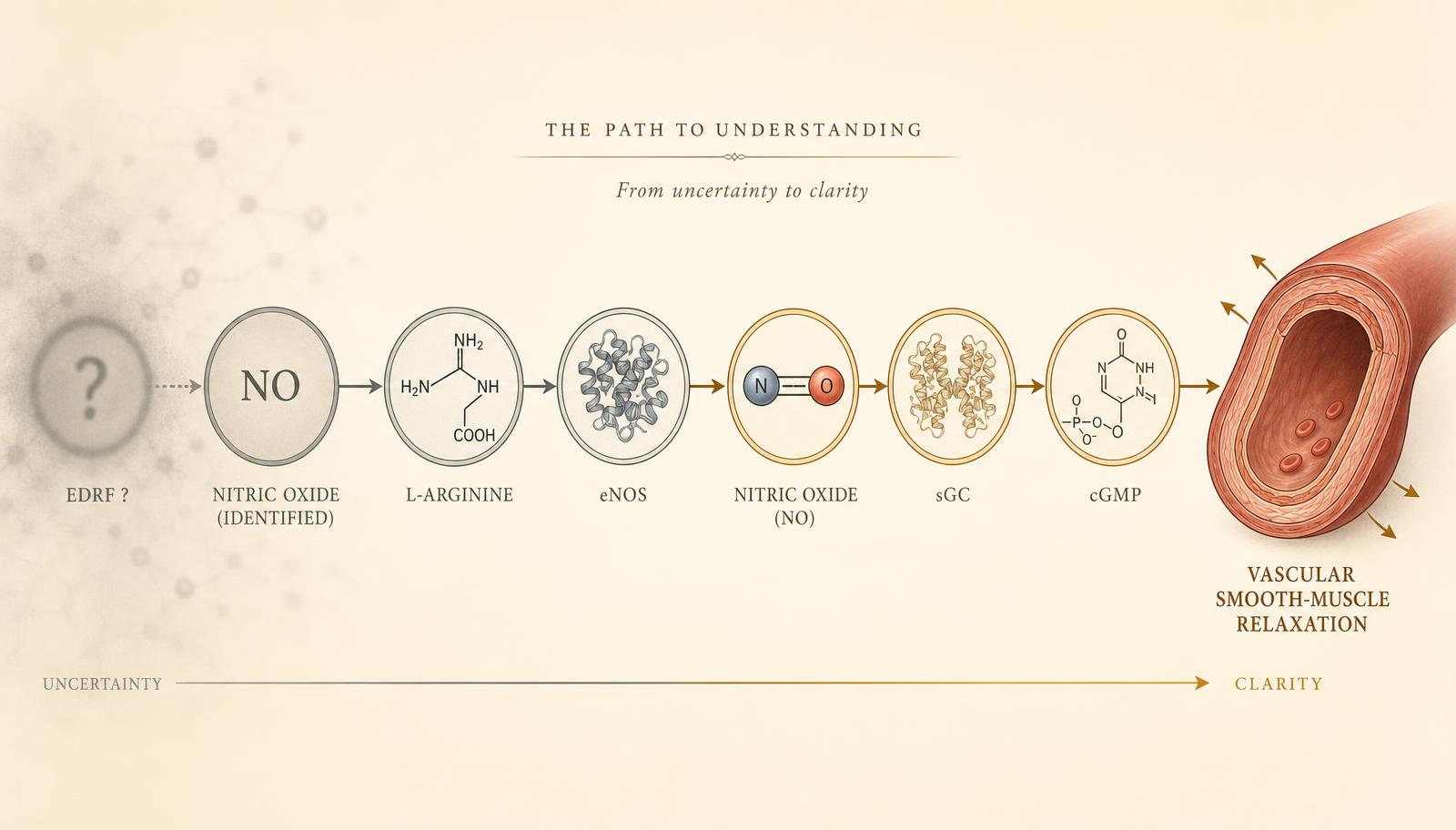
It is gaseous, highly diffusible and extremely short-lived. It does not need a conventional membrane receptor on the surface of the neighboring cell in order to begin its classic vascular signaling action. Instead, it can diffuse across membranes and activate soluble guanylate cyclase inside nearby smooth-muscle cells.
The Nobel Committee highlighted precisely this novelty: a gas produced by one cell could penetrate membranes and regulate another cell. That was a new biological paradigm. [1]
1988: Scientists Discover Where the Body Gets the Raw Material
Once researchers knew endothelial cells produced NO, another obvious question followed: what does the body make nitric oxide from?
Research by Richard Palmer, Salvador Moncada and colleagues established an important answer: L-arginine. In 1988, researchers demonstrated that vascular endothelial cells form nitric oxide from L-arginine, establishing arginine as the physiological precursor for endothelial NO production. [6]
Later work characterized the nitric-oxide-synthase enzyme family in much greater detail. For cardiovascular purposes, one member became particularly important: eNOS — endothelial nitric oxide synthase.
From EDRF to eNOS
Once the pathway was understood more completely, the endothelium was no longer simply viewed as a layer that happened to release EDRF. Scientists could describe an actual biochemical system.
1992: Nitric Oxide Becomes “Molecule of the Year”
By the early 1990s, nitric-oxide research was exploding. Researchers were discovering roles far beyond basic vascular relaxation — implications for vascular regulation, neuroscience, immune function, platelet biology and many other physiological systems.
In 1992, Science selected nitric oxide as its “Molecule of the Year.” [7] A molecule once regarded mainly as an atmospheric contaminant had become one of the hottest subjects in biomedical research.
The “Miracle Molecule”
The phrase “miracle molecule” is not a formal scientific classification. But it has become strongly associated with the extraordinary breadth of nitric-oxide biology. Louis Ignarro himself has used the description publicly, including a Lindau lecture titled “Nitric Oxide: the Miracle Molecule of Health and Longevity.”
The phrase works best when understood as enthusiasm for an extraordinary scientific discovery — not as permission to make miraculous health claims. Nitric oxide does not cure everything. And NO is not always beneficial simply because more is produced.
Different NOS enzymes produce NO in different tissues and circumstances, and excessively high or poorly regulated NO-related chemistry can also participate in harmful processes.
The real scientific wonder is subtler: one extraordinarily simple molecule participates in an astonishing variety of regulated biological signals. That is remarkable enough.
1998: The Nobel Prize
On October 12, 1998, the Nobel Assembly at Karolinska Institutet announced that the Nobel Prize in Physiology or Medicine would be shared by Robert F. Furchgott, Louis J. Ignarro and Ferid Murad for their discoveries concerning nitric oxide as a signaling molecule in the cardiovascular system. [1]
The award did not recognize a supplement. It did not recognize a particular diet. It did not establish nitric oxide as a cure for heart disease. What it recognized was much more fundamental: the discovery of a major biological signaling system operating inside the cardiovascular system.
That distinction is important. And it is precisely what gives modern NO research its credibility.
What Did the Nobel-Winning Science Actually Prove?
The word “proven” is often used too casually in wellness marketing. Here, however, there are several principles we can describe with considerable scientific confidence.
The endothelium is biologically active
It is not simply a passive lining. It produces and responds to signaling molecules that help regulate vascular behavior.
The human cardiovascular system produces nitric oxide
NO is an endogenous biological messenger — not merely a drug or environmental gas.
Endothelial NO participates in vascular relaxation
NO communicates with vascular smooth muscle through signaling involving soluble guanylate cyclase and cGMP.
L-arginine is a physiological precursor for endothelial NO
The body can synthesize NO enzymatically from L-arginine.
NO biology is highly regulated
Where NO is produced, how much, which NOS enzyme produces it and the surrounding biochemical environment all influence its effects.
Those principles are now part of mainstream cardiovascular physiology.
What the Nobel Prize Does NOT Prove
This is equally important for scientific credibility. The Nobel Prize does not prove that:
- Every “NO booster” works
- Every dose of arginine improves cardiovascular outcomes
- Every person needs an NO supplement
- More NO is always better
- Any particular commercial supplement has Nobel Prize validation
The Nobel-winning discoveries establish the physiology. Individual nutritional ingredients and formulations need to be considered on their own evidence. That distinction protects the integrity of both the science and responsible nutritional products.
The Discovery Changed the Way We Think About Heart Health
Traditional discussions of heart health understandably focused heavily on the heart itself. NO research helped strengthen a broader understanding: cardiovascular health is also vascular health.
The heart pumps into a living vascular network. Arteries need to respond. The microcirculation needs to distribute blood. The endothelial lining needs to communicate. Vascular smooth muscle needs to react to those signals. NO is one of the molecular messengers connecting those systems.
So the Nobel Prize was nominally about nitric oxide. But the deeper story was about a new way of understanding how the cardiovascular system communicates.
Nitric Oxide and Healthy Circulation
The significance becomes easy to appreciate during physical activity. Your leg muscles begin working. Their energy and oxygen requirements rise. Blood-flow patterns change. The heart increases output. Blood vessels supplying active tissue need to respond. Endothelial signaling participates in that adaptation.
That is why research on nitric oxide naturally connects to healthy blood flow, vascular responsiveness, exercise, arterial function and cardiovascular wellness.
The Science Became Even More Relevant as We Learned About Aging
Research performed after the Nobel-winning discoveries revealed another important pattern: endothelial NO bioavailability tends to decline with age. That does not mean NO production disappears. Instead, several aspects of the system can become less efficient.
- eNOS regulation can change
- Oxidative stress can increase
- NO can be destroyed more rapidly
- The important eNOS cofactor BH4 can become less available
- Arterial stiffness can increase
- Physical inactivity can further reduce healthy endothelial stimulation
This has made NO biology particularly relevant to cardiovascular research involving adults in their 50s, 60s and beyond. The historical discovery therefore became increasingly relevant to healthy aging, not merely laboratory pharmacology.
The Discovery of L-Arginine Opened a Nutritional Question
Once scientists established that endothelial cells make NO from L-arginine, an obvious nutritional question emerged: can nutritional substrate availability support this natural pathway?
The answer proved more complicated than simply “take more arginine.” Arginine is indeed the direct substrate used by eNOS. But oral arginine undergoes significant intestinal and hepatic metabolism. Researchers therefore became interested in another amino acid: L-citrulline.
Citrulline Added a Second Nutritional Route
Citrulline is not used by eNOS instead of arginine. Something more interesting happens. Oral L-citrulline is efficiently absorbed and can subsequently be converted into L-arginine.
This means nutrition can approach the arginine/eNOS system through two complementary routes. L-arginine provides the substrate directly. L-citrulline provides a route toward replenishing arginine availability.
Human research has demonstrated that the two behave differently metabolically, and a randomized human study found that 1 g L-arginine + 1 g L-citrulline raised plasma arginine more effectively than 2 g of either amino acid alone under the study conditions.
The nutritional science therefore evolved from the original NO discovery into increasingly sophisticated questions about how best to support the body's own pathway.
This Is Where the Story of ėNOS Begins
First, an explanation of the difference between ėNOS and eNOS.
- eNOS — endothelial nitric oxide synthase — is the naturally occurring endothelial enzyme involved in NO production
- ėNOS is a dietary supplement from Australiana Life
The name was chosen deliberately to reflect the connection between the physiological process and the product itself — but the distinction should always remain clear. ėNOS is a nutritional supplement formulated to support the body's natural nitric-oxide system.
ėNOS was formulated based on the research and findings related to the discovery of nitric oxide. It is not being presented here as though it was part of the original research, or endorsed by the Nobel laureates.
The connection is legitimate — and more interesting — than that. The established physiology discovered through decades of NO research provides the scientific rationale for the pathway ėNOS is designed to nutritionally support.
How ėNOS Relates to the Established Physiology
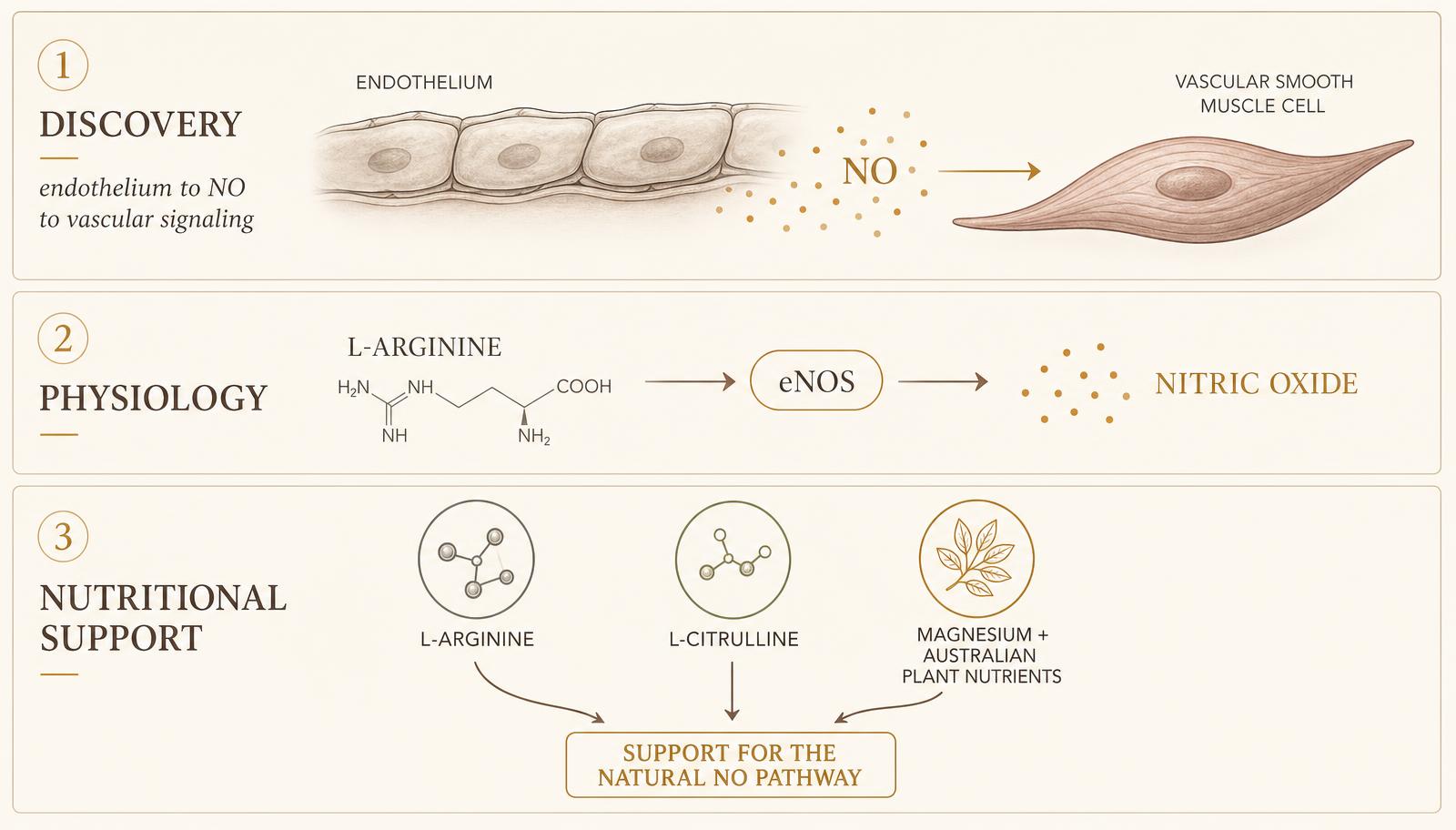
Start with the original pathway. Scientists established that endothelial NO can be produced from L-arginine. ėNOS supplies L-arginine — the direct physiological substrate relevant to the eNOS pathway.
But the formula does not stop there. It also contains L-citrulline, which provides a complementary route toward replenishing arginine availability. That combination reflects what subsequent nutritional research taught us about amino-acid metabolism.
In other words, the formulation follows the physiology:
- Provide the nutritional substrate
- Support it through complementary metabolic routes
- And allow the body's own regulated enzyme system to perform the biological work
That is very different from saying a supplement itself is nitric oxide.
Supporting Cardiovascular Wellness Requires More Than One Molecule
The Nobel-winning discoveries made NO famous. But they did not make every other aspect of cardiovascular nutrition irrelevant. Healthy cardiovascular physiology also depends upon normal muscle function, energy metabolism, electrolyte balance, healthy dietary patterns, physical activity, metabolic health and the broader nutritional environment.
That is why ėNOS includes supporting ingredients beyond arginine and citrulline. Magnesium, for example, plays important roles in normal muscle, nerve and metabolic physiology. Kakadu Plum and Davidson's Plum contribute plant-derived nutrients and phytonutrients to the broader formulation.
Their roles are different from those of arginine and citrulline. That is intentional. A good formula should not contain multiple ingredients simply pretending to do the same job.
A Modern Application of an Established Biological Principle
Decades of cardiovascular research established the importance of endogenous nitric-oxide signaling. Subsequent research identified nutritional substrates and metabolic relationships relevant to that system.
ėNOS uses those biological insights as the rationale for a nutritional formulation designed to support:
- Natural NO production
- Healthy circulation
- Vascular wellness
- Overall cardiovascular support
That is a strong connection precisely because it does not exaggerate what the history proves.
Why This Research Still Matters Today
The Nobel Prize was awarded in 1998. That does not make the science old. Foundational discoveries remain foundational. We do not dismiss DNA because its structure was described decades ago. We do not dismiss insulin biology because it was discovered in the twentieth century.
The importance of NO research has continued to expand because later scientists could build upon the central discovery that nitric oxide is a biological signaling molecule. Modern researchers now investigate NO in fields including:
- Vascular aging
- Exercise physiology
- Brain function
- Immune biology
- Mitochondrial signaling
- Oxidative stress
- The oral microbiome
- Dietary nitrate
- Arginine metabolism
- Endothelial dysfunction
A 2024 scientific review of nitric-oxide-synthase research still referred to NO as the “miracle molecule” because of its remarkably broad physiological role. The discovery was not the end of the field. It was the beginning.
Why the Nobel Prize Matters for Consumers
Consumers encounter health claims constantly. Some are supported by strong biological evidence. Some are based on preliminary findings. Others are primarily marketing.
The history of nitric oxide offers a useful benchmark for what genuine scientific authority looks like. It involved:
- Independent laboratories
- Reproducible experiments
- Decades of investigation
- Peer-reviewed publication
- Mechanistic evidence
- And eventually the highest scientific recognition
That does not mean every product associated with nitric oxide automatically inherits that evidence. But it does mean that the underlying biology of endogenous NO signaling is not a wellness fad. It is established cardiovascular science — and that provides a credible foundation from which to evaluate nutritional strategies intended to support the body's natural NO-production system.
From a Puzzling Artery to a Nobel Prize
The story is remarkable when reduced to its essentials.
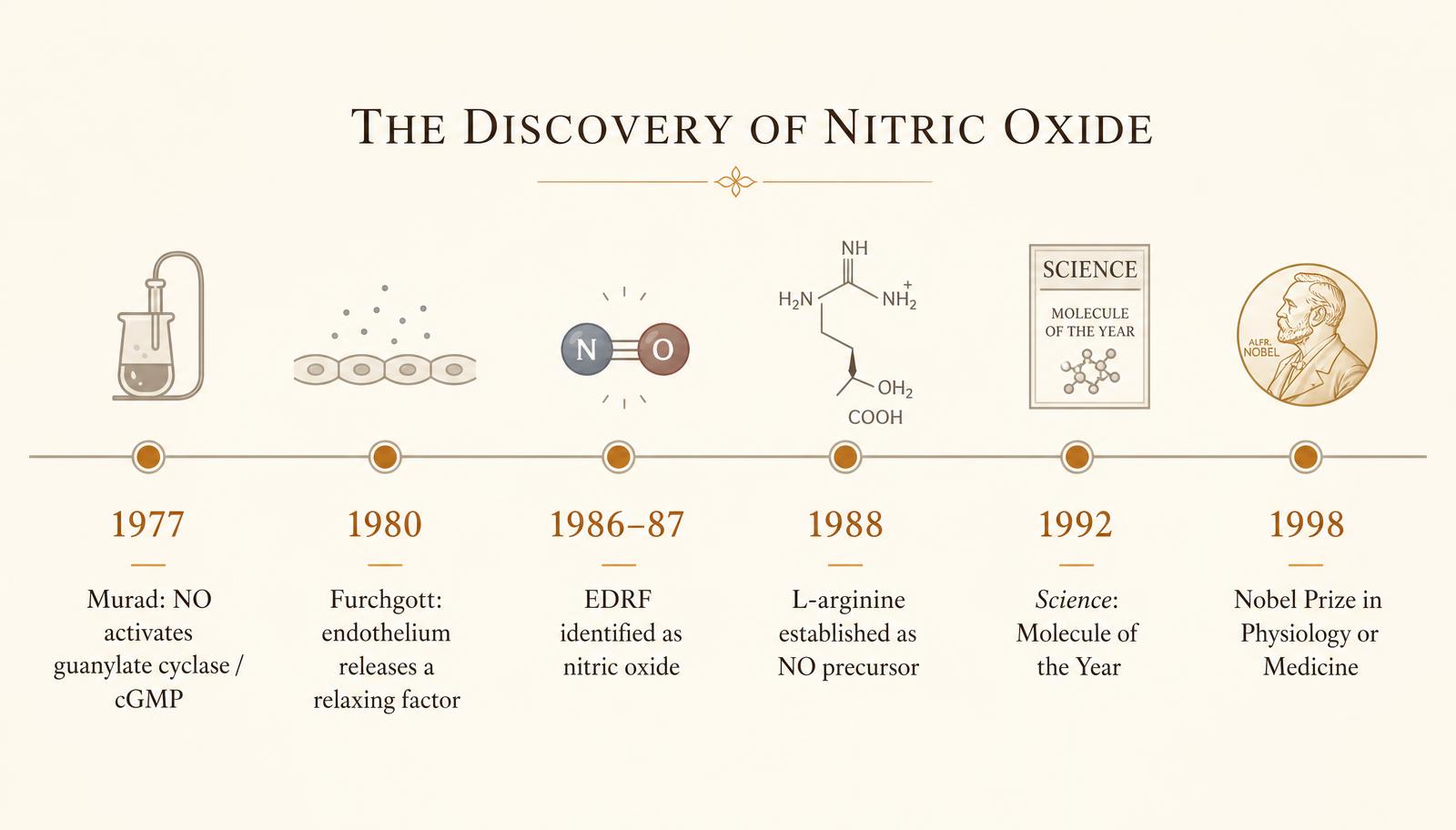
In 1977, researchers demonstrated that NO could activate cGMP signaling. In 1980, an unexpected observation showed that the endothelium released a relaxing factor. Scientists called it EDRF because they did not know what it was.
By 1986–87, converging experiments revealed the mysterious factor was nitric oxide. In 1988, researchers established L-arginine as a physiological precursor for endothelial NO. In 1992, Science named NO its Molecule of the Year. And in 1998, three scientists received the Nobel Prize for revealing nitric oxide as a cardiovascular signaling molecule.
What started as a laboratory mystery fundamentally changed cardiovascular biology.
Perhaps “Miracle Molecule” Isn't Such a Strange Name After All
Nitric oxide cannot perform miracles. Science should never require that kind of language. But consider what researchers discovered.
A molecule containing only two atoms, produced for only a short time, can move from one cell to another, change intracellular signaling, alter vascular smooth-muscle behavior and participate in the regulation of blood flow throughout the human body.
The cardiovascular system is not merely plumbing. It is a living communication network. Nitric oxide is one of its most important messages.
Scientific References
[1] The Nobel Prize in Physiology or Medicine 1998
Nobel Assembly at Karolinska Institutet. Robert F. Furchgott, Louis J. Ignarro and Ferid Murad were jointly awarded the prize for discoveries concerning nitric oxide as a signalling molecule in the cardiovascular system.
NobelPrize.org →[2] Nitric oxide activates guanylate cyclase and increases guanosine 3′:5′-cyclic monophosphate levels in various tissue preparations
Arnold WP, Mittal CK, Katsuki S, Murad F. Proceedings of the National Academy of Sciences. 1977;74(8):3203–3207. PMID: 20623.
PubMed / National Library of Medicine →[3] The obligatory role of endothelial cells in the relaxation of arterial smooth muscle by acetylcholine
Furchgott RF, Zawadzki JV. Nature. 1980;288:373–376. PMID: 6253831.
PubMed / National Library of Medicine →[4] Endothelium-derived relaxing factor produced and released from artery and vein is nitric oxide
Ignarro LJ, Buga GM, Wood KS, Byrns RE, Chaudhuri G. Proceedings of the National Academy of Sciences. 1987;84:9265–9269. PMID: 2827174.
PubMed / National Library of Medicine →[5] Nitric oxide release accounts for the biological activity of endothelium-derived relaxing factor
Palmer RMJ, Ferrige AG, Moncada S. Nature. 1987;327:524–526. PMID: 3495737.
PubMed / National Library of Medicine →[6] L-arginine is the physiological precursor for the formation of nitric oxide in endothelium-dependent relaxation
Palmer RM, Rees DD, Ashton DS, Moncada S. Biochemical and Biophysical Research Communications. 1988;153(3):1251–1256. PMID: 3390182.
PubMed / National Library of Medicine →[7] The Molecule of the Year
Koshland DE Jr. Science. 1992;258:1861. PMID: 1470903. Science magazine selected nitric oxide as its Molecule of the Year.
PubMed / National Library of Medicine →
Follow the Science Further
- What Is Nitric Oxide and Why Does It Matter? →
Start with the modern understanding of the molecule that emerged from these discoveries.
- What Is eNOS? The Enzyme Behind Natural Nitric Oxide Production →
Explore the enzyme responsible for one of the body's most important vascular NO pathways.
- The Endothelium: The Hidden Key to Healthy Blood Vessels →
See why Furchgott's discovery transformed our understanding of the blood-vessel lining.
- L-Arginine and Nitric Oxide Explained →
Follow the substrate scientists discovered was used to produce endothelial NO.
- Why Combine L-Arginine and L-Citrulline? →
See how later nutritional research built upon the original arginine/NO discovery.
NOBEL-RECOGNIZED PHYSIOLOGY — NUTRITIONAL SUPPORT TODAY
Decades of research established that the endothelium produces nitric oxide from L-arginine. ėNOS combines L-arginine + L-citrulline with deliberately selected supporting nutrients, including magnesium and Australian plant ingredients, to provide consistent nutritional support for the body's natural nitric-oxide system, healthy circulation and cardiovascular wellness.
EXPLORE ĖNOS →This article is provided for informational purposes only and is not intended as medical advice or to diagnose, treat, cure or prevent disease. The 1998 Nobel Prize recognized discoveries concerning nitric oxide biology and did not evaluate or endorse ėNOS or any dietary supplement. ėNOS is formulated to support the body's natural nitric-oxide system, healthy circulation and cardiovascular wellness and should complement, rather than replace, appropriate nutrition, physical activity, cardiovascular risk management or medical care.
More in Nitric Oxide Science
About Our Health & Science Content
Australiana Life Health & Science articles are based on published scientific research and written to make complex health and nitric oxide science easier to understand. Our educational content undergoes scientific review for accuracy and appropriate interpretation of the evidence and is updated as relevant scientific understanding evolves.