
Why Combine L-Arginine and L-Citrulline?
A Formulation Question With a Metabolic Answer
Why put L-arginine and L-citrulline together?
At first glance, it might seem unnecessary. L-arginine is already used by the body to produce nitric oxide. L-citrulline ultimately becomes arginine. So why not simply choose one?
The answer lies in what happens after you swallow them.
Arginine and citrulline do not travel through the body in the same way. They are absorbed differently. They encounter different metabolic pathways. And although they eventually converge on the same nitric-oxide system, they approach arginine availability from different directions.
That makes the combination scientifically more interesting than simply adding two similar amino acids to the same formula.
L-arginine provides the more direct substrate, while L-citrulline provides a complementary route for replenishing circulating arginine.
And importantly, this isn't only a theoretical idea. Human research has directly investigated the combination.
Start at the Destination
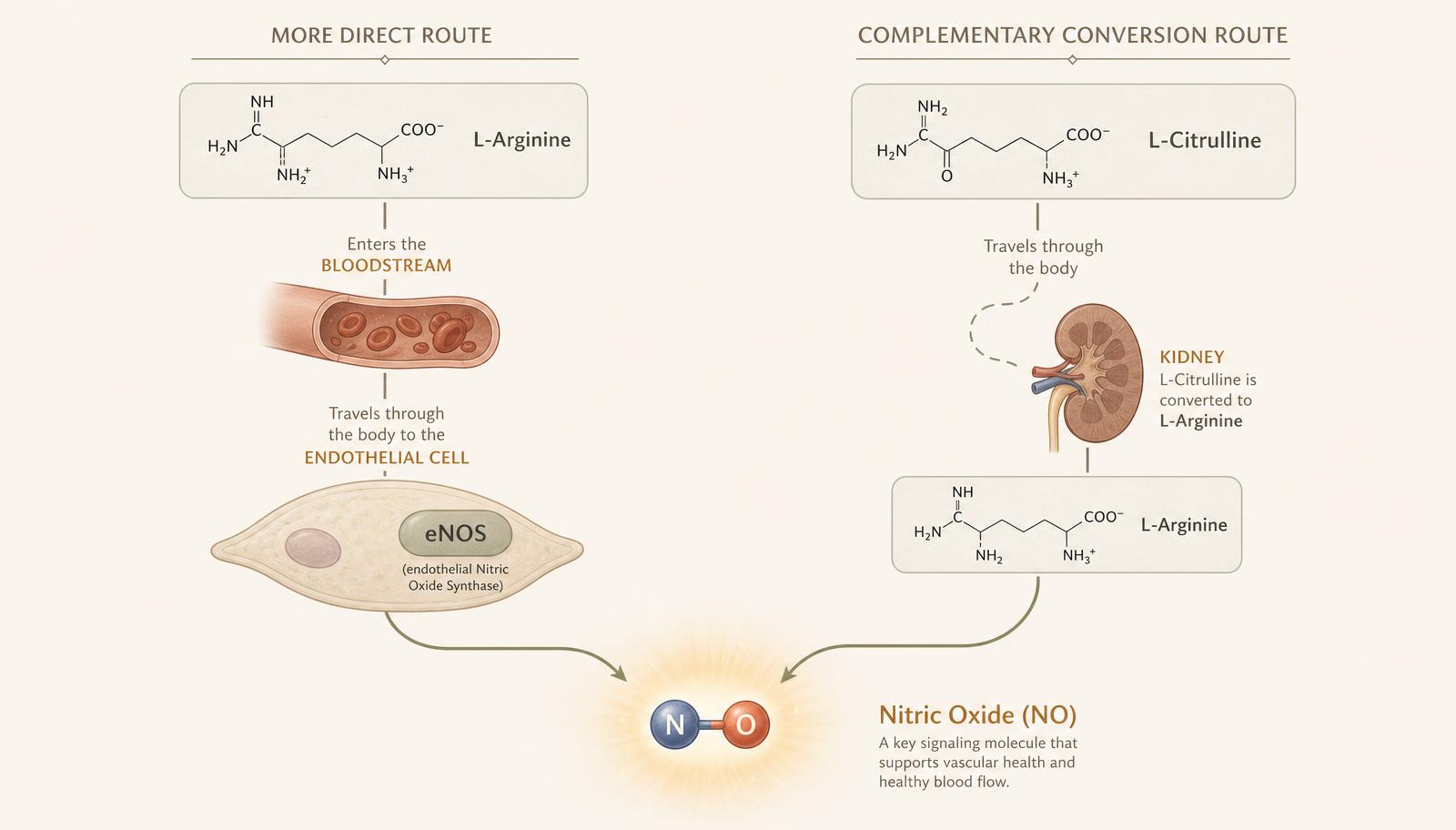
To understand why the pairing makes sense, start with what endothelial nitric oxide synthase actually needs. Inside the cells lining your blood vessels is an enzyme called eNOS — endothelial nitric oxide synthase. eNOS uses L-arginine as a substrate in the biochemical production of nitric oxide.
So if the goal is nutritional support for the endothelial NO pathway, arginine availability matters. But the next question is more interesting: what is the best way to make arginine available? That's where the two-amino-acid strategy begins.
What Happens When You Take L-Arginine?
L-arginine has an obvious advantage: it is already arginine. It does not first need to be converted from another amino acid before becoming substrate for nitric oxide synthase. After oral intake, plasma arginine can rise relatively quickly. Human pharmacokinetic studies have demonstrated this rapid increase. [1]
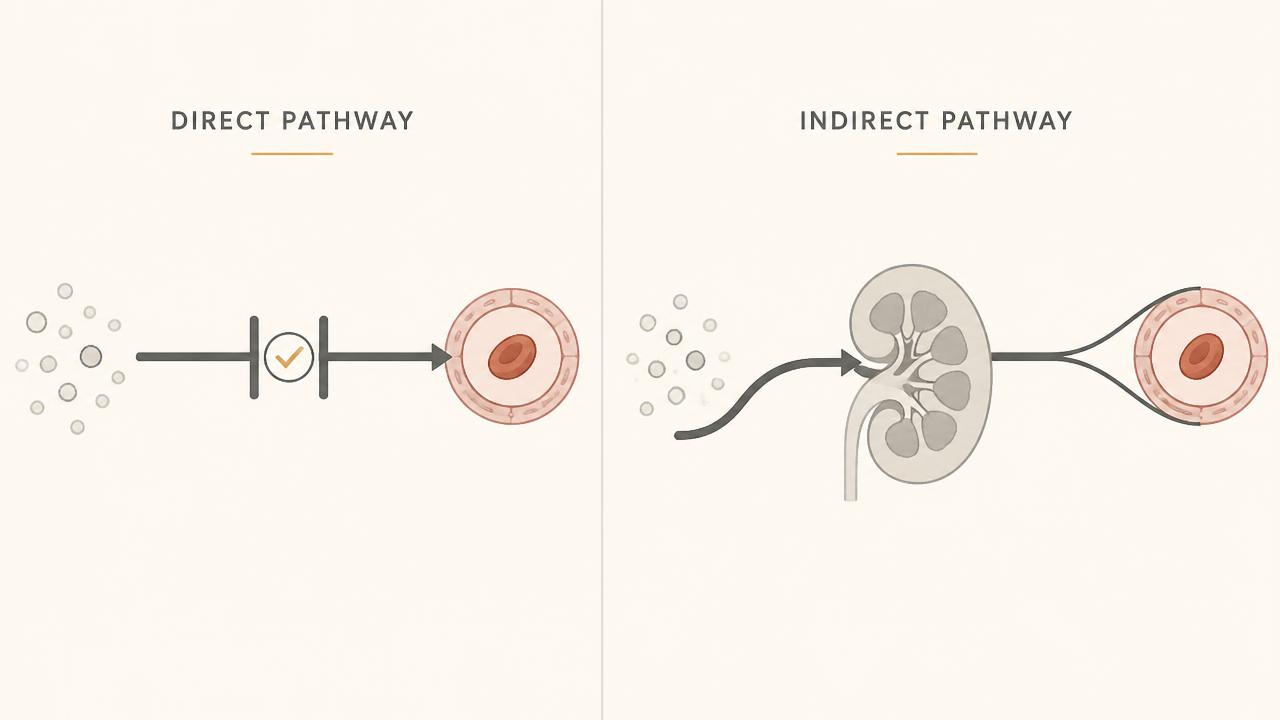
But oral arginine also faces an obstacle. A substantial portion encounters metabolism in the intestinal wall and liver before reaching the wider systemic circulation. This is known as presystemic — or first-pass — metabolism, and the enzyme arginase participates in this process.
So there is a distinction between the amount of arginine swallowed and the amount of arginine ultimately reaching systemic circulation.
Arginine provides the more direct route. But direct does not necessarily mean that every milligram gets through unchanged.
Citrulline Takes the Longer Route — but Avoids Some Traffic
L-citrulline behaves differently. After oral consumption, citrulline is efficiently absorbed and largely avoids the substantial intestinal and hepatic first-pass metabolism experienced by arginine. It enters systemic circulation, and the kidneys then play an important role in converting citrulline into L-arginine. [5]
Human studies confirm that oral citrulline can substantially increase circulating arginine. [1][2]
Here Is Where the Combination Gets Particularly Interesting
Researchers asked almost exactly the same question as the title of this article: what happens if you give arginine and citrulline together?
A human study published in Bioscience, Biotechnology, and Biochemistry compared three approaches in healthy men:
- 2 grams of L-arginine
- 2 grams of L-citrulline
- 1 gram L-arginine + 1 gram L-citrulline
The total amino-acid amount was the same. But the combination produced a particularly interesting result.
The 1 g + 1 g combination increased plasma L-arginine levels more effectively than 2 g of either L-arginine or L-citrulline alone.
That is an important finding. It suggests that combining the two amino acids can take advantage of their different absorption and metabolic characteristics rather than simply relying on a larger quantity of one. [2]
This is much stronger scientifically than saying "two ingredients must be better than one." The research provides an actual metabolic reason for the combination.
What Might Explain the Combination Effect?
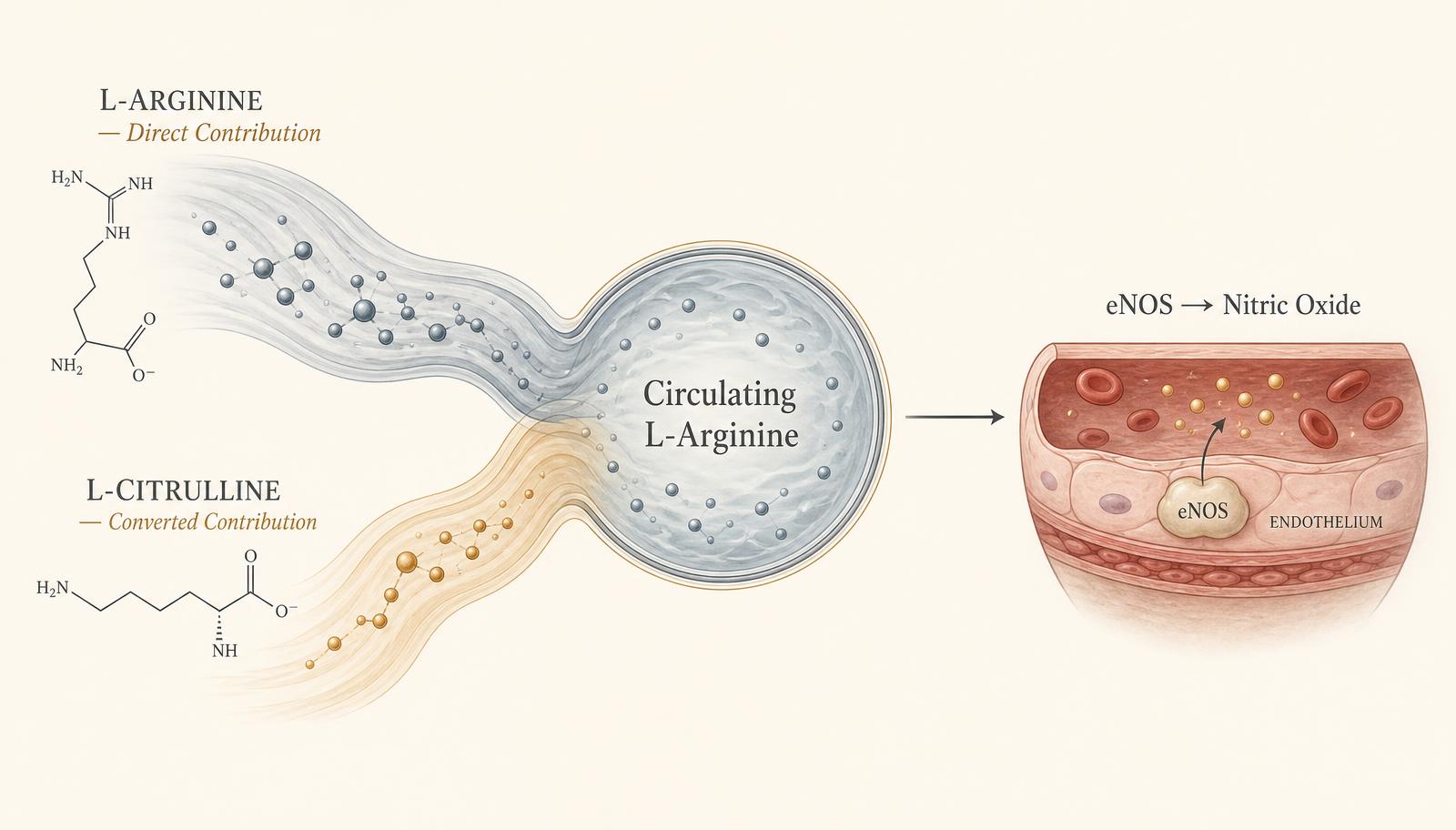
Think of two streams feeding the same reservoir.
Stream One: Oral Arginine
- Provides arginine directly.
- Some is metabolized before entering systemic circulation.
- What gets through contributes relatively promptly to circulating arginine.
Stream Two: Oral Citrulline
- Avoids much of that first-pass arginine metabolism.
- Enters circulation and can subsequently be converted into additional arginine.
Both streams therefore contribute toward circulating arginine availability. But they arrive differently. That difference creates the possibility that combining them can produce an arginine profile that neither achieves in quite the same way by itself.
Direct Availability + Replenishing Availability
L-Arginine
Provides more direct substrate availability.
L-Citrulline
Provides a replenishing route to arginine through endogenous conversion.
Together: direct availability + replenishing availability. That is a more accurate description than "fast NO + slow NO." Neither amino acid is a timed-release form of nitric oxide. What differs is how and when arginine becomes available to the body's NO-production machinery. That distinction matters scientifically.
What Does the Timing Research Show?
A randomized, double-blind human pharmacokinetic study compared oral arginine with multiple doses of citrulline. Immediate-release arginine produced a relatively rapid peak in circulating arginine. Citrulline subsequently raised plasma arginine through its conversion pathway and, at higher doses, increased minimum circulating arginine concentrations as well. [1]
The researchers concluded that oral citrulline can increase plasma arginine and augment NO-dependent signaling. This provides a useful biological framework:
- Arginine can contribute earlier substrate availability.
- Citrulline can contribute additional arginine through subsequent metabolism.
That is the basis for describing the pair as offering complementary timing and metabolic support.
Does the Combination Affect Nitric-Oxide Biology?
There is supporting evidence, but the details matter.
A 2014 experimental study compared L-arginine, L-citrulline and a combination of the two. The combination produced a more rapid increase in plasma arginine and stronger increases in markers associated with NO bioavailability and cGMP signaling than either amino acid alone at the tested amounts. [3]
However, this particular study was conducted in animals, not humans. That distinction needs to be made clearly.
The human evidence is strongest for the combination's effect on plasma arginine availability, while the animal research provides additional mechanistic support for the NO hypothesis.
There Is Human Performance Research Too
In a randomized, double-blind crossover trial involving 24 male collegiate soccer players, participants consumed both L-citrulline and L-arginine for seven days. The combination was associated with higher plasma arginine and NO metabolites and a modest improvement in 10-minute cycling power compared with placebo. [4]
The study is interesting because it demonstrates that the combination can influence relevant biology in humans. But it should not be interpreted as proving that everyone who combines arginine and citrulline will exercise better. The participants were young, male, trained soccer players, and the study examined a specific exercise protocol. Scientific results should always be interpreted within the population actually studied.
Why Not Just Take More Arginine?
If arginine is what eNOS uses, perhaps the simplest strategy would be to add more arginine. But more oral arginine means more substrate also encounters intestinal and hepatic metabolism. At some point, simply increasing quantity does not address the metabolic limitation.
Citrulline approaches the problem differently. Instead of adding more of the same substrate through the same route, it provides a different route toward the same substrate. That is the central logic of the combination.
Why Not Just Take Citrulline?
Citrulline is remarkably effective at increasing circulating arginine. In the Schwedhelm human trial, oral citrulline increased plasma arginine exposure more effectively than oral arginine under the tested conditions. [1]
So why include arginine at all? Because citrulline still has to undergo conversion. Arginine is already the substrate used by nitric oxide synthase. Combining them allows one source to contribute arginine directly, while the other contributes through subsequent endogenous synthesis — and the human combination study suggests that this can be metabolically useful. [2]
This Is Complementarity — Not Duplication
Ingredient labels can be misleading. Sometimes two ingredients appear together simply because they are both popular. That is not necessarily synergy. For two ingredients to be meaningfully complementary, there should be some logical relationship between them.
Arginine and citrulline have exactly that relationship. They are chemically related, metabolically connected, and handled differently by the body.
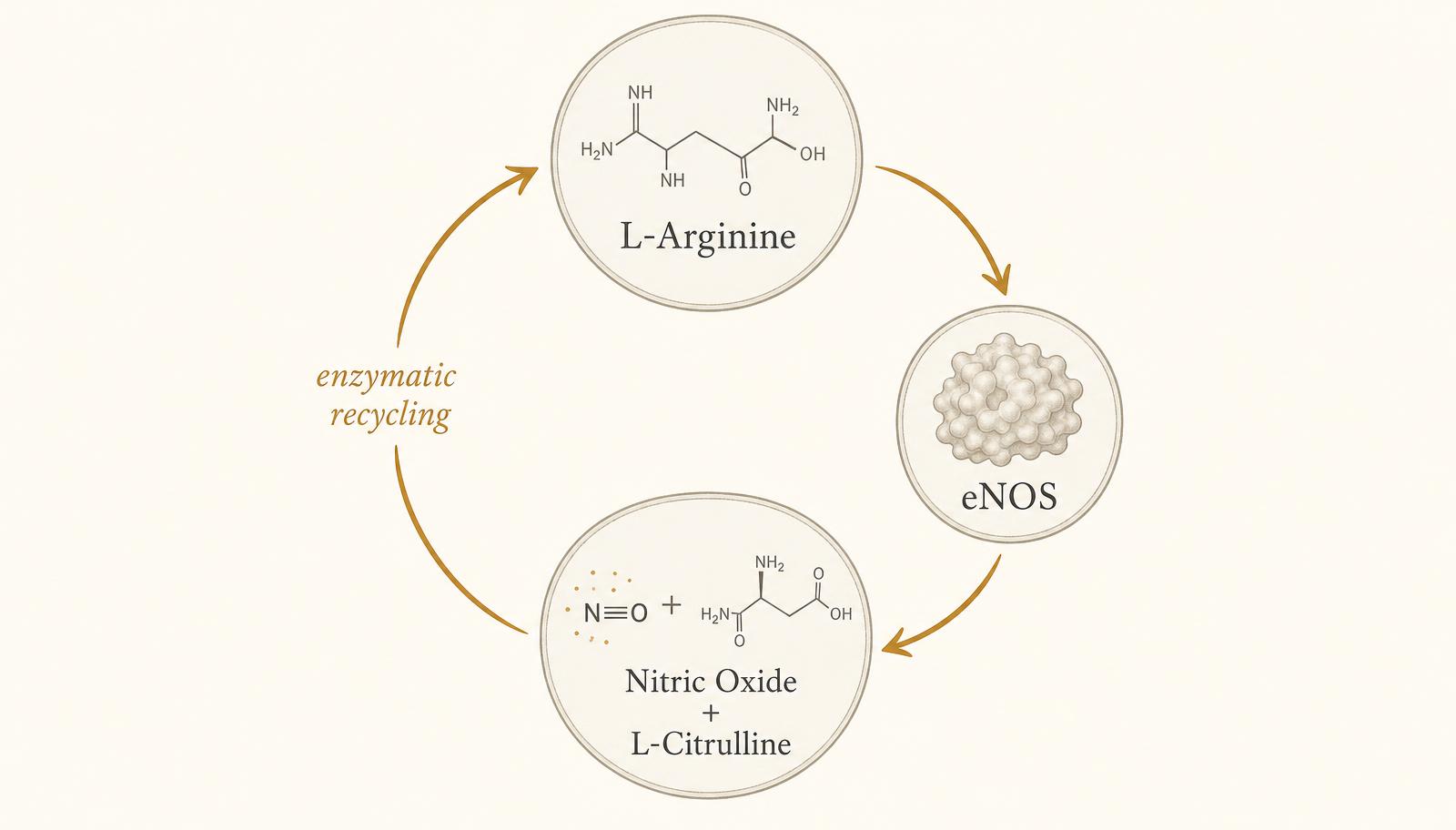
Citrulline can become arginine. Arginine can become nitric oxide and citrulline through nitric oxide synthase. Citrulline can then participate in arginine regeneration. They belong to the same metabolic story.
Does the Ratio Matter?
Potentially. This is where formulation becomes more sophisticated than simply checking whether both ingredients appear on a label. Because arginine and citrulline differ in absorption, metabolism, conversion and pharmacokinetic characteristics, the relative amounts provided can influence the resulting arginine exposure.
Human studies have tested particular combinations and ratios, but the research does not establish one universally optimal arginine-to-citrulline ratio for every person and every outcome. So it would be inappropriate to claim there is one scientifically proven "perfect ratio."
What can be said is this: the ratio is a meaningful formulation consideration because the ingredients do not behave identically.
A deliberately formulated combination is therefore conceptually different from simply sprinkling small amounts of both amino acids into a long ingredient list.
Meaningful Amounts Matter Too
Seeing L-arginine and L-citrulline on an ingredient panel does not tell the entire story. Amino-acid research commonly investigates amounts measured in grams. When evaluating a formula, useful questions include:
- How much is actually present?
- Are the amounts disclosed?
- Was the combination chosen for a defined metabolic reason?
- Does the formulation reflect the different roles of the ingredients?
Ingredient count by itself tells us very little. Biological rationale and meaningful amounts tell us much more.
A Pairing Designed Around What the Body Does Next
When someone swallows a supplement, the story doesn't end at the ingredient label. It begins there.
The digestive system gets involved. The liver gets involved. The kidneys get involved. Transport systems get involved. Enzymes get involved. The endothelium gets involved.
So a thoughtfully designed nutritional formulation should ask: what will the body actually do with these ingredients after they are consumed? For arginine and citrulline, that question leads naturally toward combination.
Why This Relationship Is Central to ėNOS
The complementary metabolism of L-arginine + L-citrulline is a central part of the formulation philosophy behind ėNOS by Australiana Life. ėNOS deliberately includes both amino acids rather than relying upon arginine alone. The scientific rationale is straightforward.
L-Arginine
Provides substrate in the form directly used by endothelial nitric oxide synthase.
L-Citrulline
Provides a complementary metabolic route that can help replenish circulating L-arginine.
Together, they allow nutritional support to approach arginine availability through two different metabolic entry points — supporting the concept behind ėNOS of providing more immediate + more sustained nutritional support for the substrate used in natural nitric-oxide production.
Importantly, that does not mean ėNOS artificially forces nitric-oxide production or continuously dilates blood vessels. The body retains control of eNOS activity and vascular signaling. The benefit is more fundamental: ėNOS provides thoughtfully selected nutritional building blocks that support the body's own natural NO-production system. That is one of the important ways the formulation differs from an arginine-only approach.
The Difference Between a Combination and a Collection
A formula can contain many ingredients. That does not automatically make it sophisticated.
A collection says: "These ingredients are all associated with cardiovascular health." A formulation asks: "How do these ingredients relate biologically, how are they metabolized, and why are they being used together?"
L-arginine and L-citrulline provide a particularly good example. One is the direct substrate. The other is an efficient precursor. They have different pharmacokinetics. They converge on the same metabolic system. And human research has demonstrated that combining them can increase circulating arginine more effectively than the same total amount of either alone under the conditions studied. [2]
That's a formulation story. Not simply an ingredient story.
The Case for Using Both
Can the body make nitric oxide from arginine? Yes. Can citrulline raise circulating arginine? Yes. Is there a rational reason to use both together? The evidence says there is.
Not because more ingredients automatically means better. Not because two amino acids guarantee a particular health outcome. But because:
- they are absorbed differently
- they are metabolized differently
- they contribute to arginine availability differently
- and human research demonstrates that the combination can produce a particularly effective increase in circulating arginine
The value of the combination lies precisely in the fact that arginine and citrulline are different.
Scientific References
[1] Pharmacokinetic and pharmacodynamic properties of oral L-citrulline and L-arginine: impact on nitric oxide metabolism
Schwedhelm E, Maas R, Freese R, et al. British Journal of Clinical Pharmacology. 2008;65(1):51–59. PMID: 17662090. Randomized, double-blind, placebo-controlled crossover study showing that oral citrulline increased circulating arginine and markers of NO-dependent signaling, while demonstrating important pharmacokinetic differences between citrulline and arginine.
PubMed / National Library of Medicine →[2] The effects on plasma L-arginine levels of combined oral L-citrulline and L-arginine supplementation in healthy males
Suzuki T, Morita M, Hayashi T, Kamimura A. Bioscience, Biotechnology, and Biochemistry. 2017;81(2):372–375. PMID: 27667025. DOI: 10.1080/09168451.2016.1230007. Human study finding that 1 g L-citrulline + 1 g L-arginine increased plasma L-arginine more effectively than 2 g of either amino acid alone under the study conditions.
PubMed / National Library of Medicine →[3] Oral supplementation with a combination of L-citrulline and L-arginine rapidly increases plasma L-arginine concentration and enhances NO bioavailability
Morita M, Hayashi T, Ochiai M, et al. Biochemical and Biophysical Research Communications. 2014;454(1):53–57. PMID: 25445598. DOI: 10.1016/j.bbrc.2014.10.029. Experimental animal study showing that the combination produced a rapid increase in plasma arginine and enhanced NO-related markers compared with the individual amino acids under the tested conditions.
PubMed / National Library of Medicine →[4] A combination of oral L-citrulline and L-arginine improved 10-min full-power cycling test performance in male collegiate soccer players: a randomized crossover trial
Suzuki T, et al. European Journal of Applied Physiology. 2019. PMID: 30847640. Randomized human crossover study in 24 male collegiate soccer players reporting higher arginine and NO metabolites and a modest improvement in cycling performance following combined supplementation compared with placebo.
PubMed / National Library of Medicine →[5] L-Citrulline Supplementation: Impact on Cardiometabolic Health
Allerton TD, Proctor DN, Stephens JM, Dugas TR, Spielmann G, Irving BA. Nutrients. 2018;10(7):921. PMID: 30029482. Review of citrulline absorption, arginine metabolism and the physiological rationale for using citrulline to increase systemic arginine availability.
PubMed / National Library of Medicine →
Related Ingredient Science
- L-Arginine and Nitric Oxide Explained →
Follow the direct substrate from ingestion to endothelial nitric-oxide production.
- L-Citrulline Explained: From Citrulline to Arginine to Nitric Oxide →
Explore the complementary conversion pathway through the kidneys.
- Arginine vs Citrulline: What's the Difference? →
Compare their individual strengths, metabolism and bioavailability.
- What Is eNOS? The Enzyme Behind Natural Nitric Oxide Production →
See exactly where the two amino-acid pathways ultimately converge.
- How Your Body Makes Nitric Oxide →
Step back and explore the entire NO-production system.
DISCOVER THE FORMULATION SCIENCE BEHIND ĖNOS
Two ingredients. One deliberate strategy. ėNOS combines L-arginine + L-citrulline because their different metabolic characteristics allow them to support arginine availability through complementary routes.
EXPLORE ĖNOS →This article is provided for informational purposes only and is not intended as medical advice or to diagnose, treat, cure or prevent disease. Human studies demonstrate that combined L-arginine and L-citrulline can influence circulating arginine availability, but individual physiological responses and health outcomes vary. ėNOS is a dietary supplement formulated to support the body's natural nitric-oxide system, healthy circulation and cardiovascular wellness. Dietary supplements should complement, rather than replace, appropriate nutrition, physical activity and medical care.
More in Nutrition & NO Support
- How to Increase Nitric Oxide Naturally
- Foods That Support Natural Nitric Oxide Production
- L-Arginine + L-Citrulline: Two Pathways Supporting Nitric Oxide
- Arginine vs. Citrulline: What's the Difference?
- L-Citrulline Explained: From Citrulline to Arginine to Nitric Oxide
- L-Arginine & Nitric Oxide Explained
- Dietary Nitrates & the Nitrate–Nitrite–Nitric Oxide Pathway
- Nitric Oxide Supplements: What Should You Look For?
About Our Health & Science Content
Australiana Life Health & Science articles are based on published scientific research and written to make complex health and nitric oxide science easier to understand. Our educational content undergoes scientific review for accuracy and appropriate interpretation of the evidence and is updated as relevant scientific understanding evolves.