
Nitric Oxide Supplements: What Should You Look For?
A Practical Guide to Ingredients, Doses, Formulation Logic and Claims
Search for a nitric oxide supplement and you'll find an enormous range of products.
Powders. Capsules. Beetroot formulas. Arginine products. Citrulline products. "NO boosters." Pre-workouts. Cardiovascular formulas with dozens of ingredients.
Some focus on exercise. Some focus on circulation. Some promise energy, pumps, endurance, heart health or nearly everything at once.
So how do you tell which formula actually makes sense? Start with one important fact:
Most nitric oxide supplements do not contain nitric oxide itself. They contain nutrients intended to support one or more of the biological pathways your body uses to produce NO.
That means the best way to evaluate an NO supplement isn't by counting ingredients. It's by asking: does this formula make biological sense?
Start Here: What Pathway Is the Product Trying to Support?
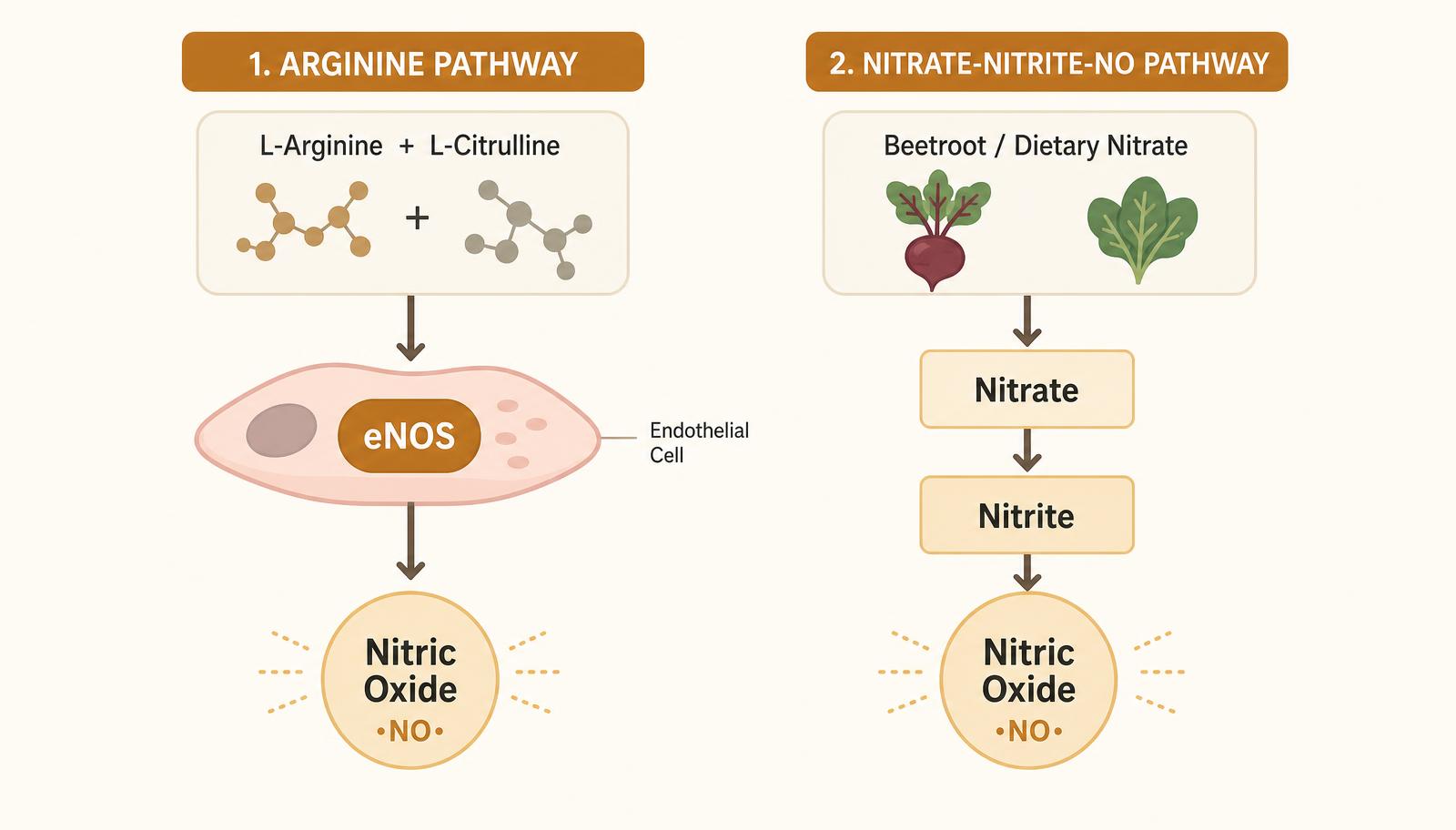
There are two major nutritional routes commonly used in nitric-oxide supplementation.
Route 1 — The Arginine / eNOS Pathway
The endothelial enzyme eNOS — endothelial nitric oxide synthase — uses L-arginine as substrate to produce nitric oxide. [6]
L-citrulline can also support this route because the body can convert citrulline into arginine. [3] So ingredients associated with this strategy include L-arginine and L-citrulline.
Route 2 — The Nitrate / Nitrite / NO Pathway
Certain vegetables naturally contain inorganic nitrate. The body can convert it in sequence:
Beetroot and leafy green vegetables are well-known dietary nitrate sources. [5] So some supplements use beetroot powder, beetroot extract or standardized dietary nitrate to approach NO production through this alternative pathway. [4]
Both strategies have legitimate biological foundations. They are not identical.
Question #1: Does It Contain Ingredients That Actually Relate to NO Biology?
This sounds obvious. It isn't.
Some formulas contain very long ingredient lists filled with plant powders, vitamins, minerals, antioxidants, herbs, fruit extracts and miscellaneous "superfoods." Some of those ingredients may have nutritional value. But having 30, 40 or 50 ingredients does not automatically make a formula better at supporting nitric oxide.
For NO-specific nutrition, the most logically connected ingredients usually fall into a few categories:
- Direct substrate — L-arginine.
- Arginine precursor — L-citrulline.
- Dietary nitrate sources — beetroot or standardized nitrate-containing ingredients.
- Supporting nutrients — chosen to complement endothelial, metabolic or antioxidant nutrition.
The key is understanding why each ingredient is there.
Question #2: Is L-Arginine Included?
L-arginine is important because it is the amino acid used directly by nitric oxide synthase. Within endothelial cells, arginine is converted by eNOS into nitric oxide, which makes it biologically central to the classical NO pathway. [6]
But oral arginine also undergoes significant metabolism in the intestinal wall and liver before all of it can reach systemic circulation. [1] So simply seeing "L-Arginine" on the label does not tell you everything. You should also ask:
- How much is present?
- Is the amount disclosed?
- Is arginine being used alone or as part of a complementary strategy?
Question #3: Is L-Citrulline Included?
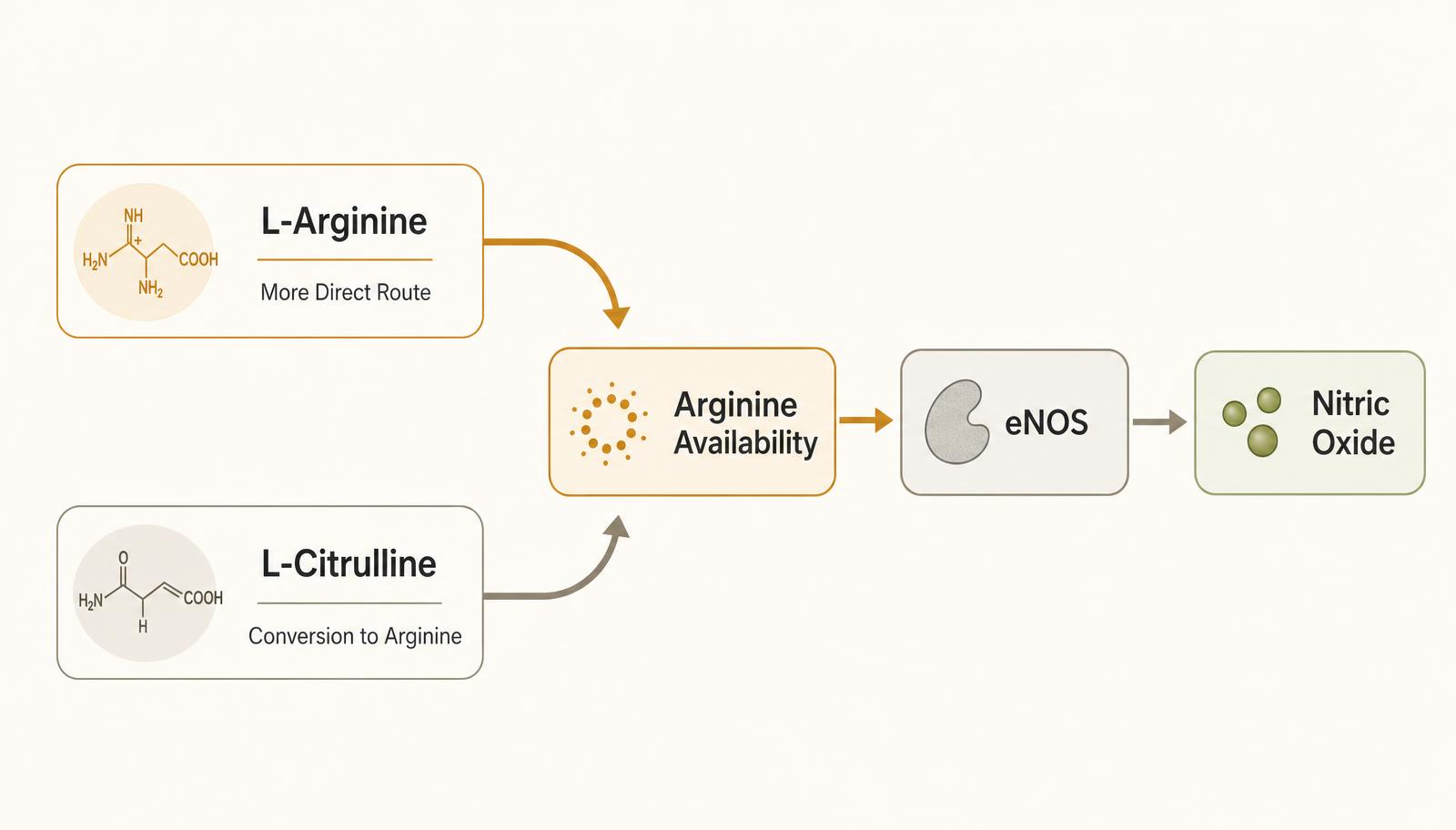
Citrulline approaches the same system differently. After absorption, L-citrulline largely avoids the extensive first-pass metabolism experienced by oral arginine. It can then be converted into L-arginine, importantly through renal metabolism. [3]
Human studies have shown that oral citrulline can effectively increase circulating arginine availability. [1][2] That makes citrulline particularly interesting in an NO formulation.
L-Arginine
Already is the substrate.
L-Citrulline
Helps the body produce more of that substrate.
The two are not redundant. They are metabolically complementary.
Question #4: Why Might a Formula Use Both?
This is one of the better questions you can ask when comparing nitric-oxide supplements. Human research has directly compared 2 g L-arginine, 2 g L-citrulline, and 1 g L-arginine + 1 g L-citrulline.
In that study, the combination produced a greater increase in plasma L-arginine than the same total amount of either amino acid alone.
That does not prove that every combination formula produces better clinical outcomes. But it gives a legitimate metabolic reason for using both. [2]
A thoughtfully designed arginine + citrulline formula can therefore approach substrate availability through more direct arginine availability plus a complementary replenishing route.
Question #5: Are the Amounts Actually Disclosed?
This may be one of the most important things on the entire label. Imagine two products.
Product A
Lists L-arginine, L-citrulline, beetroot, pomegranate, vitamin C, magnesium, ten plant extracts and twenty fruit and vegetable powders — but everything sits inside a "Proprietary Cardiovascular Matrix — 2,000 mg." You don't know how much of each ingredient is present.
Product B
Clearly tells you how much arginine, citrulline and every major active ingredient it provides.
Which one lets you make a more informed decision? Product B. Research is generally conducted using measurable amounts. A formula cannot meaningfully claim to be "science-based" if you have no way of knowing whether the researched ingredients are present in meaningful quantities.
Ingredient Count Is Not Dose
This deserves its own rule. Fifty ingredients do not automatically beat ten. If a formula contains dozens of ingredients inside a relatively small serving, basic arithmetic begins to matter. Some may necessarily be present only in very small amounts.
That doesn't mean those ingredients have no nutritional value. It means that simply listing them creates no guarantee that each is present in an amount comparable to amounts used in published research.
Ask less "how many ingredients does it contain?" and more "why are these ingredients present, and are the important ones supplied in meaningful amounts?"
Question #6: Is the Formula Designed Around a Pathway — or Around a Marketing List?
A good formulation should tell a biological story. For example:
- Arginine provides substrate.
- Citrulline replenishes arginine.
- Additional nutrients support the broader nutritional environment.
That is a coherent rationale. Compare it with "contains 47 exotic vegetables, superfruits and botanicals." That may sound impressive, but ingredient quantity is not the same as formulation quality.
A sophisticated formula is not necessarily the one with the longest label. It is the one in which you can explain what each major ingredient is intended to contribute, and how the ingredients relate to one another.
Question #7: If It Uses Beetroot, Does the Label Tell You About Nitrate?
Beetroot is frequently marketed as though the words "beetroot powder" automatically tell you how much dietary nitrate you're getting. They don't. Natural nitrate levels can vary considerably according to:
- plant variety
- growing conditions
- processing
- storage
- ingredient preparation
If a product's primary NO strategy is dietary nitrate, it is useful to know whether nitrate content is standardized or quantified. A large quantity of beetroot powder is not necessarily identical to a known quantity of nitrate — and that distinction matters when comparing product claims with research using standardized nitrate doses. [5]
Question #8: Powder or Capsules?
The form itself does not determine whether an NO product works. Both can deliver nutrients. But practical considerations matter.
Amino acids are often used in gram-level amounts in published research. Delivering several grams through capsules can require numerous capsules. Powdered drink formats can make gram-level amino-acid quantities more practical.
There are also lifestyle differences. Some people prefer capsules. Others prefer mixing a drink into their daily routine. The better format is one that can provide the intended ingredient amounts and that you can use consistently. Consistency is far more important than having the most complicated delivery format.
Question #9: Does the Product Promise Too Much?
Be skeptical when an NO supplement claims to:
- "unclog arteries"
- "reverse arterial aging"
- "prevent heart attacks"
- "cure erectile dysfunction"
- "eliminate brain fog"
- "instantly increase oxygen throughout your body"
Those are not reasonable dietary-supplement claims. Nitric oxide has important biological functions, but that does not make an NO supplement a treatment for cardiovascular, neurological or sexual disease.
More credible language focuses on:
- supporting natural nitric-oxide production
- supporting healthy circulation
- supporting normal vascular function
- supporting an active lifestyle
- providing nutritional ingredients involved in established NO pathways
The restraint is a positive sign.
Question #10: Does the Brand Explain the Science Correctly?
Here is a simple test. If a company says "citrulline slowly releases nitric oxide all day," that is an oversimplification. Citrulline does not literally function as a slow-release NO capsule.
A more accurate explanation is that citrulline can be converted into arginine, helping replenish the substrate from which NOS enzymes can subsequently produce nitric oxide. [3]
Likewise, arginine is not nitric oxide — it is a substrate for NO synthesis. And beetroot isn't NO; its nitrate can enter the nitrate → nitrite → NO pathway. [4]
Brands that explain these distinctions correctly demonstrate a deeper understanding of the physiology underlying their formulas.
Question #11: Is "More NO" Always Better?
No. Nitric oxide is a signaling molecule. Your body regulates when and where it is produced.
The objective is not to maintain every blood vessel at maximum dilation, nor to produce as much NO as physically possible. Normal NO biology depends upon location, timing, enzyme activity, vascular demand, redox balance and numerous regulatory systems. [6]
A credible NO supplement should be positioned as supporting the body's natural regulated pathways, not overwhelming them.
A 60-Second Label Test
Pick up an NO supplement and ask these seven questions:
| Question | What You Want to See |
|---|---|
| 1. What's the NO pathway? | Clear arginine/citrulline or nitrate rationale |
| 2. Are major actives disclosed? | Actual amounts, not only a proprietary blend |
| 3. Why is each major ingredient there? | Logical biological purpose |
| 4. Are arginine and citrulline used intelligently? | Complementary rather than redundant positioning |
| 5. If nitrate is central, is it quantified? | Preferably known or standardized nitrate |
| 6. Do the claims match the evidence? | Support language rather than disease-treatment promises |
| 7. Can you actually take it consistently? | Practical serving format and routine |
If a product cannot answer these questions, an impressive label may not mean very much.
What About Vitamins, Minerals and Plant Ingredients?
These can make sense. But they should have a reason for being included.
NO production happens inside a broader biological environment. Endothelial health is influenced by oxidative stress, metabolic health, diet, physical activity, micronutrient status and other factors. So a formulation may reasonably include additional vitamins, minerals or botanical ingredients that complement its broader cardiovascular-wellness strategy.
The important issue is not whether the product contains extras. It's whether those extras are deliberately chosen. A supporting ingredient should support the formula's purpose — not merely make the ingredient panel longer.
What About Antioxidants?
Nitric oxide and oxidative biology interact closely. Reactive oxygen species such as superoxide can react with NO and reduce its biological availability. [6] That gives antioxidant nutrition a legitimate connection to NO biology.
But the term "antioxidant" is extremely broad. Simply adding tiny amounts of many antioxidant-containing fruits or vegetables does not automatically demonstrate a meaningful physiological effect. A better formulation philosophy is to choose ingredients intentionally and keep claims proportional to the evidence. Whole-food plant intake remains an important foundation regardless of supplementation.
Are Australian Superfruits Relevant?
They can be — provided their role is explained correctly. Fruits such as Kakadu Plum and Davidson's Plum contain naturally occurring plant compounds relevant to broader antioxidant and phytonutrient nutrition.
They should not be described as though they directly manufacture nitric oxide in the same way that arginine supplies substrate or nitrate participates in the nitrate pathway. Their role is better understood as part of the broader nutritional environment surrounding cardiovascular wellness. That is a more credible and useful reason to include them.
Does Timing Matter?
Potentially. Different ingredients have different pharmacokinetics.
- Arginine can produce a relatively rapid increase in plasma arginine.
- Citrulline must first be absorbed and converted toward arginine.
- Dietary nitrate follows its own sequence involving absorption, salivary recycling, oral bacteria and nitrite formation.
So different formulas may use different timing strategies. [1][4] But consumers should be cautious about claims suggesting precision such as "take this and your NO peaks exactly 37 minutes later." Human metabolism varies. For general cardiovascular nutritional support, consistent use can be more relevant than trying to micromanage every minute.
What Should Someone Over 50 Look For?
After midlife, the objective often differs from that of a competitive 25-year-old athlete. You may not be trying to maximize a temporary gym pump. You may be more interested in:
- healthy circulation
- cardiovascular wellness
- staying physically active
- supporting endothelial function
- maintaining exercise capacity
- supporting natural NO biology as part of healthy aging
That suggests looking for a formula designed around ongoing cardiovascular nutritional support, rather than a highly stimulated pre-workout product built primarily around temporary workout sensations.

How ėNOS Approaches the Question
ėNOS by Australiana Life was formulated around many of the principles described in this guide. Its NO strategy centers on the complementary relationship between L-arginine and L-citrulline.
Arginine provides substrate directly relevant to the natural endothelial eNOS pathway. Citrulline follows a different metabolic route and can be converted into arginine, helping replenish circulating arginine availability. [2] Using both creates a rational nutritional strategy based on two complementary routes toward the substrate the body's endothelial NO system uses.
ėNOS then adds other deliberately selected nutritional ingredients rather than relying simply on ingredient count. Its Australian plant components, including Kakadu Plum and Davidson's Plum, contribute to the broader phytonutrient and antioxidant character of the formulation rather than being presented as direct NO generators.
And because ėNOS is provided as a powdered drink, it offers a practical way to deliver amino acids without requiring a large number of capsules. The benefit is a formula designed around the pathway, the ingredients, their complementary roles, and consistent nutritional support for natural NO production and healthy circulation.
That is a stronger formulation philosophy than simply asking how many ingredients will fit on a label.
The Best NO Supplement Question Isn't "What's the Strongest?"
A better question is: "What exactly is this product trying to support, and does the formulation make biological sense?"
Look beyond the front label. Turn the container around. Read the ingredients. Read the amounts. Ask what pathway is being supported. Ask whether the ingredients are present for a reason. Ask whether the company distinguishes evidence from marketing.
And remember: a supplement should support physiology — not promise to replace it.
- Exercise still matters.
- Vegetables still matter.
- Blood pressure still matters.
- Metabolic health still matters.
- Sleep still matters.
- And the body still controls the production of nitric oxide.
A well-designed supplement simply gives that natural system thoughtfully selected nutritional support.
Research Supporting the Major NO Supplement Strategies
[1] Pharmacokinetic and pharmacodynamic properties of oral L-citrulline and L-arginine: impact on nitric oxide metabolism
Schwedhelm E, Maas R, Freese R, et al. British Journal of Clinical Pharmacology. 2008;65(1):51–59. PMID: 17662090. Human research demonstrating important pharmacokinetic differences between arginine and citrulline and showing that oral citrulline can increase circulating arginine.
PubMed / National Library of Medicine →[2] The effects on plasma L-arginine levels of combined oral L-citrulline and L-arginine supplementation in healthy males
Suzuki T, Morita M, Hayashi T, Kamimura A. Bioscience, Biotechnology, and Biochemistry. 2017;81(2):372–375. PMID: 27667025. Human study showing that combined arginine + citrulline produced a greater increase in plasma arginine than the same total amount of either amino acid alone under the study conditions.
PubMed / National Library of Medicine →[3] L-Citrulline Supplementation: Impact on Cardiometabolic Health
Allerton TD, Proctor DN, Stephens JM, et al. Nutrients. 2018;10(7):921. PMID: 30029482. Review of citrulline absorption, conversion to arginine and cardiometabolic research.
PubMed / National Library of Medicine →[4] The nitrate–nitrite–nitric oxide pathway in physiology and therapeutics
Lundberg JO, Weitzberg E, Gladwin MT. Nature Reviews Drug Discovery. 2008;7:156–167. PMID: 18167491. Foundational review of the complementary nitrate–nitrite–NO pathway.
PubMed / National Library of Medicine →[5] Vascular effects of dietary nitrate via the nitrate–nitrite–nitric oxide pathway
Lidder S, Webb AJ. British Journal of Clinical Pharmacology. 2013;75(3):677–696. PMID: 22882425. Review of dietary nitrate from foods including leafy vegetables and beetroot.
PubMed / National Library of Medicine →[6] Nitric oxide synthases: regulation and function
Förstermann U, Sessa WC. European Heart Journal. 2012;33(7):829–837. PMID: 21890489. Detailed review of nitric-oxide synthase biology and endothelial NO signaling.
PubMed / National Library of Medicine →
Compare the Science Before You Compare the Labels
- L-Arginine and Nitric Oxide Explained →
Understand why arginine is the direct substrate for endothelial NO production.
- L-Citrulline Explained: From Citrulline to Arginine to Nitric Oxide →
Follow the different metabolic route that makes citrulline so useful.
- Why Combine L-Arginine and L-Citrulline? →
See the human research behind using the two amino acids together.
- How Your Body Makes Nitric Oxide →
Understand both major natural NO-production pathways.
- Foods That Support Natural Nitric Oxide Production →
See how food fits into the picture before supplementation.
LOOK FOR FORMULATION LOGIC, NOT INGREDIENT COUNT
ėNOS combines L-arginine + L-citrulline with deliberately selected complementary nutrients in a powdered drink designed to support the body's natural nitric-oxide system, healthy circulation and cardiovascular wellness.
EXPLORE ĖNOS →This article is provided for informational purposes only and is not intended as medical advice or to diagnose, treat, cure or prevent disease. Responses to nitric-oxide-related nutritional ingredients vary, and supplements can interact with medications or be inappropriate for some medical conditions. ėNOS is a dietary supplement formulated to support the body's natural nitric-oxide system, healthy circulation and cardiovascular wellness. People taking cardiovascular or blood-pressure medications, or those with cardiovascular disease or other health concerns, should discuss supplement use with an appropriate healthcare professional.
More in Nutrition & NO Support
- How to Increase Nitric Oxide Naturally
- Foods That Support Natural Nitric Oxide Production
- L-Arginine + L-Citrulline: Two Pathways Supporting Nitric Oxide
- Arginine vs. Citrulline: What's the Difference?
- L-Citrulline Explained: From Citrulline to Arginine to Nitric Oxide
- L-Arginine & Nitric Oxide Explained
- Why Combine L-Arginine & L-Citrulline?
- Dietary Nitrates & the Nitrate–Nitrite–Nitric Oxide Pathway
About Our Health & Science Content
Australiana Life Health & Science articles are based on published scientific research and written to make complex health and nitric oxide science easier to understand. Our educational content undergoes scientific review for accuracy and appropriate interpretation of the evidence and is updated as relevant scientific understanding evolves.