
Arginine vs. Citrulline: What's the Difference?
Which One Is Better for Supporting Nitric Oxide?
Arginine and citrulline are often grouped together.
- Both are amino acids.
- Both are connected to nitric-oxide production.
- Both appear frequently in cardiovascular and exercise supplements.
And that naturally leads to the question: which is better — L-arginine or L-citrulline?
The short answer is: they do different things well.
L-arginine is the amino acid directly used by nitric oxide synthase to produce nitric oxide.
L-citrulline is converted by the body into L-arginine and can be an efficient way to raise circulating arginine because it avoids much of the first-pass metabolism that limits orally consumed arginine. [1][2][3]
So the more useful comparison is not simply "arginine or citrulline?" It is: what role does each one play — and why might they be useful together?
The 30-Second Comparison
| L-Arginine | L-Citrulline | |
|---|---|---|
| Relationship to NO | Direct substrate used by nitric oxide synthase | Converted into arginine before supporting NO synthesis |
| Route | More direct | Indirect but metabolically efficient |
| First-pass metabolism | Significant intestinal/liver metabolism | Largely avoids this first-pass extraction |
| Major conversion step | Already arginine | Converted to arginine, importantly by the kidneys |
| Circulating arginine | Can raise it rapidly | Often raises it efficiently and can maintain availability longer |
| Food sources | Protein foods, nuts, seeds, legumes | Watermelon is the best-known natural source |
| Why it matters | Direct raw material for eNOS | Helps replenish the arginine pool |
Arginine is more direct, while citrulline can be more efficient at increasing systemic arginine availability. Both can be true.
Why Arginine Gets So Much Attention
Arginine has a clear relationship with nitric oxide.
Inside endothelial cells, an enzyme called endothelial nitric oxide synthase — eNOS — uses L-arginine as substrate in the biochemical reaction that produces nitric oxide.
That direct relationship is why arginine became one of the first amino acids widely associated with NO support. If the body is going to produce NO through the endothelial NOS pathway, arginine has to be available.
That makes arginine important. But it also raises another question: how much of the arginine you swallow actually reaches the circulation?
Arginine's Main Limitation: First-Pass Metabolism
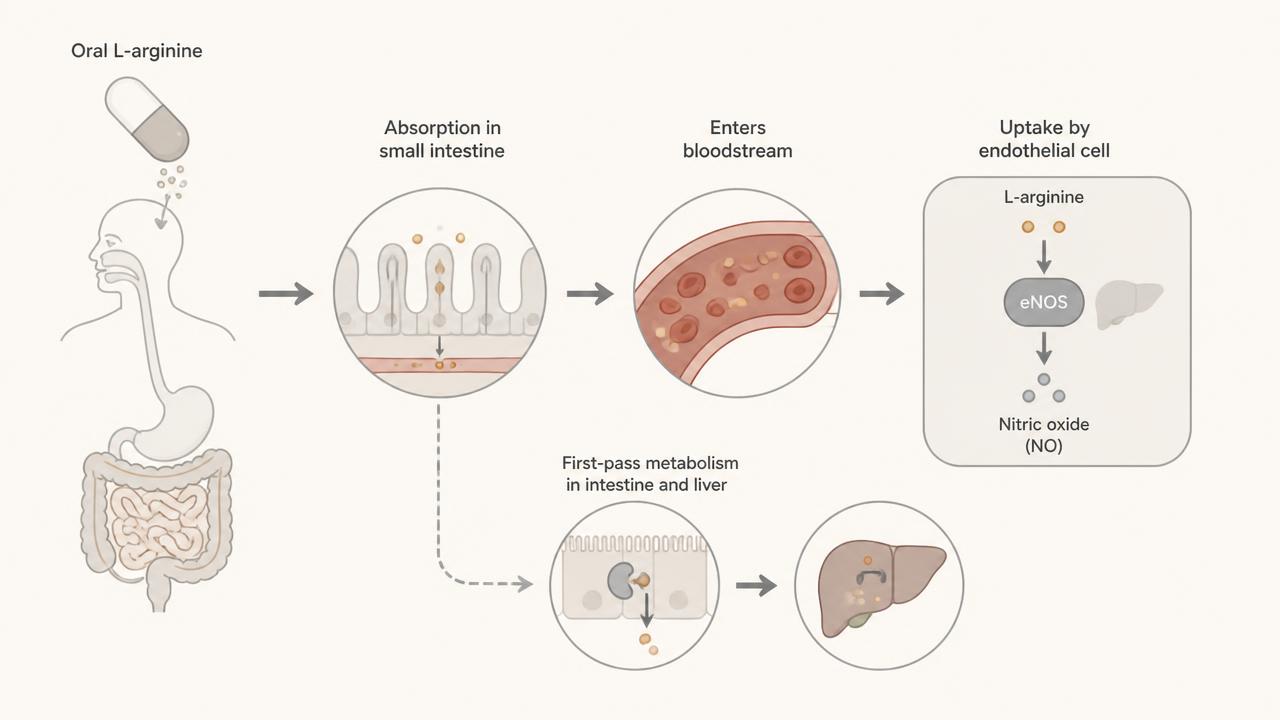
After oral arginine is absorbed, part of it is metabolized before it reaches the wider circulation.
The intestine and liver contain arginase, an enzyme that metabolizes arginine. This intestinal and hepatic first-pass processing reduces the proportion of oral arginine that ultimately becomes systemically available. [2][3]
This is important because supplement labels tell you how much arginine was consumed. They do not automatically tell you how much ultimately reached the vascular tissues where it might become available to nitric oxide synthase.
This does not mean orally consumed arginine is useless. It means bioavailability matters.
Citrulline Takes the Scenic Route — and That Can Be an Advantage
L-citrulline is not directly used by eNOS as the substrate for NO production. Instead, it takes another path.
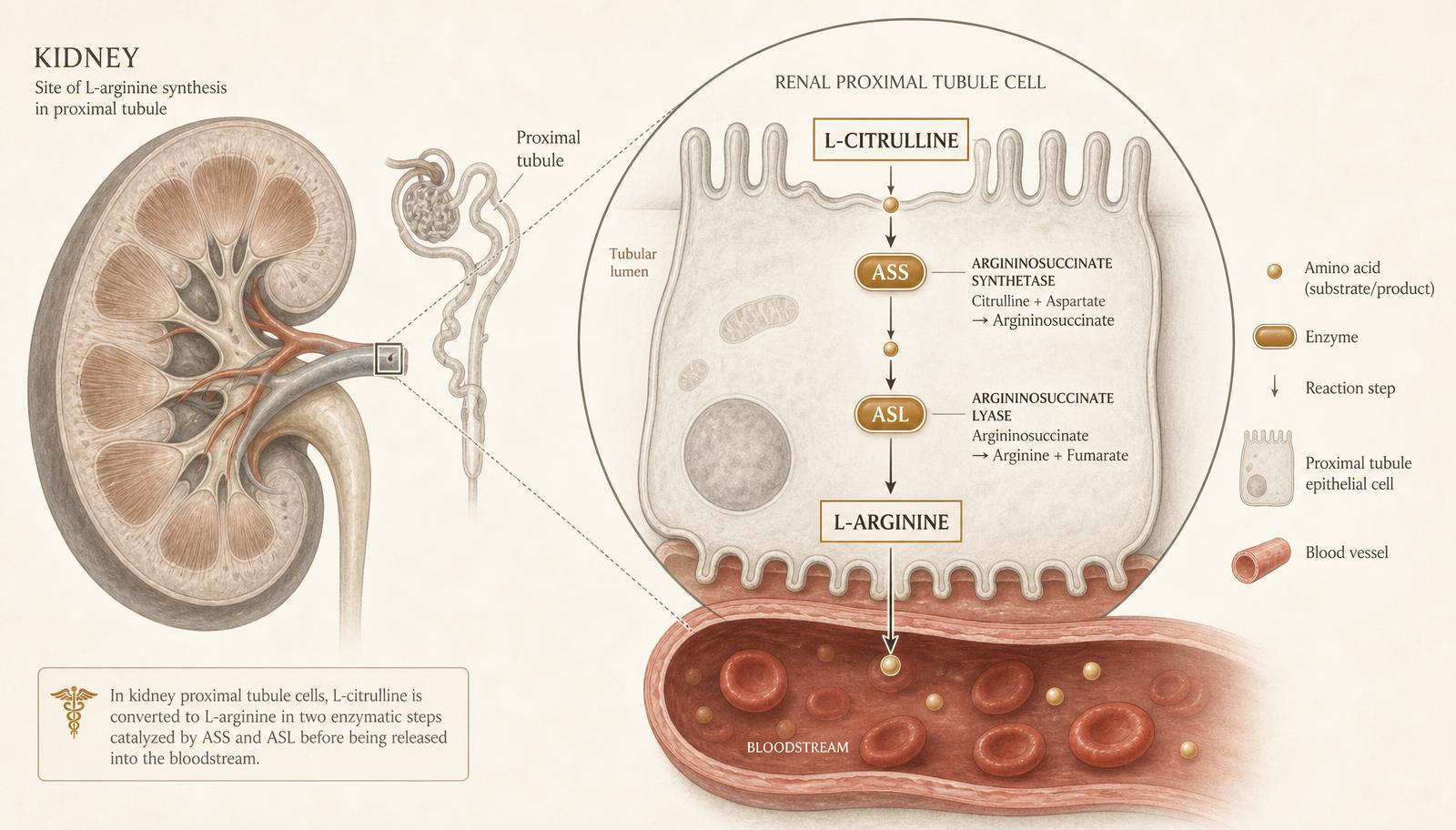
After being absorbed, citrulline largely bypasses the extensive intestinal and hepatic first-pass metabolism experienced by arginine. It enters the circulation. The kidneys then play an important role in converting citrulline into L-arginine. [2][3]
That newly produced arginine becomes part of the circulating arginine pool.
So Which Raises Arginine Better?
This is where human research provides a particularly interesting answer.
In a randomized, double-blind, placebo-controlled crossover study, researchers directly compared oral L-citrulline and L-arginine. They found that L-citrulline increased plasma L-arginine exposure and peak arginine concentrations more effectively than the tested oral arginine regimen. Higher-dose citrulline also increased minimum arginine concentrations and augmented biochemical markers associated with NO-dependent signaling. [1]
A broader pharmacokinetic review has similarly concluded that citrulline generally has better systemic bioavailability than arginine because of its absorption and metabolism. [4]
A 2020 physiological review went further, arguing that available evidence favors citrulline as an NO precursor in many circumstances because of its low first-pass metabolism, high intestinal absorption and renal conversion to arginine. [5]
So if the question is "which is generally better at raising circulating arginine after oral supplementation?" the evidence often favors L-citrulline. But that still does not make arginine biologically unimportant.
Direct vs Efficient: The Real Difference
This is probably the easiest way to understand the comparison.
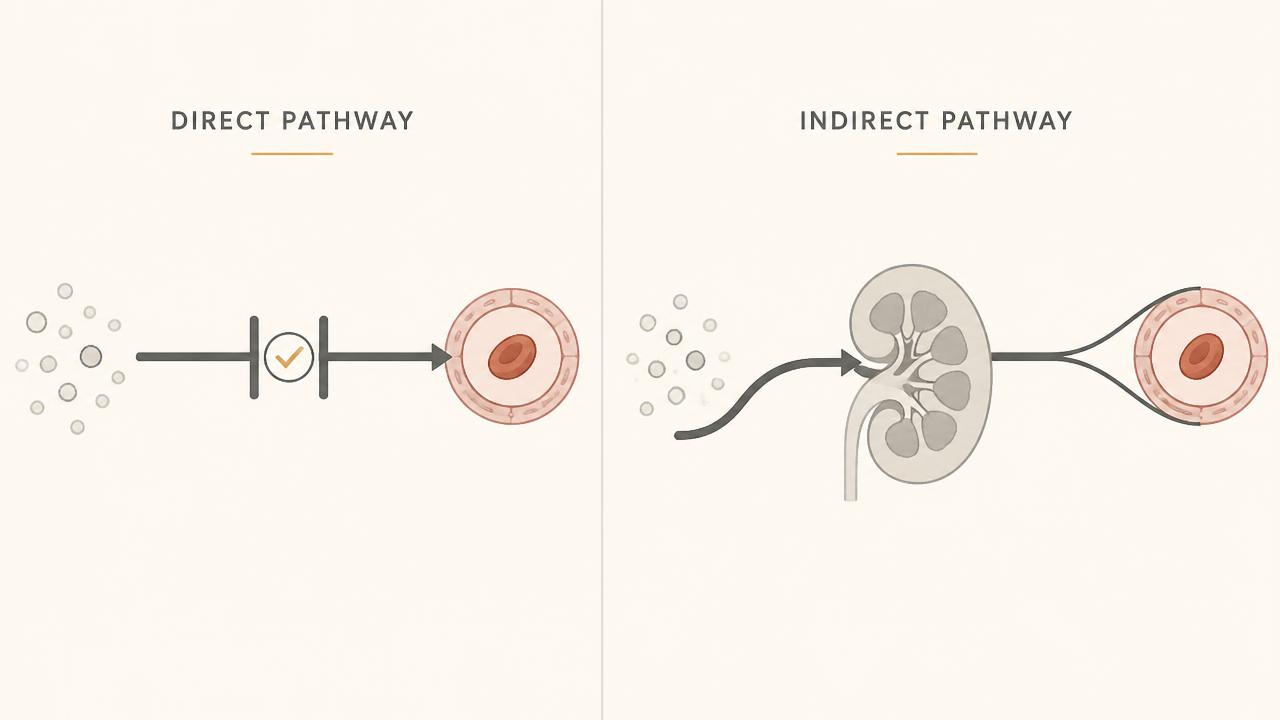
Arginine is direct. It is already the substrate required by nitric oxide synthase. It does not have to be converted from another amino acid before entering that part of the pathway.
Citrulline is efficient. It follows a metabolic route that avoids much of arginine's first-pass metabolism and can subsequently increase circulating arginine.
So "better" depends upon the question.
- Which amino acid does eNOS actually use? Arginine.
- Which oral amino acid can be especially effective at raising circulating arginine? Citrulline.
That distinction matters.
Is Citrulline Better Than Arginine for Nitric Oxide?
This is where headlines can become misleading. You may encounter articles claiming "citrulline is better than arginine for nitric oxide."
There is some scientific reasoning behind that statement. Because citrulline can raise circulating arginine efficiently, it may provide more substrate availability downstream than an equivalent conceptual strategy relying only on orally consumed arginine. Reviews of citrulline supplementation have emphasized exactly this metabolic advantage. [2][5]
But the statement still needs context. Citrulline does not replace arginine in the NO-producing reaction. Citrulline ultimately works in part because the body converts it into arginine.
So physiologically, this is not really a competition between two unrelated substances. They are interconnected.
An Interesting Twist: Citrulline Can Be Better at Delivering Arginine Than Arginine
It sounds contradictory: take citrulline to get more arginine. But that's what makes this metabolism so interesting.
Imagine two routes into a city. Route A looks shorter, but it has several toll booths and checkpoints. Route B is longer, but traffic moves through efficiently and eventually joins the same road.
Arginine is somewhat like Route A. Citrulline is somewhat like Route B.
Citrulline avoids much of the initial metabolism affecting oral arginine and is later converted into arginine. That is why consuming the precursor can sometimes increase systemic arginine very effectively.
What About Speed?
Another distinction is timing.
Immediate-release oral arginine can produce a relatively rapid increase in plasma arginine. Citrulline requires an additional conversion step before becoming arginine. That creates different pharmacokinetic patterns.
This is why we prefer language such as:
- more immediate arginine availability
- replenished or extended arginine availability
rather than describing them as "fast NO" and "slow NO." Nitric oxide itself is not being released from either amino acid like a timed-release medication. The difference is in how the body supplies substrate to the NO pathway.
Is Taking Both Better Than Taking One?
Scientifically, there is a logical basis for combining them.
Arginine provides substrate that is already in the form used by NOS. Citrulline provides a complementary mechanism for generating additional arginine through endogenous metabolism.
Direct substrate + replenishing precursor.
However, it is important not to turn biological rationale into an unsupported universal claim. The ideal amount, ratio and effect can depend on the population, health status, dose, formulation and outcome being measured. Not every clinical study shows that combining the two automatically produces superior outcomes to every single-ingredient approach.
The scientifically defensible point is: their different metabolic routes make them complementary. That is stronger than simply saying "two is better than one."
The Combination Has Been Studied
Research has also examined combined oral arginine and citrulline administration. The reason is logical: simultaneous provision may offer immediate exogenous arginine alongside citrulline that can later contribute to endogenous arginine production.
This is an evolving area of research, and outcomes vary according to dose, study design and population. That is another reason the combination is best discussed in terms of metabolic complementarity, rather than making an absolute clinical superiority claim.
Do Arginine and Citrulline Come From Food?
Yes — although their food distribution differs substantially.
Arginine
Arginine occurs widely in protein-containing foods. Examples include:
- turkey and other poultry
- meat
- fish
- dairy foods
- peanuts
- walnuts and other nuts
- pumpkin and other seeds
- beans and legumes
Citrulline
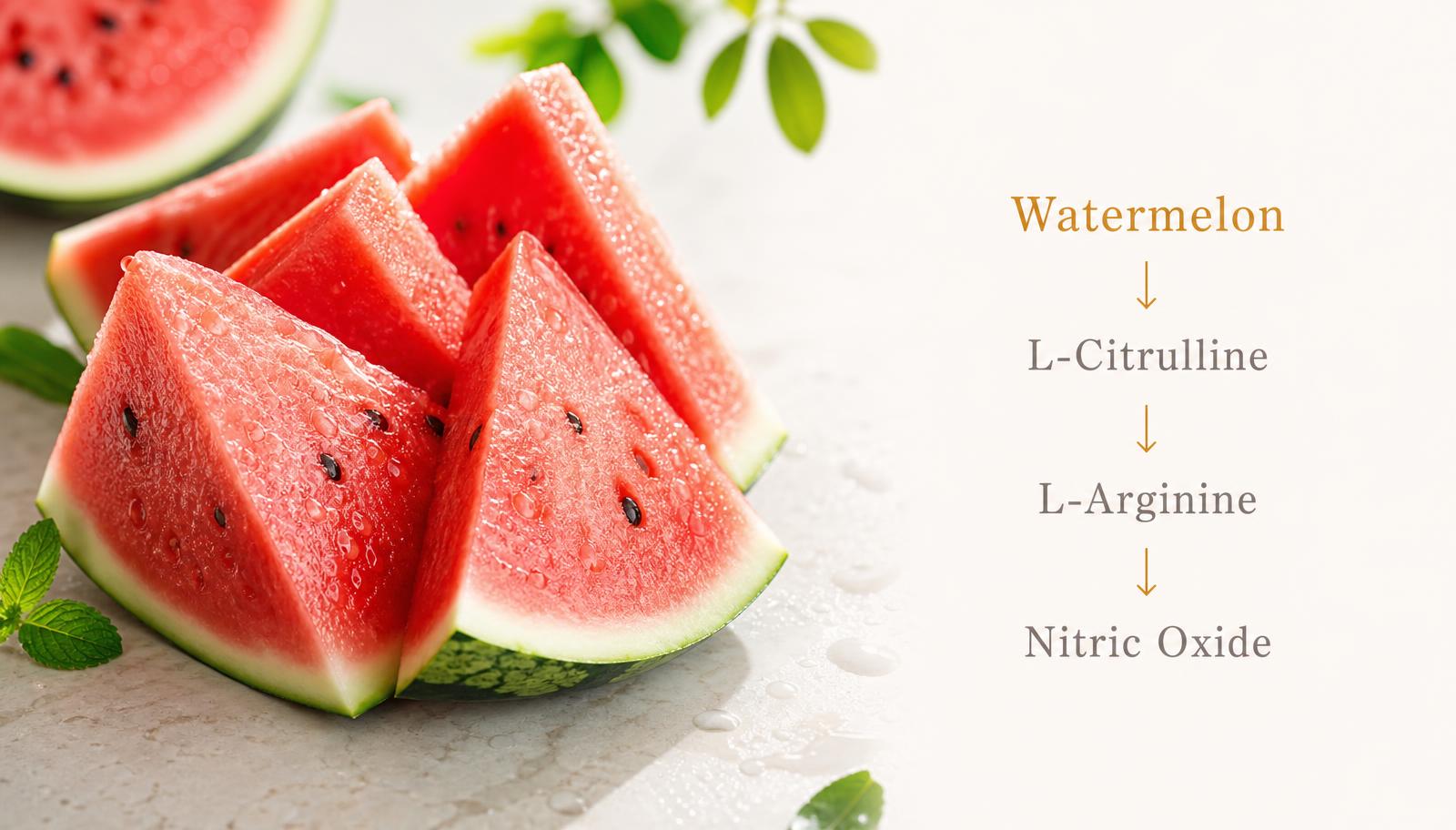
Citrulline is much less widespread in significant food quantities. Its best-known dietary source is watermelon. Both the flesh and rind contain citrulline, although concentrations vary.
What About Exercise Performance?
Arginine and citrulline are widely marketed to athletes because NO is involved in vascular physiology and exercise blood flow. But supplement claims often run ahead of evidence.
A 2023 narrative review of arginine, citrulline and citrulline malate found mixed results across exercise studies, with responses depending upon dose, population and type of performance measured. [6]
Citrulline has generally attracted substantial interest because of its pharmacokinetic advantages, but neither amino acid should be presented as guaranteeing better athletic performance.
For our purposes, their relevance is broader: they participate in the nutritional biology surrounding arginine availability and natural nitric-oxide production.
What About Cardiovascular Support?
The same caution applies.
Nitric oxide is important to cardiovascular physiology. Citrulline and arginine influence NO-related metabolism. But neither should be presented as a treatment for cardiovascular disease.
Studies and reviews have examined effects on outcomes including blood pressure, endothelial function and other vascular measures, with results varying among populations and interventions. [2][5][6]
This is why credible nutritional messaging should distinguish supporting a normal biological pathway from claiming to treat a medical condition. They are not the same thing.
Arginine vs Citrulline: Which One Would You Choose?
If we reduce the science to practical questions, the comparison becomes clearer.
If your priority is the direct NO substrate
Arginine has the clearest role. It is what eNOS actually uses.
If your priority is efficiently raising circulating arginine
Citrulline has important metabolic advantages. It largely avoids first-pass arginine metabolism and is subsequently converted into arginine.
If your priority is supporting the pathway through complementary routes
Using both has a logical biological rationale. That is where the arginine-versus-citrulline debate becomes less useful. The physiology suggests they can be viewed as partners rather than competitors.
Why ėNOS Uses Both
This comparison is directly relevant to the formulation philosophy behind ėNOS by Australiana Life. ėNOS does not choose between L-arginine and L-citrulline. It uses both deliberately. The reason is their differing metabolic roles.
L-Arginine
Provides the amino acid directly used as substrate by endothelial nitric oxide synthase.
L-Citrulline
Provides a complementary route that can be converted into arginine and help replenish circulating arginine.
The concept is direct availability + replenishing availability — or, in consumer terms, more immediate + more sustained support for the substrate behind natural NO production.
This is not based on simply adding two ingredients that carry the words "nitric oxide" in marketing literature. It is based on understanding how the two amino acids are actually handled by the body.
The Answer Is More Interesting Than "A vs B"
Search engines encourage us to frame questions as competitions. Arginine vs citrulline. Which is better? Which wins?
Human physiology is rarely so binary.
Arginine is essential to the eNOS reaction. Citrulline is an efficient metabolic precursor to arginine. One offers direct substrate availability. The other helps create additional substrate through a different route.
Arginine and citrulline have different strengths because they reach the same nitric-oxide system differently.
Understanding those differences is much more valuable than simply choosing one name over the other.
Scientific References
[1] Pharmacokinetic and pharmacodynamic properties of oral L-citrulline and L-arginine: impact on nitric oxide metabolism
Schwedhelm E, Maas R, Freese R, et al. British Journal of Clinical Pharmacology. 2008;65(1):51–59. PMID: 17662090. Randomized, double-blind crossover research directly comparing oral citrulline and arginine. Citrulline increased plasma arginine exposure and NO-dependent signaling markers in a dose-dependent manner.
PubMed / National Library of Medicine →[2] L-Citrulline Supplementation: Impact on Cardiometabolic Health
Allerton TD, Proctor DN, Stephens JM, et al. Nutrients. 2018;10(7):921. PMID: 30029482. Review describing differences in first-pass metabolism between arginine and citrulline and the renal conversion of citrulline into arginine.
PubMed / National Library of Medicine →[3] Therapeutic Potential of Citrulline as an Arginine Supplement
Clinical pharmacology review. PMID: 32140997. Review of arginine/citrulline pharmacokinetics noting citrulline's avoidance of hepatic first-pass metabolism and greater systemic availability.
PubMed / National Library of Medicine →[4] Pharmacokinetics of arginine and related amino acids
Cynober L, et al. Journal of Nutrition. PMID: 17513441. Review comparing arginine, citrulline and related amino-acid pharmacokinetics and systemic bioavailability.
PubMed / National Library of Medicine →[5] Endogenous flux of nitric oxide: Citrulline is preferred to Arginine
Bahri S, et al. Acta Physiologica. 2021. PMID: 33089645. Physiological review evaluating arginine and citrulline as precursors for NO production and discussing citrulline's pharmacokinetic advantages.
PubMed / National Library of Medicine →[6] Dietary Arginine and Citrulline Supplements for Cardiovascular Health and Athletic Performance: A Narrative Review
Gonzalez AM, Trexler ET. Nutrients. 2023;15:1268. PMID: 36904267. Review of cardiovascular and exercise research involving arginine, citrulline and citrulline malate.
PubMed / National Library of Medicine →
Compare, Then Explore Further
- L-Arginine + L-Citrulline: Two Pathways Supporting Nitric Oxide →
Go beyond the comparison and see how the two pathways can complement one another.
- What Is eNOS? The Enzyme Behind Natural Nitric Oxide Production →
Understand exactly where arginine enters the body's NO pathway.
- How to Increase Nitric Oxide Naturally →
Explore amino acids alongside exercise, nitrate-rich vegetables and other natural strategies.
- The Endothelium: The Hidden Key to Healthy Blood Vessels →
Meet the vascular cells in which endothelial NO production takes place.
DISCOVER THE SCIENCE BEHIND ĖNOS
Discover why Australiana Life selected L-arginine + L-citrulline as complementary components of the ėNOS formulation.
EXPLORE ĖNOS →This article is provided for educational purposes only and is not intended as medical advice or to diagnose, treat, cure or prevent disease. ėNOS is a dietary supplement. Research outcomes for arginine and citrulline vary according to dose, study population and outcome measured. Dietary supplements should complement rather than replace appropriate nutrition, exercise and medical care.
More in Nutrition & NO Support
- How to Increase Nitric Oxide Naturally
- Foods That Support Natural Nitric Oxide Production
- L-Arginine + L-Citrulline: Two Pathways Supporting Nitric Oxide
- L-Citrulline Explained: From Citrulline to Arginine to Nitric Oxide
- L-Arginine & Nitric Oxide Explained
- Why Combine L-Arginine & L-Citrulline?
- Dietary Nitrates & the Nitrate–Nitrite–Nitric Oxide Pathway
- Nitric Oxide Supplements: What Should You Look For?
About Our Health & Science Content
Australiana Life Health & Science articles are based on published scientific research and written to make complex health and nitric oxide science easier to understand. Our educational content undergoes scientific review for accuracy and appropriate interpretation of the evidence and is updated as relevant scientific understanding evolves.