
Healthy Aging: Supporting Circulation, Blood Flow & Nitric Oxide After 50
Why Maintaining a Responsive Cardiovascular System Becomes More Important With Age — and What You Can Do to Support It
Turning 50 does not suddenly change your cardiovascular system overnight. There is no biological switch. No nitric-oxide cliff. No moment when healthy circulation stops working the way it did the day before.
But something important does happen gradually through midlife and beyond: the cardiovascular system ages with us. Arteries tend to become less flexible. Endothelial function can become less efficient. Oxidative stress may increase. Physical activity often decreases. And one particularly important cardiovascular signaling molecule — nitric oxide (NO) — tends to become less biologically available.
That matters because nitric oxide helps blood vessels remain responsive to the changing demands of everyday life: walking, climbing stairs, exercising, regulating blood pressure, supplying working muscles and supporting circulation throughout the body.
Healthy aging is therefore not simply about keeping the heart beating. It is about maintaining a capable cardiovascular system — and supporting healthy nitric-oxide biology is one important part of that goal. [1][2][3]
Healthy Aging Is About Maintaining Capability
There is a tendency to define aging by what might be lost: strength, speed, energy, flexibility, circulation. But there is a more useful way to think about it. Healthy aging is about preserving the ability to walk comfortably, travel, exercise, work, garden, play golf, keep up with family, carry groceries, think clearly, recover from activity and remain independent.
All of those activities depend, in one way or another, upon blood moving where it needs to go. That makes circulation fundamental to healthy aging.

What Happens to Circulation After 50?
Blood does not simply flow through a collection of rigid pipes. Your arteries are living tissues. They need to expand, contract, sense blood flow, respond to chemical signals and adjust circulation according to demand. The thin layer of cells lining every blood vessel is called the endothelium.
When we are younger, the endothelium generally performs these functions efficiently. As we age, endothelial responsiveness tends to decline. Researchers commonly observe age-related changes involving:
- Reduced nitric-oxide bioavailability
- Greater oxidative stress
- Changes in eNOS function
- Increasing arterial stiffness
- Less efficient vascular relaxation
Those observations come from the contemporary cardiovascular-aging literature [1] [2] [3]. They do not mean healthy circulation becomes impossible after 50. They mean maintaining it becomes increasingly worth paying attention to.
Nitric Oxide Becomes an Important Part of the Healthy-Aging Story
Within endothelial cells is an enzyme called eNOS — endothelial nitric oxide synthase. One of its important functions is producing nitric oxide from the amino acid L-arginine.
NO can then communicate with nearby vascular smooth muscle. That signaling helps blood vessels relax appropriately and adjust their diameter according to physiological need, contributing to healthy vascular tone, normal endothelial function and regulation of blood flow. Nitric oxide is therefore not simply an interesting biochemical molecule — it is part of the day-to-day operating system of healthy circulation.
Why Does Nitric-Oxide Availability Tend to Decline With Age?
There is no single reason. Cardiovascular aging involves multiple overlapping changes. A major 2025 review of nitric oxide and cardiovascular aging identified several contributors [1]:
- Changes in nitric-oxide-synthase activity
- Increasing oxidative stress
- Alterations in eNOS regulation
- Reduced availability of important cofactors such as BH4
- Changes in arginine metabolism
- Metabolic changes that influence vascular function
It helps to think of the NO system as having several moving parts. You need the machinery, the raw materials, the right cellular environment, and the ability to preserve the NO after it is produced. Aging can affect all four.
Producing NO Is Only Half the Story
Imagine producing water while someone else is opening the drain. You might increase production — but still end up with less available. Something similar can happen with nitric oxide.
NO is extremely short-lived. Reactive molecules such as superoxide can interact with NO and reduce the amount remaining available for normal vascular signaling. Because oxidative stress tends to increase with aging, a person may experience less efficient NO production combined with greater NO loss.
That is why scientists often talk about nitric-oxide bioavailability rather than simply nitric-oxide production. What matters biologically is not only whether NO is made — it is whether enough remains available to perform its normal signaling functions.
Why Does This Matter to Blood Flow?
Blood-flow requirements change continually. When you stand up, the cardiovascular system adjusts. When you start walking, your leg muscles need more blood. During exercise, demand rises substantially. When you digest food, blood-flow patterns shift again. When you become hot, circulation toward the skin changes.
Healthy blood vessels need to respond, and NO is one of the signals participating in that responsiveness. So healthy circulation is not about trying to create maximum blood flow everywhere. The goal is appropriate blood flow where it is needed, when it is needed. That ability becomes a useful marker of cardiovascular vitality as we age.
Blood Flow Supports More Than the Heart
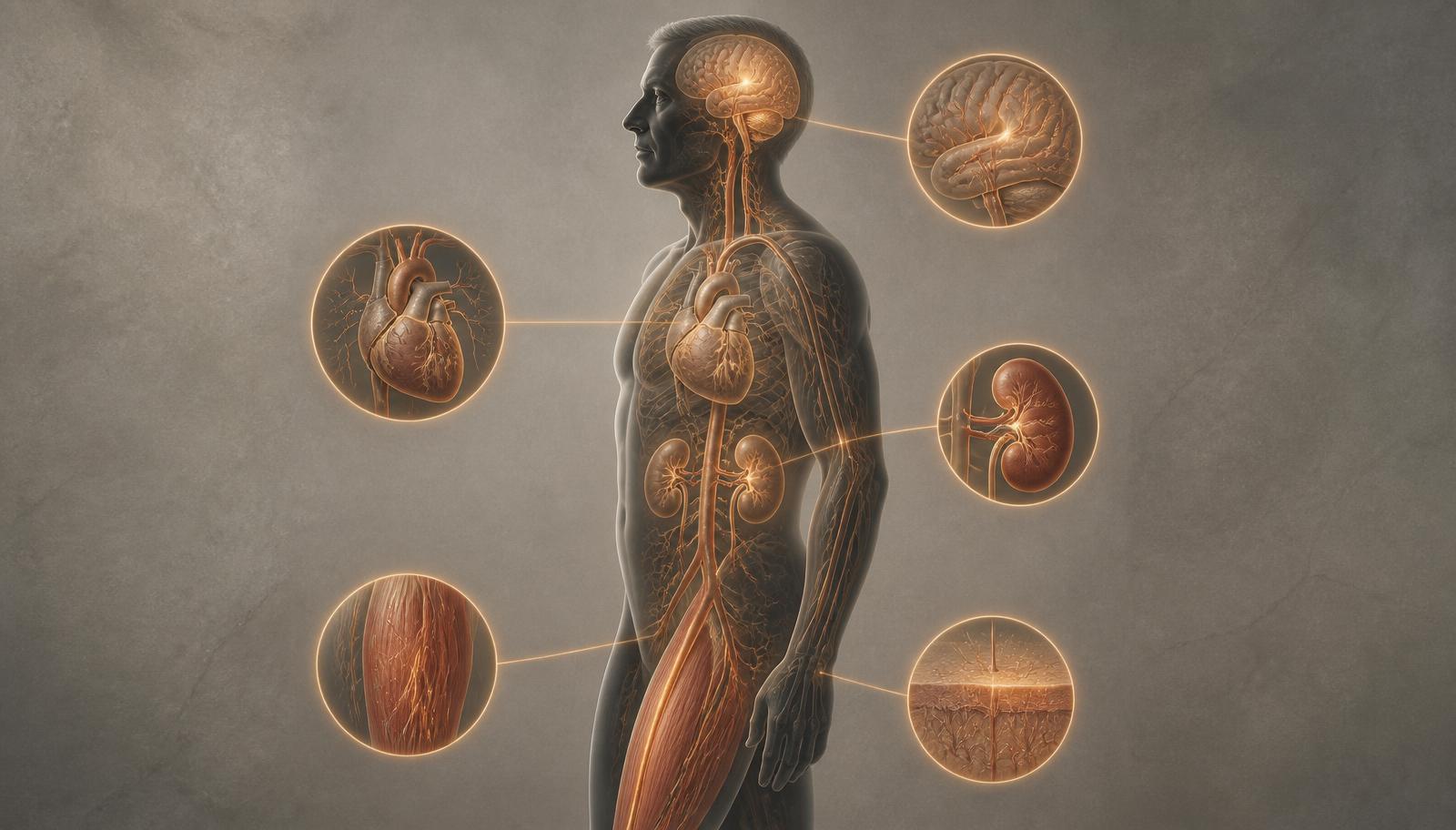
The heart receives most of the attention in conversations about cardiovascular health. But blood flow serves the entire body.
- Muscles — need oxygen and nutrients during activity
- Brain — depends upon tightly regulated cerebral circulation
- Skin — uses changing blood flow to help regulate temperature
- Kidneys — depend heavily upon blood flow for filtration and metabolic regulation
- Digestive system — changes circulation according to nutritional demand
- Every living tissue — depends upon the cardiovascular system for delivery and removal
That is why nitric oxide and circulation should not be thought of only as a "heart issue." They are part of whole-body healthy aging.
After 50, Your Blood Vessels Still Respond to What You Do
This is where the healthy-aging story becomes very positive. Aging changes the vascular system, but it does not eliminate its ability to adapt. Exercise research in middle-aged and older adults repeatedly demonstrates that vascular endothelial function can improve with training.
A 2025 systematic review and network meta-analysis included 20 randomized controlled trials involving 1,123 middle-aged and older adults. Aerobic, resistance, combined and high-intensity interval exercise were all evaluated, with aerobic exercise ranking highest for improvement in flow-mediated dilation in that analysis [4].
More recent 2026 research examining adults aged 60 and older also found favorable vascular adaptations from several different kinds of exercise — including walking, aerobic and resistance approaches — with no justification for believing that only one form of activity can support vascular health [5].
An older cardiovascular system is still a trainable cardiovascular system.
Movement May Be One of the Best Things You Can Do for Aging Circulation
When you move, muscles become active, blood-flow demand rises, blood moves more rapidly and endothelial shear stress changes. The endothelium senses that blood flow, and the signal can stimulate pathways involving eNOS and nitric oxide.
Movement is not simply burning calories. It is using the circulatory system you want to preserve.
Walking Deserves More Credit
After 50, exercise advice can become unnecessarily intimidating: high-intensity workouts, training zones, complex programs, expensive equipment. None of those are required before movement becomes valuable. Walking remains one of the most accessible ways to activate large muscles, increase blood flow, stimulate circulation, support metabolic health and maintain mobility.
If you enjoy more vigorous exercise, excellent. But if your preferred activity is walking consistently, that counts. Healthy aging does not require becoming an athlete. It requires continuing to use your body.
Keep Your Muscles Too
Muscle and circulation are partners. Muscles help move venous blood. Muscles consume glucose. Muscles allow us to remain active. And maintaining leg strength makes it easier to walk, climb stairs, travel, exercise and remain independent.
Not because resistance exercise is a direct "NO treatment" — but because strong muscles help you continue living an active cardiovascular life.
Sitting Less Matters Too
Someone can exercise for 30 minutes and still spend most of the remaining day seated. Long periods of inactivity can reduce lower-limb blood flow and alter endothelial function. The solution does not require exercising all day. Simply stand up, walk around, take stairs, do household activities, walk after meals, and avoid allowing hours of uninterrupted sitting to become normal.
Think of circulation as something that benefits from being used throughout the day, not only during a scheduled workout.
Food Gives the NO System More Than One Route
The body has more than one way to produce nitric oxide, and that creates an interesting nutritional opportunity.
- The arginine / eNOS pathway — L-arginine is used by eNOS as substrate for NO production
- The nitrate / nitrite pathway — dietary nitrate, particularly from vegetables, can be converted toward nitrite and ultimately nitric oxide through a complementary pathway involving the oral microbiome
So nutrition can support NO biology from different directions.
Eat Your Greens — They Really Do Matter
Particularly nitrate-rich vegetables can include arugula / rocket, spinach, lettuce, beetroot, celery and other leafy vegetables.
Research continues to investigate dietary nitrate as one strategy for supporting NO biology in older adults. An especially interesting 2025 human study compared younger adults aged 18–30 with older adults aged 67–79 and found age-related differences in the oral microbiome and in vascular responses to nitrate-rich beetroot juice, reinforcing both the importance and complexity of the nitrate–nitrite–NO pathway later in life [6].
The message is not that food stops working when you are older. It doesn't. The better message is: use the nutritional routes your body still has available.
Protein Nutrition Supports Another Part of the System
The eNOS pathway depends upon L-arginine, which is present in numerous foods including fish, meat, poultry, dairy, legumes, nuts and seeds. Adequate nutrition therefore contributes to the body's normal amino-acid environment.
But oral arginine has an interesting limitation: a significant portion can be metabolized in the intestine and liver before reaching systemic circulation. That is where another amino acid becomes important.
L-Citrulline: The Indirect Route That Helps Support Arginine
L-citrulline is absorbed efficiently and largely avoids the same first-pass metabolism encountered by oral arginine. It can then travel through the bloodstream and be converted — importantly through the kidneys — into L-arginine [7].
Human research has demonstrated that combining these amino acids can be particularly effective at increasing circulating arginine under studied conditions [8]. That relationship becomes highly relevant when considering targeted NO nutritional support after 50.
Why Consistent Nutritional Support Can Make Sense After 50
Food remains the foundation. But food is naturally variable. One day may include leafy vegetables, quality protein, nuts, fruit and balanced meals. Another day involves travel, restaurants, work, social events or simply different choices.
At the same time, the natural NO system may become less efficient with age. That creates a sensible role for consistent, targeted nutritional support — not as a replacement for a healthy diet, and not as a substitute for exercise, but as a way of supplying relevant nutritional ingredients reliably from day to day.
Where ėNOS Fits Into Healthy Aging After 50
First, an important distinction. eNOS is endothelial nitric oxide synthase — the naturally occurring enzyme involved in vascular nitric-oxide production. ėNOS is a dietary supplement from Australiana Life, specifically formulated around the established science of nitric oxide and designed to provide nutritional support for the body's natural NO-production system, healthy circulation and cardiovascular wellness.
Its purpose becomes particularly relevant after midlife because nitric-oxide availability tends to become more challenging with age — at the same time that maintaining healthy circulation becomes increasingly important.
Why ėNOS Uses Both L-Arginine and L-Citrulline
At the center of the ėNOS formulation is a deliberate combination: L-arginine provides the direct physiological substrate used by eNOS, while L-citrulline provides a complementary metabolic route toward replenishing circulating arginine. Together they support arginine availability through two complementary approaches [7] [8].
This is particularly relevant to adults over 50 because the goal is not simply to create a temporary sensation of increased blood flow. The more meaningful objective is to consistently support the natural NO-production pathway that contributes to healthy vascular responsiveness.
What Potential Benefits Are We Supporting?
It is important to describe these benefits accurately. ėNOS is not a drug. It does not treat cardiovascular disease. And it cannot guarantee specific changes in blood pressure, arterial stiffness or clinical outcomes. Its intended role is nutritional support.
- Supporting healthy blood flow — NO participates in the normal vascular signaling that helps blood vessels adjust to physiological demand
- Supporting healthy circulation — a responsive vascular system helps distribute blood throughout the body
- Supporting cardiovascular wellness — the heart and blood vessels operate as one integrated system
- Supporting an active lifestyle — healthy circulation is particularly relevant when muscles require increased blood flow during activity
- Supporting the body's natural NO production — ėNOS provides nutritional ingredients selected around the body's existing NO pathways rather than attempting to replace them
Why This Can Matter More at 60 Than at 30
A healthy 30-year-old may have robust endothelial responsiveness, greater NO bioavailability, high physical activity and fewer accumulated cardiovascular challenges. By 60 or 70, the biology may be different.
This does not mean everyone over 50 has poor circulation, and it certainly does not mean decline is inevitable. It means the systems that once seemed automatic may deserve more deliberate support: exercise, nutrition, sleep, body composition, metabolic health, blood-pressure awareness and nitric-oxide nutrition.

ėNOS Is Designed to Complement an Active Life
The strongest use of ėNOS is not "take this instead of living well." It is "live well — and support the nutritional pathway at the same time." Walk. Exercise. Maintain muscle. Eat nitrate-rich vegetables. Eat quality protein. Sleep. Don't smoke. Stay socially and physically engaged. Know your cardiovascular numbers. And use targeted nutritional support where it fits your lifestyle.
Supporting Ingredients Have Different Jobs
ėNOS is not simply a container of arginine and citrulline. The formulation also includes complementary nutrients selected to support the broader nutritional environment. Magnesium, for example, contributes to normal muscle function, nerve function, energy metabolism, electrolyte balance and broader cardiovascular physiology.
ėNOS also contains Australian plant ingredients including Kakadu Plum and Davidson's Plum. These should not be described as direct nitric-oxide generators; their contribution is broader, providing plant-derived nutrients and phytonutrients within the overall formulation. Different ingredients can support different aspects of the same wellness goal.
Supporting NO Does Not Mean Trying to Maximize NO
Nitric oxide is a regulated signaling molecule. The objective is not "as much NO as possible." The body controls where NO is produced, when it is produced and how much is required. A sensible nutritional strategy therefore supports the body's natural production system rather than attempting to overwhelm it.
"Support natural nitric-oxide production" is a more biologically meaningful phrase than "maximize nitric oxide." Healthy physiology is about balance and responsiveness.
Healthy Circulation Is Something You Use
Think about the activities people often want to continue after 50: walking through an airport, playing 18 holes of golf, traveling, hiking, cycling, swimming, gardening, playing with grandchildren, working on the house, or simply climbing stairs comfortably.
Those activities require muscle, energy, balance and circulation. The cardiovascular system is not simply something you hope remains healthy while you sit still. It is something you use to live.
Your Brain Is Part of the Circulation Story Too
The brain represents only a small portion of body weight but requires a substantial and tightly regulated blood supply. Cerebral circulation must continually adjust to neural activity and metabolic demand, and nitric oxide participates in this vascular signaling environment — although brain NO biology is more complex than endothelial eNOS alone.
This does not mean an NO supplement should be marketed as a treatment for memory loss or cognitive decline. But it does reinforce a broader healthy-aging principle: vascular health and brain health are connected.
Sexual Health Also Reminds Us Why Vascular Function Matters
Nitric oxide is also involved in normal vascular responses associated with sexual function — another reminder that NO biology extends throughout the body. With advancing age, vascular changes can contribute to changes in sexual responsiveness in both men and women. This article is not about treating sexual dysfunction, and ėNOS should not be positioned as a treatment for it. But the physiology reinforces the larger point: healthy vascular responsiveness matters to many aspects of quality of life.
Circulation Is Closely Connected to Vitality
People often use the word "energy." But energy is not a single biological measurement. Feeling capable and vital depends upon many systems: sleep, metabolism, muscle, cardiorespiratory fitness, nutrition, mental health and circulation.
Healthy blood flow contributes to the ability to deliver oxygen and nutrients to active tissues. That makes circulation relevant to the feeling of being able to move, exercise, participate and keep going. Again, NO is one part of that larger system.
A Practical Healthy-Aging Strategy After 50
You do not need to become obsessed with nitric oxide. Build a lifestyle that naturally supports it.
- Move most days — walk, cycle, swim or choose activity you enjoy
- Keep your muscles — include appropriate resistance activity
- Sit less — interrupt long periods of inactivity
- Eat vegetables regularly — especially nitrate-rich leafy greens
- Eat appropriate protein — support muscle and amino-acid nutrition
- Sleep — give the cardiovascular system the recovery environment it needs
- Don't smoke — few lifestyle decisions are more important for endothelial health
- Support metabolic health — know your blood pressure, blood glucose and blood lipids
- Consider targeted nutritional support — especially where consistency becomes useful

Don't Wait Until Something Feels Wrong
One difficulty with cardiovascular health is that many changes develop quietly. You cannot necessarily feel declining endothelial function, slightly lower NO bioavailability, gradually increasing arterial stiffness or slowly changing metabolic health.
That is why healthy aging should be proactive. Exercise before mobility disappears. Strengthen muscles before weakness becomes limiting. Eat well before nutrition becomes a response to illness. Pay attention to cardiovascular health before symptoms force your attention. And support the body's natural physiological systems while they are still functioning.
50 Is Not a Deadline. It Is a Useful Reminder.
There is nothing magical about age 50. Some people become proactive at 40, others at 60, others at 75. The value of midlife is that it creates an opportunity to ask: what do I want my next 20 or 30 years to look like?
If the answer includes travel, activity, independence, family, exercise, clear thinking and quality of life, then cardiovascular health deserves a place near the top of the list. Healthy circulation is part of the infrastructure that supports all of it.
The Goal Is Not to Feel 30 Again
Healthy aging should not be a war against age. There is no requirement to look 30, exercise like you're 30, or pretend your body has not changed. A better goal is to function well at the age you are: maintain the ability to move, maintain strength, maintain cardiovascular capacity, support circulation, support healthy vascular responsiveness and give your body the nutritional resources it needs.
The Body Over 50 Still Has Remarkable Capacity
- The vascular system can still respond to exercise
- Muscle can still become stronger
- Fitness can still improve
- Dietary nitrate can still participate in NO biology
- Citrulline can still be converted toward arginine
- eNOS still exists, and the body still produces nitric oxide
Those points rest on the exercise meta-analyses [4] [5], the dietary-nitrate research in older adults [6] and the citrulline–arginine pharmacokinetic literature [7] [8]. So the healthy-aging story should never be "everything declines, so try to slow the inevitable." A better story is: biology changes — but it remains responsive to what you do.
Why ėNOS Has a Natural Place in That Opportunity
ėNOS was created around a simple physiological idea: support a system the body already possesses. The body supplies the endothelium, eNOS, the regulatory mechanisms and the biological demand. ėNOS supplies targeted nutritional ingredients — particularly L-arginine + L-citrulline — selected to support the substrate side of natural NO production, together with complementary nutrients supporting the broader cardiovascular-wellness formulation.
For people over 50, that can provide a useful level of consistency at precisely the stage of life when maintaining healthy NO availability and circulation becomes increasingly relevant. That is not about fighting age. It is about supporting healthy physiology as you age.
Healthy Aging Is Something You Participate In
Genes matter. Age matters. Medical history matters. But lifestyle matters too. Every walk. Every healthy meal. Every strength session. Every smoke-free day. Every good night's sleep. Every decision to maintain cardiovascular health. These choices accumulate — and so does nutritional consistency.
Supporting nitric oxide is one piece of that larger picture. Not the entire answer, but an important biological system worth supporting — especially through the decades when vascular function deserves increasing attention.
Keep the Blood Moving. Keep the System Responsive. Keep Living.
A healthy cardiovascular system is valuable not because of what it looks like on a laboratory report. It is valuable because of what it allows you to do: move, travel, exercise, work, think, explore, participate and remain independent.
Nitric oxide helps support the vascular responsiveness behind healthy circulation. After 50, maintaining that biology becomes increasingly worth the effort. The encouraging message is that your body still responds — so give it reasons to.
Healthy aging is not about stopping the years. It is about supporting the body that carries you through them.
Scientific References
[1] Adhikari H, Patel P, Javvaji N, Crabtree MJ, Simon JN. Declining nitric oxide bioavailability in cardiovascular aging: mechanistic insights and emerging interventions.
Journal of Cardiovascular Aging. 2025;5(4):20. PMID: 41953454. Contemporary review identifying diminished NO bioavailability, altered NOS activity, oxidative stress and metabolic changes as important contributors to cardiovascular aging.
PubMed / National Library of Medicine →[2] Seals DR, Jablonski KL, Donato AJ. Aging and vascular endothelial function in humans.
Clinical Science. 2011;120(9):357–375. PMID: 21244363. Foundational review of vascular endothelial aging and the contribution of reduced nitric-oxide bioavailability and oxidative stress.
PubMed / National Library of Medicine →[3] Donato AJ, Machin DR, Lesniewski LA. Mechanisms of dysfunction in the aging vasculature and role in age-related disease.
Circulation Research. Research describing endothelial dysfunction, arterial stiffening and reduced NO bioavailability as major characteristics of vascular aging.
PubMed / National Library of Medicine →[4] Chen Q, Gao X, Wang C, Zhang P. Influence of different exercise types on vascular endothelial function in middle-aged and older adults — a systematic review and network meta-analysis.
Archives of Gerontology and Geriatrics. 2025;128:105624. PMID: 39288582. Analysis of 20 randomized controlled trials involving 1,123 middle-aged and older adults showing favorable endothelial effects from several exercise approaches, with aerobic exercise ranking highest for flow-mediated dilation.
PubMed / National Library of Medicine →[5] Wen Y, Liu X, Huang Y, Ma H, Zhao Y. Comparative effectiveness of various exercise modalities on arterial stiffness and endothelial function in older adults: a systematic review and network meta-analysis of randomised controlled trials.
2026. PMID: 42516957. Recent analysis of exercise interventions in adults 60 and older finding favorable vascular adaptations across several modalities, with differences according to vascular outcome.
PubMed / National Library of Medicine →[6] Vanhatalo A, et al. Ageing modifies the oral microbiome, nitric oxide bioavailability and vascular responses to dietary nitrate supplementation.
Free Radical Biology and Medicine. 2025. PMID: 40615058. Controlled human study comparing adults aged 18–30 with adults aged 67–79, demonstrating age-related differences in the oral microbiome, nitrate metabolism and vascular responses to dietary nitrate.
PubMed / National Library of Medicine →[7] Schwedhelm E, Maas R, Freese R, et al. Pharmacokinetic and pharmacodynamic properties of oral L-citrulline and L-arginine: impact on nitric oxide metabolism.
British Journal of Clinical Pharmacology. 2008;65(1):51–59. PMID: 17662090. Human randomized research demonstrating effective increases in circulating arginine following oral citrulline.
PubMed / National Library of Medicine →[8] Suzuki T, Morita M, Hayashi T, Kamimura A. The effects on plasma L-arginine levels of combined oral L-citrulline and L-arginine supplementation in healthy males.
Bioscience, Biotechnology, and Biochemistry. 2017;81(2):372–375. PMID: 27667025. Human randomized research showing that combined L-arginine + L-citrulline increased plasma arginine more effectively than the same total amount of either amino acid alone under the study conditions.
PubMed / National Library of Medicine →
Continue the Lifestyle & Healthy Aging Journey
- LIFESTYLE HABITS THAT SUPPORT HEALTHY NITRIC OXIDE PRODUCTION →
Build the everyday habits that support NO biology over time.
- EXERCISE & NITRIC OXIDE: WHY MOVEMENT MATTERS →
See how movement converts blood flow into a signal the endothelium can detect.
- CAN A SEDENTARY LIFESTYLE AFFECT NITRIC OXIDE & CIRCULATION? →
Understand why avoiding prolonged inactivity becomes increasingly important after midlife.
- DIET & NITRIC OXIDE: HOW EVERYDAY FOOD CHOICES MATTER →
Explore the nutritional routes supporting natural NO production.
- SLEEP, CARDIOVASCULAR HEALTH & NITRIC OXIDE →
See why healthy sleep belongs in the cardiovascular-health picture.
- SMOKING, VASCULAR HEALTH & NITRIC OXIDE →
Understand why avoiding tobacco removes one of the strongest lifestyle threats to endothelial NO biology.
DISCOVER HOW ĖNOS SUPPORTS HEALTHY CIRCULATION & ACTIVE AGING AFTER 50
Your body still produces nitric oxide after 50 — but production and bioavailability can become less efficient as the cardiovascular system ages. ėNOS by Australiana Life was formulated around nitric-oxide science to provide consistent nutritional support for the body's natural NO-production system, healthy circulation and cardiovascular wellness. Its L-arginine + L-citrulline combination supports arginine availability through complementary nutritional routes, while magnesium and deliberately selected Australian plant ingredients contribute to the broader formulation.
EXPLORE ĖNOS →This article is provided for informational purposes only and is not intended as medical advice or to diagnose, treat, cure or prevent disease. Changes in circulation, exercise tolerance, chest discomfort, unexplained shortness of breath or other cardiovascular symptoms should be appropriately evaluated. ėNOS is a dietary supplement formulated by Australiana Life to support the body's natural nitric-oxide system, healthy circulation and cardiovascular wellness. Individual responses to dietary supplements vary, and supplements should complement, rather than replace, appropriate nutrition, physical activity, healthy lifestyle practices and medical care.
More in Lifestyle & Healthy Aging
- Nitric Oxide & Exercise Performance
- Nitric Oxide & Exercise Recovery
- Lifestyle Habits That Support Healthy Nitric Oxide Production
- Exercise & Nitric Oxide: Why Movement Matters
- Can a Sedentary Lifestyle Affect Nitric Oxide & Circulation?
- Diet & Nitric Oxide: How Everyday Food Choices Matter
- Sleep, Cardiovascular Health & Nitric Oxide: What Do We Know?
- Smoking, Vascular Health & Nitric Oxide
- Nitric Oxide, Energy & Staying Active as We Age
- Nitric Oxide & Men's Sexual Health: The Blood-Flow Connection
- Nitric Oxide & Oral Health: The Surprising Connection
- Nitric Oxide & Aging: What Changes After 40, 50 and Beyond?
- Why Does Nitric Oxide Production Change With Age?
- Nitric Oxide and Brain Health/Cognition
About Our Health & Science Content
Australiana Life Health & Science articles are based on published scientific research and written to make complex health and nitric oxide science easier to understand. Our educational content undergoes scientific review for accuracy and appropriate interpretation of the evidence and is updated as relevant scientific understanding evolves.