
Nitric Oxide and Exercise Performance
What Happens to Blood Flow, Working Muscle and Oxygen Delivery When You Exercise?
The moment you begin exercising, your body starts making adjustments.
Heart rate rises. Breathing increases. Blood flow is redirected toward working muscles. Muscle cells begin using more oxygen and fuel. The vascular system adapts to a rapidly changing demand.
One of the signaling molecules involved in this response is nitric oxide — NO.
Nitric oxide has long been studied in cardiovascular science because of its ability to influence vascular tone and blood-vessel relaxation. But exercise physiology has revealed a broader story. NO is involved not only in the blood vessels supplying muscle, but also in signaling within skeletal muscle itself, mitochondrial function, glucose metabolism and other processes relevant to physical performance. [1,2]
That does not make nitric oxide a magic performance enhancer. It does make it an important part of the physiology that allows the body to respond to exercise.
When Exercise Starts, Demand Changes Fast
At rest, skeletal muscles require a relatively modest supply of oxygen and nutrients.
Start walking uphill, cycling, lifting weights or running, and those requirements can rise dramatically. Working muscle needs:
- more oxygen
- more glucose and other fuels
- faster removal of metabolic byproducts
- and greater blood flow
The cardiovascular system responds almost immediately. The heart pumps harder. Blood flow is redistributed. Small blood vessels supplying active muscle adjust their diameter. Local metabolites and vascular signals accumulate.
Nitric oxide contributes to this integrated response.

More Blood Flow Is Not the Whole Story
It is tempting to reduce exercise performance to: more blood flow equals better performance.
Human physiology is more complicated than that. Exercise blood flow is controlled by many overlapping systems:
- local metabolic signals
- neural control
- vascular smooth muscle
- endothelial signaling
- cardiac output
- oxygen extraction by muscle
Nitric oxide is one participant in this network. Its importance lies partly in helping blood vessels respond appropriately to the increased demand of active tissue.
The goal is not maximum vasodilation everywhere. It is appropriate distribution of blood to the tissues doing the work.
How Nitric Oxide Helps Blood Vessels Respond
The inside of blood vessels is lined by the endothelium. Within endothelial cells, an enzyme called endothelial nitric oxide synthase — eNOS — uses L-arginine as substrate to produce NO.
Nitric oxide can diffuse into the smooth muscle surrounding the blood vessel and activate signaling that promotes relaxation. As the smooth muscle relaxes, the vessel can widen. That ability to change vessel diameter is one component of regulating exercise blood flow.
Exercise Itself Can Stimulate NO Signaling
There is a two-way relationship.
Nitric oxide helps influence vascular responses to exercise. But exercise also stimulates the endothelial system that produces NO.
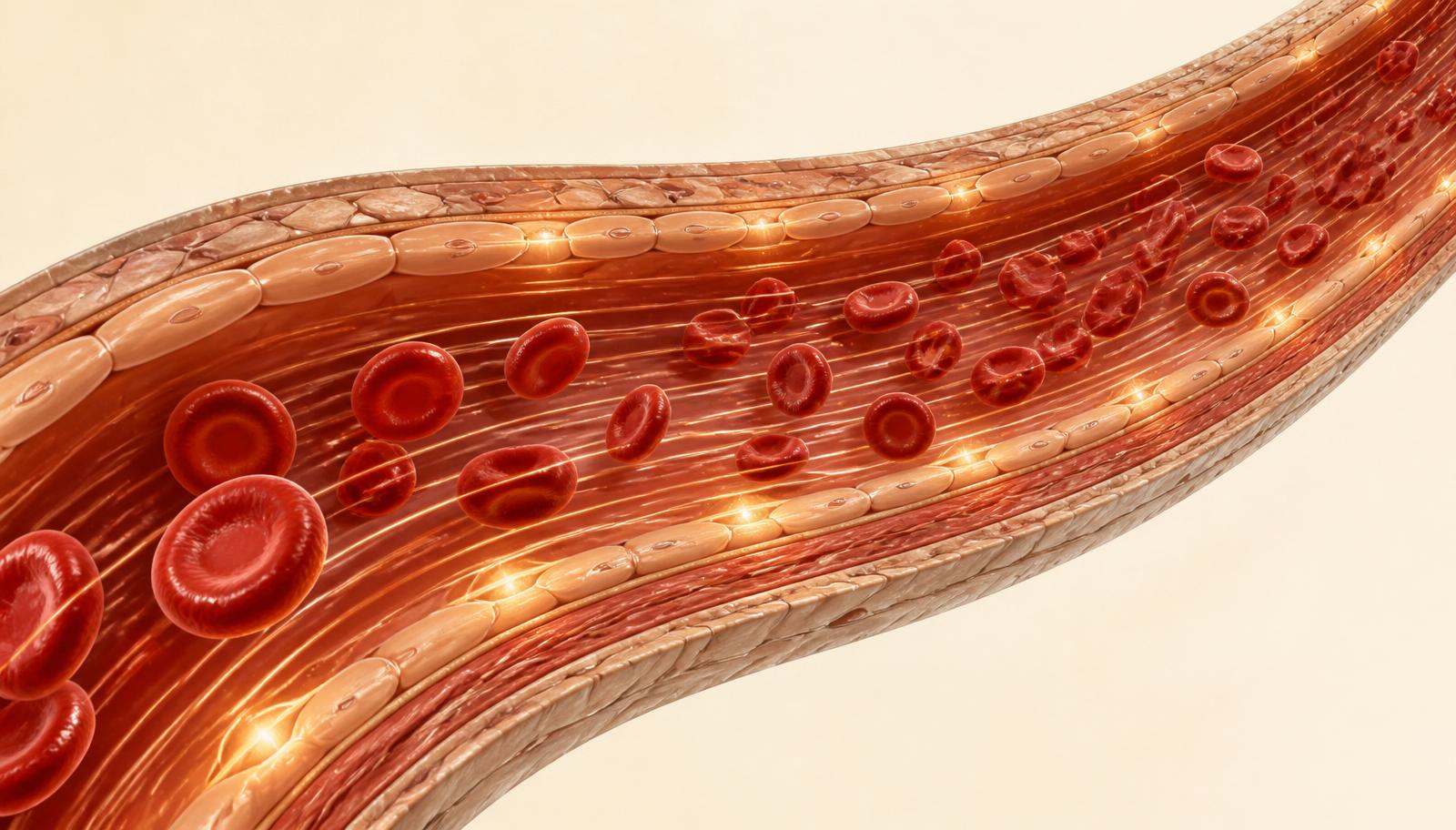
When blood flow increases, moving blood creates a mechanical force along the endothelial surface called shear stress. Endothelial cells sense that force, and shear stress activates signaling pathways associated with eNOS and nitric-oxide production.
Oxygen Delivery: Why Blood Flow Matters to Performance
Muscles need oxygen to sustain aerobic energy production. Oxygen enters the lungs, binds to hemoglobin in red blood cells and travels through the circulation. Blood flow brings those oxygen-carrying red blood cells to working muscle, and at the capillary level oxygen moves into the muscle tissue.
During endurance exercise, the ability of the cardiovascular system to deliver oxygen — and the ability of muscle to extract and use it — are major determinants of performance.
Nitric oxide does not carry oxygen itself. But by participating in vascular regulation, NO contributes to the system responsible for getting blood where it is needed.
That distinction is important. NO supports the delivery system. It is not oxygen. And it is not energy.
Nitric Oxide Also Exists Inside Skeletal Muscle
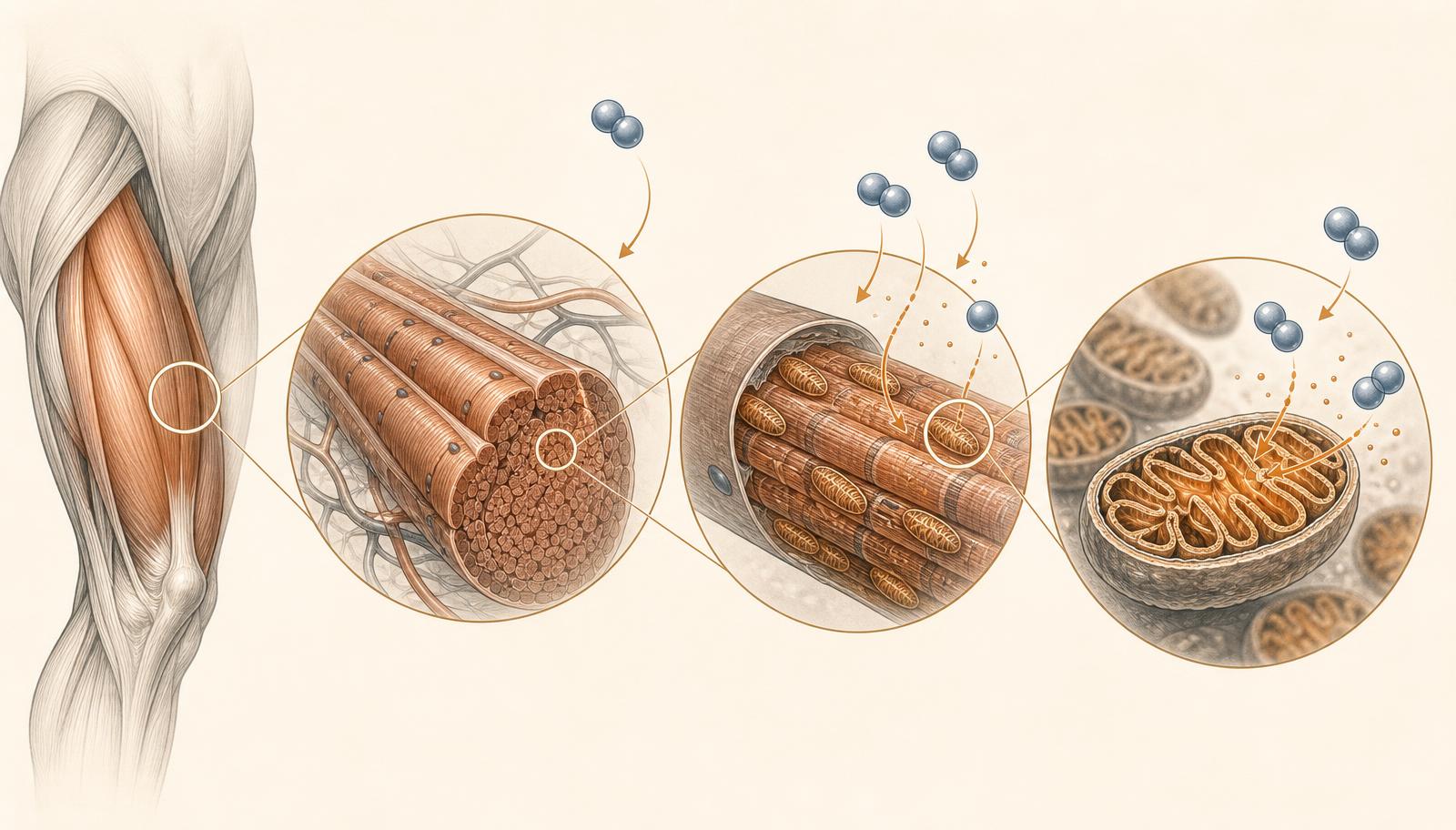
The NO story does not stop at the blood vessel. Skeletal muscle itself expresses nitric-oxide synthase enzymes and uses NO as a local signaling molecule.
Research has examined skeletal-muscle NO in relation to:
- contraction
- glucose uptake
- mitochondrial regulation
- muscle blood flow
- redox signaling
- adaptation to exercise
A 2025 review of nitric oxide in exercise physiology noted that NO appears to influence skeletal-muscle contractile function, mitochondrial biology and redox regulation, although many effects remain context-dependent and are still being investigated. [1]
This makes nitric oxide relevant to exercise on more than one level.
Mitochondria Enter the Story
Mitochondria are the structures inside cells responsible for much of aerobic energy production.
Nitric oxide interacts with mitochondrial biology in complex ways. At physiological concentrations, NO participates in signaling related to mitochondrial respiration, efficiency and biogenesis. Research has also explored whether NO influences the oxygen cost of exercise — essentially how much oxygen is required to perform a given amount of work. [1]
This is one reason dietary nitrate became so interesting to exercise scientists. Some studies have reported improved exercise efficiency following nitrate supplementation. But results are not universal. Training status, dose, exercise duration and individual response all appear to matter.
Why Beetroot Became a Sports-Nutrition Favorite
Beetroot contains naturally occurring dietary nitrate.
Dietary nitrate has therefore become one of the most extensively studied nutritional strategies for increasing NO bioavailability during exercise. Beetroot juice is particularly common in research because it can provide a standardized nitrate dose more easily than ordinary mixed meals.
Systematic reviews have found small performance benefits in some exercise settings, particularly certain endurance tasks, while other studies report little or no benefit. [3–5]
A 2025 umbrella review examining 20 systematic reviews with meta-analyses concluded that nitrate supplementation can influence several exercise-performance outcomes, but effects differ substantially across performance domains and protocols. [3]

Does Dietary Nitrate Improve Endurance?
Sometimes. But that answer needs context.
A large systematic review of food sources capable of increasing NO bioavailability found small but statistically significant improvements in endurance performance from nitrate-rich foods overall. [4] Other reviews have suggested nitrate may be particularly useful in certain time-to-exhaustion or moderate-duration exercise tasks. [1,5]
However, effects can be smaller or absent in highly trained athletes. Why? Elite endurance athletes may already have:
- high baseline endothelial function
- very efficient oxygen delivery
- strong NO-related adaptations
- and limited remaining room for improvement
The same nutritional strategy may have a different effect in an elite cyclist than in a recreationally active 55-year-old. That is an important nuance.
What About Strength and Power?
Nitric oxide is usually associated with endurance exercise. But researchers have increasingly examined nitrate in resistance exercise and muscular power.
Recent literature suggests nitrate supplementation may improve certain measures of muscular power or repetitions to fatigue in some settings, although the evidence base is smaller and less consistent than the endurance literature. [1,6]
This remains an active research area. It would therefore be premature to say “more nitric oxide makes you stronger.” A more defensible statement is that NO-related nutrition is being studied for both endurance and resistance-exercise performance, with outcomes varying by protocol and population.
Where Arginine Fits
L-arginine is the direct substrate used by nitric oxide synthase. That makes it biologically important.
But oral arginine has an important limitation for supplementation. A significant portion undergoes first-pass metabolism in the intestine and liver before reaching systemic circulation. This can limit the rise in circulating arginine following oral intake, and exercise studies using arginine alone have produced inconsistent results. [7]
A 2023 narrative review found that commonly studied arginine doses did not consistently improve athletic performance or increase NO synthesis in recreational and trained athletes. [7]
So although arginine is central to the pathway biologically, taking more oral arginine does not automatically translate into better exercise performance.
Citrulline Takes a Different Route
L-citrulline is metabolically different. It largely avoids the first-pass metabolism experienced by oral arginine. After absorption, citrulline can be converted into arginine, importantly through renal metabolism. That can raise circulating arginine availability.
This has made citrulline a popular sports-nutrition ingredient. Studies have investigated:
- resistance exercise
- endurance
- blood flow
- muscle soreness
- recovery
- perceived exertion
The results are mixed. A review of human studies found that citrulline can increase plasma arginine and nitrate/nitrite concentrations, but acute effects on vasodilation and muscle perfusion have been inconsistent. Some studies nevertheless report improvements in performance or recovery measures. [8]
A 2023 meta-analysis focused on endurance performance found no clear overall benefit of acute citrulline supplementation in young healthy adults. [9]
Citrulline clearly affects arginine metabolism. Whether that produces a measurable performance improvement depends on more than metabolism alone.
Arginine + Citrulline: Why the Combination Is Interesting
This is where physiology and formulation become more interesting than the typical “which one is better?” debate.
- Arginine — already in the form used by NOS, providing more direct substrate availability.
- Citrulline — absorption, conversion to arginine, and replenished availability.
That makes the two metabolically complementary. For exercise nutrition, the rationale is not simply “two NO ingredients must be better than one.” It is that the two amino acids reach the arginine/NO system differently.
Clinical performance superiority of every combination is not established, but the biological rationale for complementary substrate support is clear.
The Famous “Pump” — What's Really Happening?
Gym culture often uses the phrase “the pump.” During resistance exercise, working muscles can temporarily increase in volume as blood flow rises and fluid shifts within muscle tissue.
Nitric oxide is frequently marketed as though it is solely responsible for this effect. It isn't. Muscle blood flow during resistance exercise involves numerous local and systemic processes. NO participates in vascular regulation, but the workout “pump” is not a direct measurement of nitric-oxide production and should not be treated as proof that a supplement is working.
A bigger pump also does not automatically mean more strength, more muscle growth, or better long-term performance. The physiology is more complicated than the marketing slogan.
Does More NO Mean Better Performance?
Not necessarily. Physiology operates within useful ranges.
Nitric oxide is a signaling molecule, not a performance dial where more is always better. The effects of NO depend on:
- where it is produced
- how much is produced
- timing
- redox conditions
- training status
- and the physiological context
Very high NO-related reactive signaling can have different effects from normal physiological NO signaling.
This is another reason the scientifically correct goal is not to maximize nitric oxide. It is to support normal NO biology and vascular responsiveness.
Active Aging Changes the Performance Question
For a 25-year-old competitive athlete, performance might mean a faster 10K, one more repetition, a heavier lift, or seconds off a cycling time trial.
After 50, performance often has a broader meaning. It may mean:
- walking farther without fatigue
- climbing hills comfortably
- keeping up on a bike ride
- maintaining strength
- recovering well enough to exercise again
- playing golf or tennis, hiking, skiing
- or simply staying physically capable
The underlying physiology still matters. Working muscles need blood flow. Oxygen delivery matters. Endothelial responsiveness matters. Muscle mass matters. Mitochondrial function matters.
This makes nitric-oxide science highly relevant to active aging, even when nobody is chasing a medal.

Exercise Is Itself an NO Strategy
This point can easily get lost in supplement discussions.
One of the best-supported ways to influence endothelial NO signaling is exercise itself. Physical activity increases blood flow. Blood flow increases endothelial shear stress. Shear stress stimulates eNOS-related signaling. Repeated training creates vascular adaptation.
If someone is interested in nitric oxide purely to improve exercise performance but is not exercising consistently, the priorities are backwards. Training comes first. Nutrition supports training. Not the other way around.
Food Before Formulas
A performance-oriented diet can naturally include foods relevant to NO biology.
Nitrate-rich foods
- Arugula / rocket
- Spinach
- Leafy greens
- Beetroot
- Celery
Arginine-containing foods
- Nuts
- Seeds
- Legumes
- Fish
- Poultry
- Other protein foods
Citrulline-containing food
- Watermelon
These foods also bring many other nutrients. The goal should not be to turn every meal into a nitric-oxide protocol. The goal is to build a healthy nutritional foundation that supports training.
Recovery: Where Does NO Fit?
Recovery is another area where claims can become exaggerated.
Exercise creates temporary physiological stress. Recovery involves:
- replenishing energy stores
- repairing muscle tissue
- restoring fluid balance
- nervous-system recovery
- sleep
- protein synthesis
- and adaptation
Blood flow participates in nutrient delivery and metabolic transport, but nitric oxide should not be marketed as though it independently “repairs muscles.” Some citrulline studies have reported reductions in muscle soreness or improved recovery measures, but findings are inconsistent. [8]
For recovery, the basics remain more powerful:
- sleep
- adequate calories
- protein
- hydration
- appropriate training load
- rest
NO-related nutrition may complement that foundation.
Four Questions to Ask About Any “NO Workout” Product
Sports nutrition is filled with aggressive claims. Before accepting them, ask:
Does it disclose meaningful ingredient amounts?
A long ingredient list is not evidence of an effective dose.
Is it supporting an actual biological pathway?
Look for a reason the ingredient is there.
Does the research match the claim?
Improving a blood marker is not automatically the same as improving performance.
Is the claim realistic?
No powder replaces training.
Those questions separate physiology from hype.
Where ėNOS Fits Into the Performance Picture
The formulation philosophy behind ėNOS by Australiana Life begins with supporting the body's natural nitric-oxide system rather than promising an artificial workout “boost.”
Central to that approach are L-arginine and L-citrulline. Arginine provides substrate more directly to the eNOS pathway. Citrulline follows a complementary metabolic route and can help replenish circulating arginine availability. The formulation also incorporates additional selected nutrients and Australian plant ingredients as part of a broader nutritional strategy.
For active adults, the purpose is not to replace training. It is to nutritionally support the vascular and NO-related systems that training itself asks the body to use.
Performance Begins With Physiology
Nitric oxide has earned a large presence in sports nutrition. Some of that attention is justified. Some of it is marketing. The science gives us a more useful middle ground.
- NO participates in vascular regulation.
- Exercise stimulates endothelial NO signaling.
- NO also participates in skeletal-muscle biology.
- Dietary nitrate can improve some performance outcomes in some people.
- Citrulline can increase circulating arginine but does not guarantee improved performance.
- Arginine is biologically central to NO synthesis, but oral supplementation alone has produced inconsistent athletic results.
- And training status matters enormously.
So the most useful question is not “How do I get the biggest nitric-oxide boost before my workout?” It is “How do I support the physiology that allows my muscles and cardiovascular system to perform when I ask more of them?”
That answer begins with training. Then comes recovery. Then nutrition.
Nitric oxide belongs within that larger performance system.
Scientific References
[1] Nitric oxide in exercise physiology: past and present perspectives
Mueller SM, Roberts MD, Mobley CB, Judd RL, Kavazis AN. Frontiers in Physiology. 2025. PMID: 39850450. Contemporary review of NO in skeletal-muscle function, mitochondrial biology, redox signaling and exercise performance.
PubMed / National Library of Medicine →[2] Skeletal muscle nitric oxide signaling and exercise: a focus on glucose metabolism
Merry TL, McConell GK. American Journal of Physiology. 2012. PMID: 22550064.
PubMed / National Library of Medicine →[3] Dietary Nitrate Supplementation and Exercise Performance: An Umbrella Review of 20 Published Systematic Reviews with Meta-analyses
2025. PMID: 40085422. Broad synthesis of nitrate supplementation across multiple exercise-performance domains.
PubMed / National Library of Medicine →[4] Effect of food sources of nitrate, polyphenols, L-arginine and L-citrulline on endurance exercise performance
Blomstrand E, et al. A systematic review and meta-analysis of randomised controlled trials. Sports Medicine. 2022. PMID: 34965876.
PubMed / National Library of Medicine →[5] Effects of Nitrate Supplementation on Exercise Performance in Humans: A Narrative Review
Senefeld JW, et al. Nutrients. 2021. PMID: 34579061.
PubMed / National Library of Medicine →[6] Effects of dietary nitrate supplementation on muscular power output: Influence of supplementation strategy and population
Tan R, et al. 2023. PMID: 37244391.
PubMed / National Library of Medicine →[7] Dietary Arginine and Citrulline Supplements for Cardiovascular Health and Athletic Performance: A Narrative Review
Park HY, Kim SW, Seo J, et al. Nutrients. 2023;15(5):1268. PMID: 36904267.
PubMed / National Library of Medicine →[8] Effects of Citrulline Supplementation on Exercise Performance in Humans: A Review of the Current Literature
Gonzalez AM, Trexler ET. Journal of Strength and Conditioning Research. 2020;34(5):1480–1495. PMID: 31977835.
PubMed / National Library of Medicine →[9] Effects of citrulline on endurance performance in young healthy adults
Harnden CS, et al. A systematic review and meta-analysis. Journal of the International Society of Sports Nutrition. 2023. PMID: 37155582.
PubMed / National Library of Medicine →
Explore the Performance Side of NO
- Nitric Oxide and Blood Flow: How Are They Connected? →
See how blood vessels adjust flow when tissues demand more oxygen and nutrients.
- L-Arginine + L-Citrulline: Two Pathways Supporting Nitric Oxide →
Understand why these amino acids approach the NO pathway differently.
- Arginine vs Citrulline: What's the Difference? →
Compare absorption, metabolism and the evidence behind each.
- Foods That Support Natural Nitric Oxide Production →
Explore nitrate-rich foods, arginine sources and watermelon.
- Healthy Circulation After 50: Why Blood Flow Matters →
Connect exercise physiology with the needs of active aging.
- Support the System You Train →
Explore how nitric-oxide physiology and complementary amino-acid metabolism influenced the formulation philosophy behind ėNOS.
SUPPORT THE SYSTEM YOU TRAIN
Explore how nitric-oxide physiology and complementary amino-acid metabolism influenced the formulation philosophy behind ėNOS for active living.
EXPLORE ĖNOS →This article is provided for educational purposes only and is not intended as medical advice or to diagnose, treat, cure or prevent disease. Exercise-performance responses to dietary nitrate, arginine, citrulline and other nutritional interventions vary substantially among individuals and study populations. ėNOS is a dietary supplement and should complement rather than replace appropriate training, nutrition, hydration, recovery or medical care.
More in Lifestyle & Healthy Aging
- Nitric Oxide & Exercise Recovery
- Lifestyle Habits That Support Healthy Nitric Oxide Production
- Exercise & Nitric Oxide: Why Movement Matters
- Can a Sedentary Lifestyle Affect Nitric Oxide & Circulation?
- Diet & Nitric Oxide: How Everyday Food Choices Matter
- Sleep, Cardiovascular Health & Nitric Oxide: What Do We Know?
- Smoking, Vascular Health & Nitric Oxide
- Nitric Oxide, Energy & Staying Active as We Age
- Nitric Oxide & Men's Sexual Health: The Blood-Flow Connection
- Nitric Oxide & Oral Health: The Surprising Connection
- Nitric Oxide & Aging: What Changes After 40, 50 and Beyond?
- Why Does Nitric Oxide Production Change With Age?
- Healthy Aging: Supporting Circulation, Blood Flow & Nitric Oxide After 50
- Nitric Oxide and Brain Health/Cognition
About Our Health & Science Content
Australiana Life Health & Science articles are based on published scientific research and written to make complex health and nitric oxide science easier to understand. Our educational content undergoes scientific review for accuracy and appropriate interpretation of the evidence and is updated as relevant scientific understanding evolves.