
Smoking, Vascular Health and Nitric Oxide
How Cigarette Smoke Affects the Endothelium, Reduces Nitric-Oxide Availability and Works Against Healthy Circulation
Most people know smoking damages the lungs. Fewer realise how directly cigarette smoke affects the blood vessels. Every cigarette exposes the cardiovascular system to a complex mixture of chemicals capable of influencing the endothelium, oxidative stress, inflammation, blood pressure, platelet activity, vascular tone and nitric-oxide availability.
That last connection is particularly important. Nitric oxide — NO — is one of the signaling molecules the vascular endothelium uses to help regulate healthy blood-vessel function and circulation. Smoking interferes with that system. Modern reviews of human vascular research describe cigarette smoking as a major cause of endothelial dysfunction, characterised in part by reduced vascular nitric-oxide bioavailability and increased oxidative stress. [1] [2]
Many lifestyle habits help create a more favourable environment for NO biology. Smoking pushes strongly in the opposite direction.
Smoking Is Not Only a Lung Issue
When cigarette smoke enters the lungs, its effects do not remain there. Chemicals from smoke enter the bloodstream, so the cardiovascular system is repeatedly exposed. The American Heart Association identifies tobacco and nicotine avoidance as one of its Life's Essential 8 components of cardiovascular health: smoking and nicotine exposure can raise heart rate and blood pressure, affect blood vessels and increase cardiovascular risk.
But cardiovascular risk develops through more than one mechanism. Smoking affects:
- The vessel lining
- Blood coagulation
- Inflammation
- Oxidative chemistry
- Lipid biology
- Vascular responsiveness
One of the earliest places scientists can detect those effects is the endothelium.
The Endothelium: Where Smoking Meets Nitric Oxide
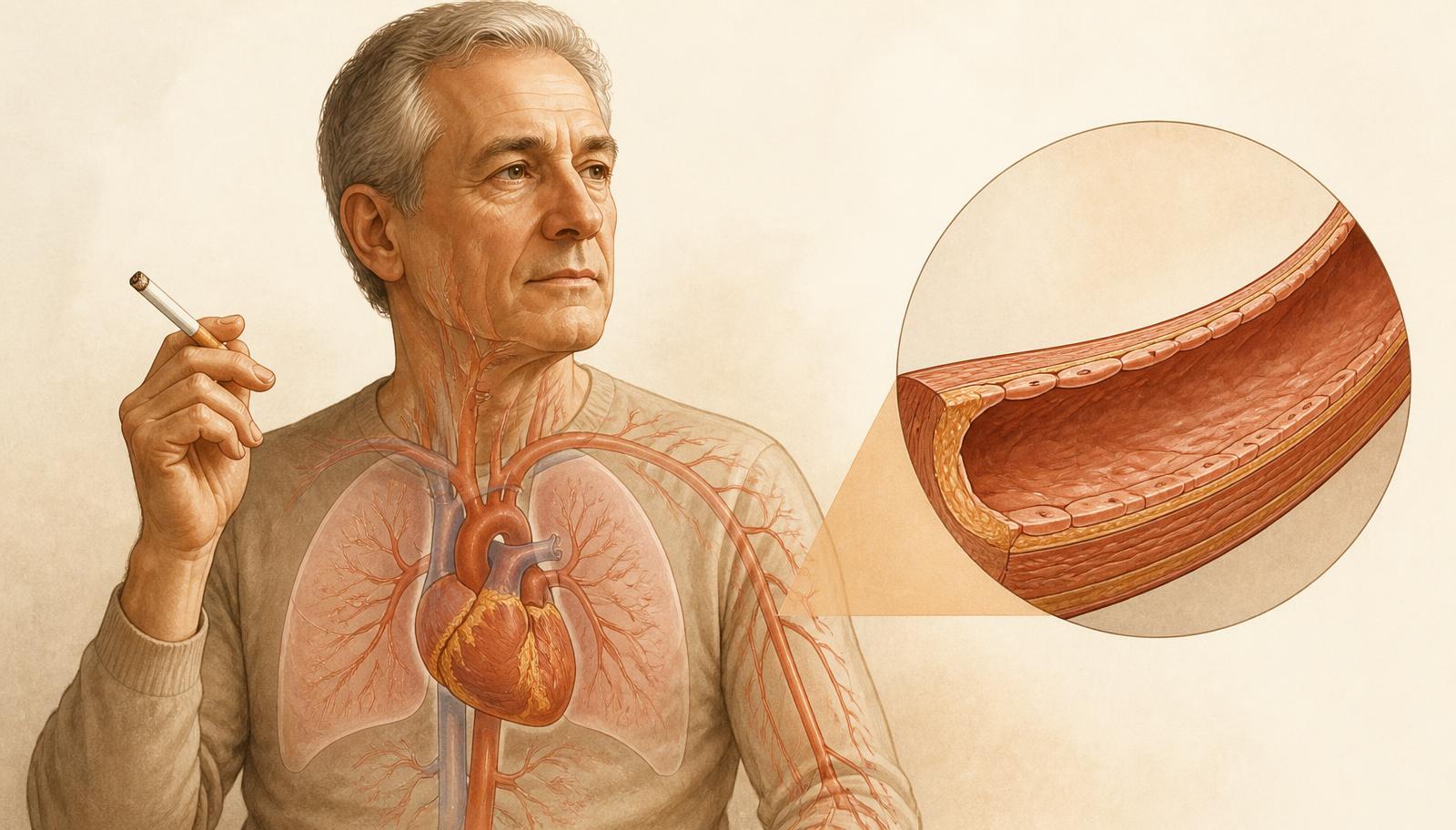
The endothelium is the thin layer of cells lining every blood vessel. It is only one cell thick. Yet it helps regulate vascular tone, blood-flow responses, blood clotting, inflammatory signaling and communication between the bloodstream and vessel wall.
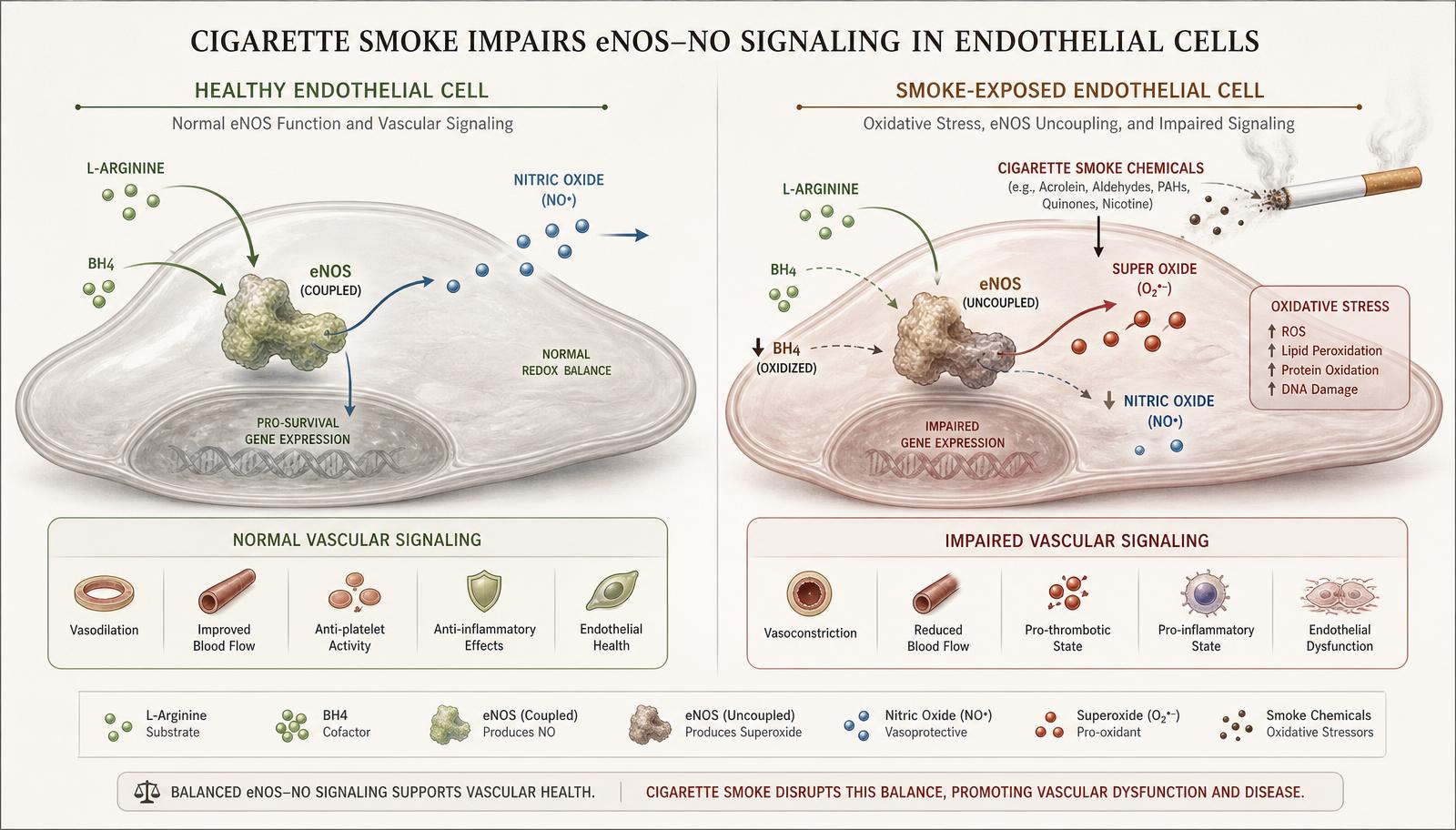
One of the endothelium's important signaling molecules is nitric oxide. Within endothelial cells, an enzyme called eNOS — endothelial nitric oxide synthase — uses L-arginine as substrate in NO production.
Smoking Does Not Simply "Use Up" Nitric Oxide
The actual biology is more interesting. Nitric-oxide availability reflects a balance between how much NO is produced and how rapidly NO is lost or inactivated. Cigarette smoke can disturb both sides. Research has found effects involving reduced eNOS activity, altered eNOS expression, increased generation of reactive oxygen species and accelerated destruction of available NO. [1] [3]
So the problem is not merely "smoking lowers NO." A more complete description is that smoking creates a vascular environment in which normal NO production and NO bioavailability can both become impaired.
Oxidative Stress Is a Major Part of the Story
One molecule is particularly important: superoxide, a reactive oxygen species. When superoxide levels rise excessively, it can react rapidly with nitric oxide, removing NO from normal vascular signaling. So even if an endothelial cell successfully produces nitric oxide, increased oxidative stress can reduce how much of it remains biologically available.
Human vascular reviews identify increased superoxide production as an important reason smokers exhibit reduced vascular NO bioavailability. [2]
NO produced is not necessarily the same as NO available. Smoking can worsen that difference.
Smoke Can Turn the NO-Producing Machinery Against Itself
eNOS normally requires several cofactors to function correctly. One important cofactor is tetrahydrobiopterin — BH4. When sufficient BH4 is available, eNOS is described as coupled: it performs its normal chemistry and helps produce NO. Under severe oxidative conditions, BH4 can become depleted or oxidised, and eNOS can become uncoupled — generating more superoxide instead of functioning efficiently as an NO-producing enzyme.
Experimental cigarette-smoke research has demonstrated BH4 depletion, eNOS dysfunction and increased superoxide generation following smoke exposure. [3] [4]
Human Arteries Show the Difference
This is not only laboratory theory. A 2024 meta-analysis examined studies assessing endothelial function using flow-mediated dilation — FMD. Across 14 included studies, smoking exposure was associated with significantly poorer FMD, supporting a strong relationship between smoking and endothelial dysfunction. [5]
FMD measures how effectively an artery dilates in response to increased blood flow, and nitric oxide plays an important role in this response. So reduced FMD provides real-world evidence that smoking affects the ability of arteries to respond normally.
Researchers Have Also Measured NO Function More Directly
Research examining resistance arteries from smokers found reduced endothelium-dependent relaxation, reduced NO production, and lower expression or activation of nitric-oxide-synthase enzymes compared with nonsmokers. [6]
This does not mean every smoker has the same degree of endothelial impairment. Exposure differs. Genetics differ. Age differs. Diet, activity and other risk factors differ. But the overall scientific direction is remarkably consistent: cigarette smoke is hostile to normal endothelial NO biology.
Why Nitric Oxide Matters to Circulation
Healthy circulation is not simply more blood flow. Different tissues need different amounts of blood at different times. Working muscle needs more during exercise. Skin circulation changes with temperature. The digestive system changes after eating. The brain regulates its own blood supply tightly.
Blood vessels must therefore continuously adjust their diameter, and nitric oxide participates in this regulation. Smoking can impair vascular responsiveness, making it harder for the endothelium to perform part of that normal regulatory role efficiently. That is why discussing smoking only in terms of lungs misses much of the physiology.
Nicotine Is Only Part of the Problem
Nicotine deserves attention. It is addictive. It can increase sympathetic nervous-system activity, raise heart rate and blood pressure and influence vascular tone. But cigarette smoke contains far more than nicotine. Thousands of chemicals are generated during combustion, including reactive compounds capable of affecting endothelial cells and oxidative chemistry.
Research has identified compounds such as acrolein, a reactive aldehyde present in cigarette smoke, as capable of reducing eNOS activity and NO production in human vascular endothelial cells under experimental conditions. [7] So replacing the entire smoking story with "nicotine constricts blood vessels" would be far too simplistic. Combustion products matter enormously.
Carbon Monoxide Adds Another Cardiovascular Burden
Cigarette smoke also contains carbon monoxide, which binds to haemoglobin and reduces the blood's ability to carry oxygen efficiently. The American Heart Association notes that carbon monoxide from cigarette smoke reduces oxygen carried by red blood cells, adding another cardiovascular burden on top of smoking's effects on blood vessels.
This creates an unfortunate combination: the circulatory system is responsible for delivering oxygen, while smoking can simultaneously interfere with both oxygen transport and vascular function.
Smoking Affects More Than Nitric Oxide
Cardiovascular damage from smoking cannot be reduced to one molecule. Smoking also promotes:
- Inflammation
- Platelet activation
- Pro-thrombotic conditions
- Oxidative modification of lipids
- Autonomic changes
- Structural changes in blood vessels
A 2024 cardiovascular review identifies endothelial dysfunction, inflammation and thrombosis among the major mechanisms linking cigarette smoking to atherosclerotic cardiovascular disease, with reduced NO bioavailability and increased superoxide as central components of that endothelial dysfunction. [8] So NO belongs inside the smoking story — but it is part of a much larger vascular problem.
What About "Just a Few Cigarettes"?
Many people assume cardiovascular harm requires heavy smoking. Recent evidence gives little support to the idea that very light smoking is harmless. A large 2025 analysis highlighted by the American Heart Association found elevated cardiovascular and mortality risk even among people smoking relatively small numbers of cigarettes per day, reinforcing the message that reducing smoking is beneficial but complete cessation remains the better objective.
The cardiovascular system does not recognise a cigarette as "only one." It experiences another exposure. That does not mean reducing cigarette consumption has no value — for someone working toward quitting, reduction may be part of the process. But biologically: less smoking is better than more smoking, and no smoking is better than less.
What About Secondhand Smoke?
You do not necessarily have to hold the cigarette to expose your vascular system to tobacco smoke. Secondhand smoke contains many of the same combustion products. Human studies have found impaired flow-mediated dilation in people exposed to passive smoking compared with unexposed nonsmokers. [9] Research reviews have also described rapid endothelial effects from secondhand-smoke exposure, potentially involving oxidative stress and inactivation of nitric oxide. [10]
The practical implication is straightforward: protecting cardiovascular health includes reducing unnecessary exposure to other people's cigarette smoke as well.
What About Vaping?
Traditional combustible cigarettes have an enormous body of evidence documenting cardiovascular harm. Newer products such as electronic cigarettes have not existed long enough to produce the same decades of long-term outcome data. That does not mean they should be considered harmless. Contemporary vascular reviews report endothelial dysfunction associated with both conventional cigarette smoking and newer tobacco or nicotine products, although the exposures and long-term risk profiles are not necessarily identical. [1]
The American Heart Association's current guidance is also clear that smoking and vaping should not be regarded as safe cardiovascular habits. For healthy aging, the best vascular objective remains avoiding tobacco and unnecessary nicotine exposure rather than searching for the least harmful way to maintain it.
Smoking and Aging Can Push in the Same Direction
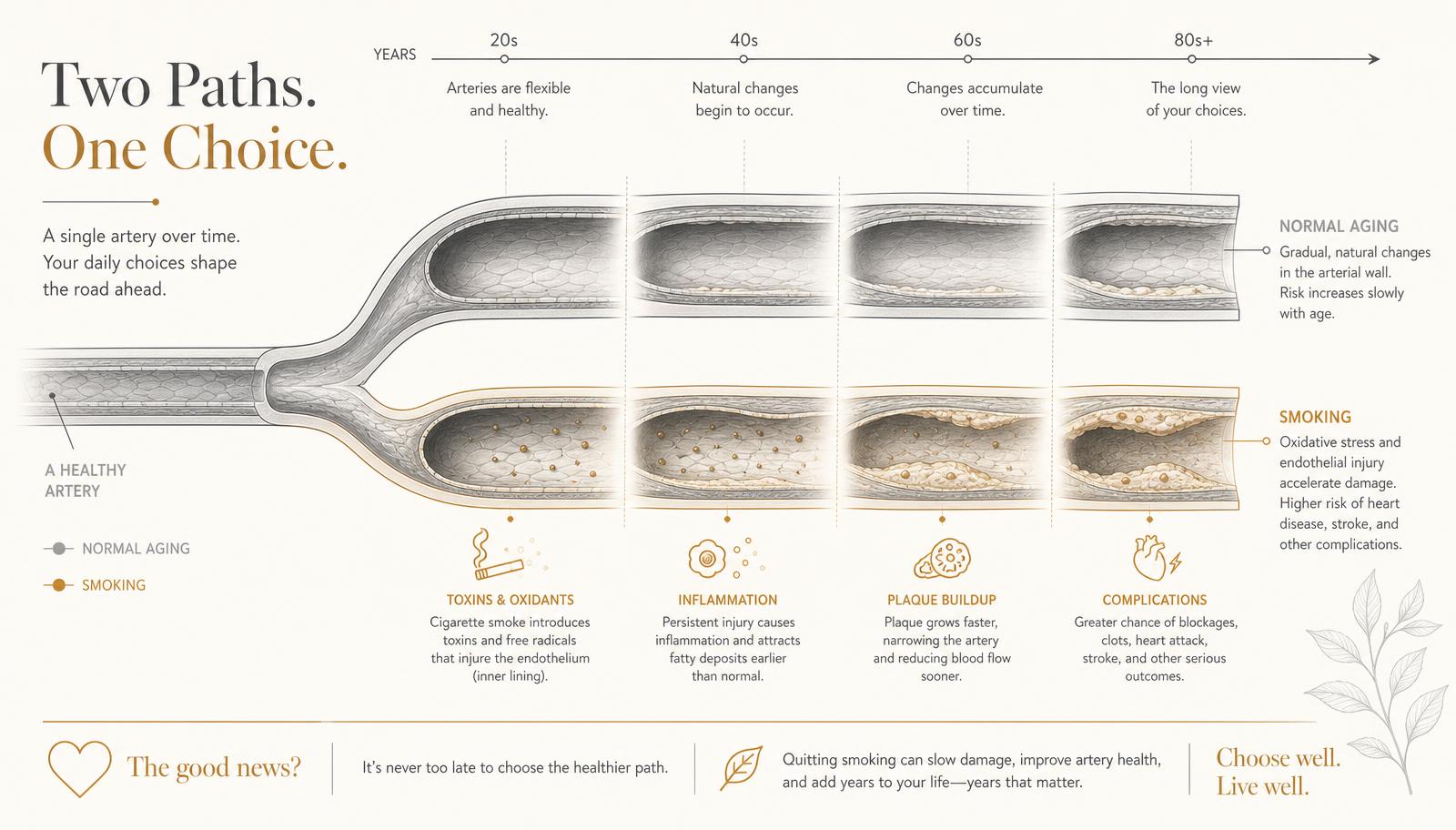
Normal vascular aging tends to involve reduced NO bioavailability, greater oxidative stress, changes in endothelial function and increasing arterial stiffness. Smoking can promote reduced NO availability, greater oxidative stress, endothelial dysfunction and vascular injury. Notice the overlap.
This does not mean smoking and aging are biologically identical — they are not. But they can push several aspects of vascular physiology in the same unfavourable direction. That makes smoking increasingly incompatible with a healthy-aging strategy.
Is It Too Late to Quit After 50?
No. This is one of the most important messages in the entire article. Someone who has smoked for 20, 30 or 40 years may understandably think: "The damage is already done. What difference would quitting make now?" The answer is: a great deal.
Quitting stops repeated exposure. Heart rate and blood-pressure effects from nicotine begin changing quickly. Carbon monoxide levels fall. Circulation and lung function can improve over subsequent weeks. And long-term cardiovascular risk continues to decrease with increasing time since cessation. You cannot change yesterday's exposure. But you can stop adding tomorrow's.
Cardiovascular Recovery Begins Earlier Than Many People Realise
The American Heart Association summarises a broad recovery pattern after smoking cessation. Heart rate and blood pressure begin moving away from nicotine-induced elevations quickly. Carbon monoxide levels normalise over the following days. Circulation and lung function begin improving over subsequent weeks. Over the years that follow, risks for coronary heart disease, stroke and other smoking-related conditions decline substantially.
Those timelines should not be interpreted as exact promises for every individual. Recovery depends on age, duration and intensity of smoking, existing disease, genetics and other lifestyle factors. But the direction is clear: stopping exposure gives the body an opportunity it does not have while exposure continues.
Does Endothelial Function Recover After Quitting?
A 2023 review focusing specifically on smoking cessation and vascular endothelial function concluded that smoking clearly impairs endothelial function through mechanisms including oxidative stress, inflammation and reduced NO bioavailability. Studies of cessation suggest endothelial function can improve, but the response is not identical in every study or every person. [11]
That is exactly what we should expect biologically. Stopping smoking removes an important insult, but the vascular system does not necessarily reset instantly to that of someone who never smoked. Age, accumulated exposure and other cardiovascular risk factors still matter.
Think Recovery, Not Reversal on a Stopwatch
People often want to know: "How long before my arteries are normal?" There is no universal answer. Instead, think in terms of a direction. Every smoke-free day is a day without another dose of combustion products, another acute nicotine exposure, another pulse of carbon monoxide, and another cigarette adding to oxidative and inflammatory stress.
The cardiovascular objective is not to predict the exact date at which every biological effect disappears. It is to stop repeatedly pushing the system in the wrong direction.
Exercise Becomes a Particularly Valuable Partner After Quitting
Stopping smoking removes an adverse vascular exposure. Movement provides a positive vascular stimulus. Exercise increases muscular demand, blood flow rises, and shear stress increases across the endothelium — stimulating signaling involving eNOS and nitric oxide.
So exercise and smoking influence the vascular environment in almost opposite ways. Smoking contributes to oxidative stress and impaired endothelial function; exercise repeatedly challenges the endothelium to respond and adapt. For someone building a healthier life after quitting, regular movement therefore makes biological sense far beyond simply helping with weight control.
Diet Matters Too
A healthy diet cannot neutralise cigarette smoke. But after smoking cessation, diet becomes part of creating a more favourable cardiovascular environment. Vegetables can supply dietary nitrate, potassium, vitamin C, polyphenols and other plant nutrients. Protein foods provide amino acids including L-arginine. Watermelon provides L-citrulline. These nutrients interact with NO biology through different pathways.
The goal is not "eat enough antioxidants to cancel smoking" — that concept is misleading. A better strategy is to remove the major adverse exposure and build healthier habits around the cardiovascular system that remains.
Sleep and Metabolic Health Belong in the Recovery Picture
Smoking often exists within a larger lifestyle pattern: poor sleep, high stress, inactivity, unbalanced diet, metabolic changes. These factors can all influence endothelial function. So quitting smoking can become a useful turning point rather than an isolated health decision. Walk more. Strengthen your muscles. Eat better. Sleep better. Know your blood pressure. Pay attention to blood glucose and lipids. Build cardiovascular capacity.
Can Supplements Protect Nitric Oxide From Smoking?
This needs a very clear answer. No dietary supplement should be presented as protection against cigarette smoking. Smoking affects the vascular system through too many mechanisms. Providing L-arginine does not neutralise smoke toxins. Providing L-citrulline does not remove carbon monoxide. Antioxidant nutrients do not make cigarettes safe. And increasing nutritional support for an NO pathway cannot be assumed to overcome smoking-induced endothelial dysfunction.
If someone smokes, the most powerful smoking-specific cardiovascular intervention is to stop smoking — not to find a stronger supplement.
Where ėNOS Fits
An important naming distinction: eNOS is endothelial nitric oxide synthase — the natural enzyme involved in vascular nitric-oxide production. ėNOS is a dietary supplement from Australiana Life, specifically formulated around nitric-oxide science to support the body's natural NO system, healthy circulation and cardiovascular wellness. Its central L-arginine + L-citrulline combination provides complementary nutritional support for arginine availability relevant to the natural eNOS pathway.
That gives ėNOS a logical role within a healthy cardiovascular lifestyle. But smoking changes the priority. ėNOS is not designed to compensate for smoking. For someone who smokes, stopping tobacco exposure is considerably more important than trying to nutritionally offset its vascular effects.
ėNOS fits naturally alongside the positive behaviours discussed throughout this Lifestyle & Healthy Aging section: regular exercise, less sedentary time, good nutrition, healthy sleep and avoiding tobacco. For someone who has quit smoking — or who has never smoked — ėNOS can provide consistent nutritional support for the body's natural nitric-oxide system as part of that broader cardiovascular strategy. Its role remains to support the physiology, not to protect the body from an avoidable toxic exposure.
If You Smoke, Quitting Deserves More Support Than Willpower Alone
Nicotine dependence is real, and quitting can be difficult. Difficulty quitting should not be mistaken for lack of motivation. Evidence-based approaches can include behavioural support and, when appropriate, medications or nicotine-replacement strategies under suitable professional guidance. The American Heart Association recommends using established cessation support rather than relying on unproven approaches.
If someone has tried to quit before and started smoking again, that does not make another attempt pointless. Many former smokers required more than one attempt. The important cardiovascular direction remains: away from smoking.
Don't Let the Perfect Quit Prevent the Next Quit
Someone may think: "I've already failed three times." But the vascular system does not care how many previous attempts there were. It responds to exposure. If exposure stops again, the biology changes again. That makes every serious quit attempt meaningful. The ultimate objective is complete cessation — but progress toward that objective still matters.

Smoking and Nitric Oxide: The Relationship in Plain English
The science can become complicated — BH4, superoxide, eNOS coupling, oxidative stress, endothelial signaling. But the basic relationship is easy to understand. Healthy endothelial cells use nitric oxide as part of normal vascular communication. Cigarette smoke injures the endothelial environment, increases oxidative stress, reduces NO bioavailability and impairs normal vascular responsiveness. That is why smoking and healthy nitric-oxide biology do not fit comfortably together.
The Most Important NO Decision a Smoker Can Make May Have Nothing to Do With a Supplement
There are many ways to support nitric-oxide biology: exercise, vegetables, arginine, citrulline, healthy sleep, metabolic health, targeted supplementation. But for someone who smokes, one decision stands apart: stop repeatedly exposing the endothelium to cigarette smoke. Everything else can then work in a more favourable environment. That does not guarantee perfect vascular health — nothing does — but it removes one of the most important modifiable cardiovascular insults.
After 50, Removing a Negative Can Be as Important as Adding a Positive
Healthy-aging marketing often focuses on what to add: a supplement, a superfood, another workout, another wellness habit. Sometimes the more powerful decision is to remove something working against the system. Smoking is the clearest example.
If you stop smoking, you are not adding another task to the body. You are removing a repeated cardiovascular burden. Then exercise can provide a healthy vascular stimulus, nutrition can supply useful raw materials, sleep can support physiological regulation, and targeted supplementation can serve the role it was actually intended to serve.
Scientific References
[1] Daiber A, Münzel T, et al. Regulation of endothelial function by cigarette smoke and next-generation tobacco and nicotine products.
Pflügers Archiv — European Journal of Physiology. 2023. PMID: 37285061. Review describing endothelial dysfunction from cigarette smoke and newer tobacco/nicotine products, including oxidative stress and reduced nitric-oxide availability.
PubMed / National Library of Medicine →[2] Münzel T, Hahad O, et al. Tobacco smoking and vascular biology and function: evidence from human studies.
2023. PMID: 36961561. Review of human evidence identifying reduced vascular NO bioavailability, increased superoxide, inflammation and endothelial dysfunction among key effects of cigarette smoking.
PubMed / National Library of Medicine →[3] Abdelghany TM, et al. Cigarette smoke constituents cause endothelial nitric oxide synthase dysfunction and uncoupling due to depletion of tetrahydrobiopterin with degradation of GTP cyclohydrolase.
2018. PMID: 29524646. Experimental evidence linking cigarette-smoke exposure with BH4 depletion, reduced NO production, eNOS dysfunction and increased superoxide.
PubMed / National Library of Medicine →[4] El-Mahdy MA, et al. Chronic cigarette smoke exposure triggers a vicious cycle of leukocyte and endothelial-mediated oxidant stress that results in vascular dysfunction.
2020. PMID: 32412791. Experimental research describing cigarette-smoke-induced oxidative stress, BH4 depletion and eNOS uncoupling.
PubMed / National Library of Medicine →[5] The association between smoking exposure and endothelial function evaluated using flow-mediated dilation values: a meta-analysis.
2024. PMID: 38840064. Meta-analysis of 14 studies finding significantly poorer flow-mediated dilation with smoking exposure.
PubMed / National Library of Medicine →[6] Decreased expression of neuronal nitric oxide synthase contributes to the endothelial dysfunction associated with cigarette smoking in humans.
2020. PMID: 32109572. Human vascular research reporting reduced NO production and impaired endothelium-dependent relaxation in arteries from smokers.
PubMed / National Library of Medicine →[7] Cigarette smoke extract and its cytotoxic factor acrolein inhibit nitric oxide production in human vascular endothelial cells.
2020. PMID: 32879145. Experimental research demonstrating effects of cigarette-smoke extract and acrolein on eNOS activation, expression and NO production.
PubMed / National Library of Medicine →[8] Cigarette smoking and atherosclerotic cardiovascular disease.
2024. PMID: 38220184. Review describing endothelial dysfunction, inflammation, thrombosis, reduced NO bioavailability and increased superoxide as major mechanisms of smoking-related cardiovascular injury.
PubMed / National Library of Medicine →[9] Effect of passive smoking on endothelial function in healthy adults.
PMID: 15656044. Human study finding impaired flow-mediated dilation in passive smokers as well as active smokers compared with unexposed nonsmokers.
PubMed / National Library of Medicine →[10] Secondhand smoke as an acute threat for the cardiovascular system: a change in paradigm.
PMID: 16230308. Review describing acute endothelial dysfunction, oxidative stress and NO inactivation associated with secondhand-smoke exposure.
PubMed / National Library of Medicine →[11] Higashi Y. Smoking cessation and vascular endothelial function.
Hypertension Research. 2023;46(12):2670–2678. PMID: 37828134. Review describing reduced NO bioavailability as an important mechanism of smoking-related endothelial dysfunction and evaluating evidence for vascular improvement after cessation.
PubMed / National Library of Medicine →
Continue the Lifestyle & Healthy Aging Journey
- LIFESTYLE HABITS THAT SUPPORT HEALTHY NITRIC OXIDE PRODUCTION →
See how tobacco avoidance fits alongside movement, diet, sleep and metabolic health.
- EXERCISE & NITRIC OXIDE: WHY MOVEMENT MATTERS →
Explore the positive endothelial stimulus that physical activity provides.
- CAN A SEDENTARY LIFESTYLE AFFECT NITRIC OXIDE & CIRCULATION? →
Understand another lifestyle factor influencing blood flow and endothelial responsiveness.
- DIET & NITRIC OXIDE: HOW EVERYDAY FOOD CHOICES MATTER →
See how everyday nutrition supports the biological environment in which NO is produced.
- NITRIC OXIDE AND OXIDATIVE STRESS →
Go deeper into the chemistry explaining why producing NO is only half the story — preserving its availability matters too.
DISCOVER HOW ĖNOS FITS INTO A HEALTHY, SMOKE-FREE LIFESTYLE
Smoking works against healthy endothelial function and nitric-oxide availability. Quitting removes that repeated exposure — then movement, good food, healthy sleep and cardiovascular fitness can take over. ėNOS by Australiana Life is designed to complement those healthy choices by providing L-arginine + L-citrulline and deliberately selected supporting nutrients for the body's natural nitric-oxide system, healthy circulation and cardiovascular wellness. No supplement should be used as justification to continue smoking.
EXPLORE ĖNOS →This article is provided for informational purposes only and is not intended as medical advice or to diagnose, treat, cure or prevent disease. Smoking and tobacco dependence are significant health issues, and people seeking to quit may benefit from evidence-based cessation support and appropriate professional guidance. ėNOS is a dietary supplement formulated to support the body's natural nitric-oxide system, healthy circulation and cardiovascular wellness. It is not intended to prevent or counteract the cardiovascular effects of smoking. Dietary supplements should complement, rather than replace, a smoke-free lifestyle, appropriate nutrition, physical activity and medical care.
More in Lifestyle & Healthy Aging
- Nitric Oxide & Exercise Performance
- Nitric Oxide & Exercise Recovery
- Lifestyle Habits That Support Healthy Nitric Oxide Production
- Exercise & Nitric Oxide: Why Movement Matters
- Can a Sedentary Lifestyle Affect Nitric Oxide & Circulation?
- Diet & Nitric Oxide: How Everyday Food Choices Matter
- Sleep, Cardiovascular Health & Nitric Oxide: What Do We Know?
- Nitric Oxide, Energy & Staying Active as We Age
- Nitric Oxide & Men's Sexual Health: The Blood-Flow Connection
- Nitric Oxide & Oral Health: The Surprising Connection
- Nitric Oxide & Aging: What Changes After 40, 50 and Beyond?
- Why Does Nitric Oxide Production Change With Age?
- Healthy Aging: Supporting Circulation, Blood Flow & Nitric Oxide After 50
- Nitric Oxide and Brain Health/Cognition
About Our Health & Science Content
Australiana Life Health & Science articles are based on published scientific research and written to make complex health and nitric oxide science easier to understand. Our educational content undergoes scientific review for accuracy and appropriate interpretation of the evidence and is updated as relevant scientific understanding evolves.