
Diet & Nitric Oxide: How Everyday Food Choices Matter
How the Way You Eat Can Support Nitric Oxide Production, Endothelial Function and Healthy Circulation — Especially After 50
Every meal changes your internal environment. Blood glucose changes. Amino acids enter the circulation. Fats are absorbed. Minerals arrive. Plant compounds are metabolized. Hormones respond. And the cells lining your blood vessels experience the consequences.
That makes diet highly relevant to nitric oxide — NO. Not because there is one magical "nitric oxide food." There isn't. Diet can influence NO biology in several different ways:
- Providing nitrate that can be converted toward nitric oxide
- Providing amino acids involved in the eNOS pathway
- Supporting the broader endothelial and antioxidant environment
- Influencing metabolic conditions that can either favor or work against healthy NO availability
This becomes increasingly important as we age. Research shows that NO bioavailability and endothelial function tend to become less efficient with advancing age [9]. Diet cannot stop aging, but it is one of the everyday factors we can control that influences the environment in which the cardiovascular system operates.
The most useful question is not "What food increases nitric oxide the most?" It is: "What kind of diet repeatedly supports the biology that produces and preserves healthy nitric oxide?"
Your Blood Vessels Experience Every Meal
We tend to judge food by calories, protein, fat, carbohydrate or body weight. But food also has immediate effects on the vascular system. Researchers can measure changes in endothelial function before and after meals.
The endothelium is the one-cell-thick lining covering the inside of blood vessels. One of its important functions is the production of nitric oxide through eNOS — endothelial nitric oxide synthase. So when diet improves or impairs endothelial function, nitric-oxide biology is often part of the explanation.
A major 2025 systematic review analyzed 133 randomized dietary studies examining whole foods and dietary patterns in relation to flow-mediated dilation, a measure of endothelial function [1]. Fruits, vegetables, nuts and seeds, soy, tea and Mediterranean-style dietary patterns were among the interventions associated with improved endothelial function, although the certainty of evidence varied among food categories.
Diet is not only fuel for your body. It is part of the environment your blood vessels live in.
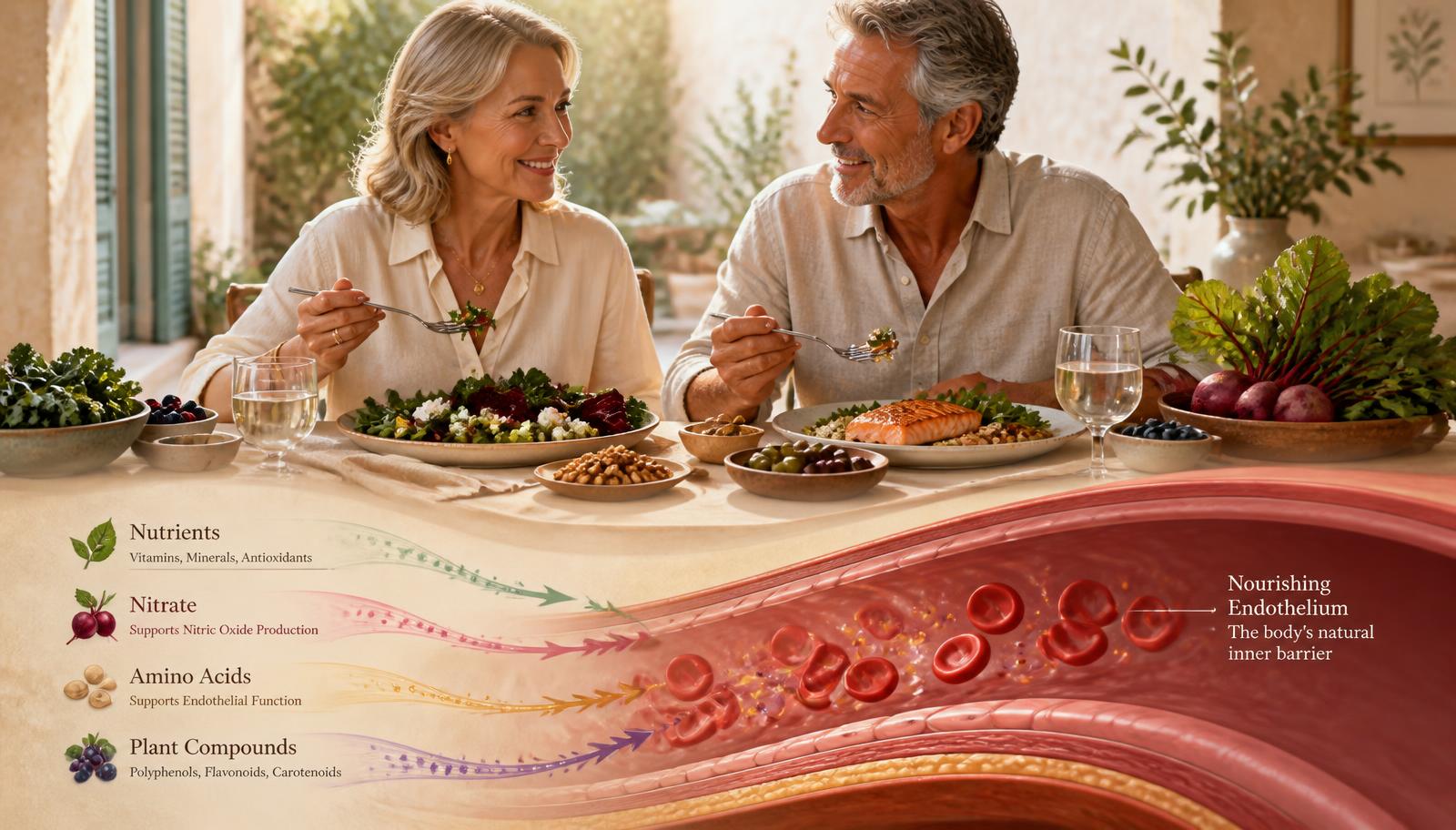
There Are Two Major Nutritional Routes Toward Nitric Oxide
To understand how diet matters, it helps to remember that nutrition interacts with at least two major NO pathways.
Route One: The Arginine / eNOS Pathway
L-arginine is therefore the direct amino-acid substrate for endothelial NO production [5]. L-citrulline can also contribute because the body can convert it into arginine [6].
Route Two: The Nitrate / Nitrite Pathway
Certain vegetables supply dietary nitrate. The body can then use the nitrate → nitrite → nitric oxide route, which involves digestion, circulation, salivary recycling and nitrate-reducing bacteria living in the mouth [4]. So food can approach nitric-oxide biology from more than one direction. That makes diet considerably more interesting than simply eating one "NO superfood."
Choice #1: Make Vegetables a Daily Habit, Not an Occasional Side Dish
If there is one food category with an especially direct relationship to nitric-oxide biology, it is vegetables. Particularly nitrate-rich choices can include:
- Arugula / rocket
- Spinach
- Lettuce
- Beetroot
- Celery
- Other leafy greens
Vegetable nitrate can participate in the nitrate → nitrite → NO pathway. The scientific literature now recognizes this as an important complementary route to the classical arginine/eNOS pathway [4].
But vegetables do much more than provide nitrate. They also deliver combinations of:
- Potassium
- Vitamin C
- Folate
- Polyphenols
- Carotenoids
- Fiber and numerous other plant compounds
That is one reason thinking in terms of vegetable-rich dietary patterns is generally more useful than chasing one isolated nutrient.
The Best Vegetable May Be the One You Actually Eat Regularly
It is easy for nutritional science to become unnecessarily complicated. Should you eat spinach or arugula? Raw beetroot or cooked beetroot? Which lettuce has the highest nitrate? Those are interesting scientific questions. But for everyday health, consistency matters more.
The vegetable you enjoy and eat frequently may provide more practical value than the theoretically perfect food you rarely buy. Instead of asking "Which vegetable gives me the most nitric oxide?" try "How can I get vegetables onto my plate more often?" That is a better lifestyle question.
Choice #2: Think Beyond Nitrate
One reason this article is different from a simple list of nitrate-rich foods is that NO biology is larger than the nitrate pathway. Remember: eNOS uses L-arginine. Arginine occurs naturally in many protein-containing foods, including fish, meat, poultry, dairy foods, legumes, nuts and seeds. Your body can also synthesize arginine.
So adequate, balanced protein nutrition contributes to the amino-acid environment in which the classical NO pathway operates. A review of arginine and endothelial biology describes L-arginine as a fundamental substrate in NO synthesis and vascular-tone regulation [5].
That does not mean eating an arginine-containing food automatically causes a large increase in NO. Human metabolism regulates the pathway. The important point is simpler: protein provides biological raw material.
Choice #3: Include Foods That Support the Citrulline–Arginine Connection
L-citrulline adds another piece to the nutritional puzzle. The best-known natural source is watermelon. Citrulline is metabolized differently from arginine. After absorption, it can circulate and then be converted — importantly through the kidneys — into L-arginine.
Research reviews consistently show that oral citrulline can increase circulating arginine efficiently because it avoids much of the first-pass metabolism that affects oral arginine [6].
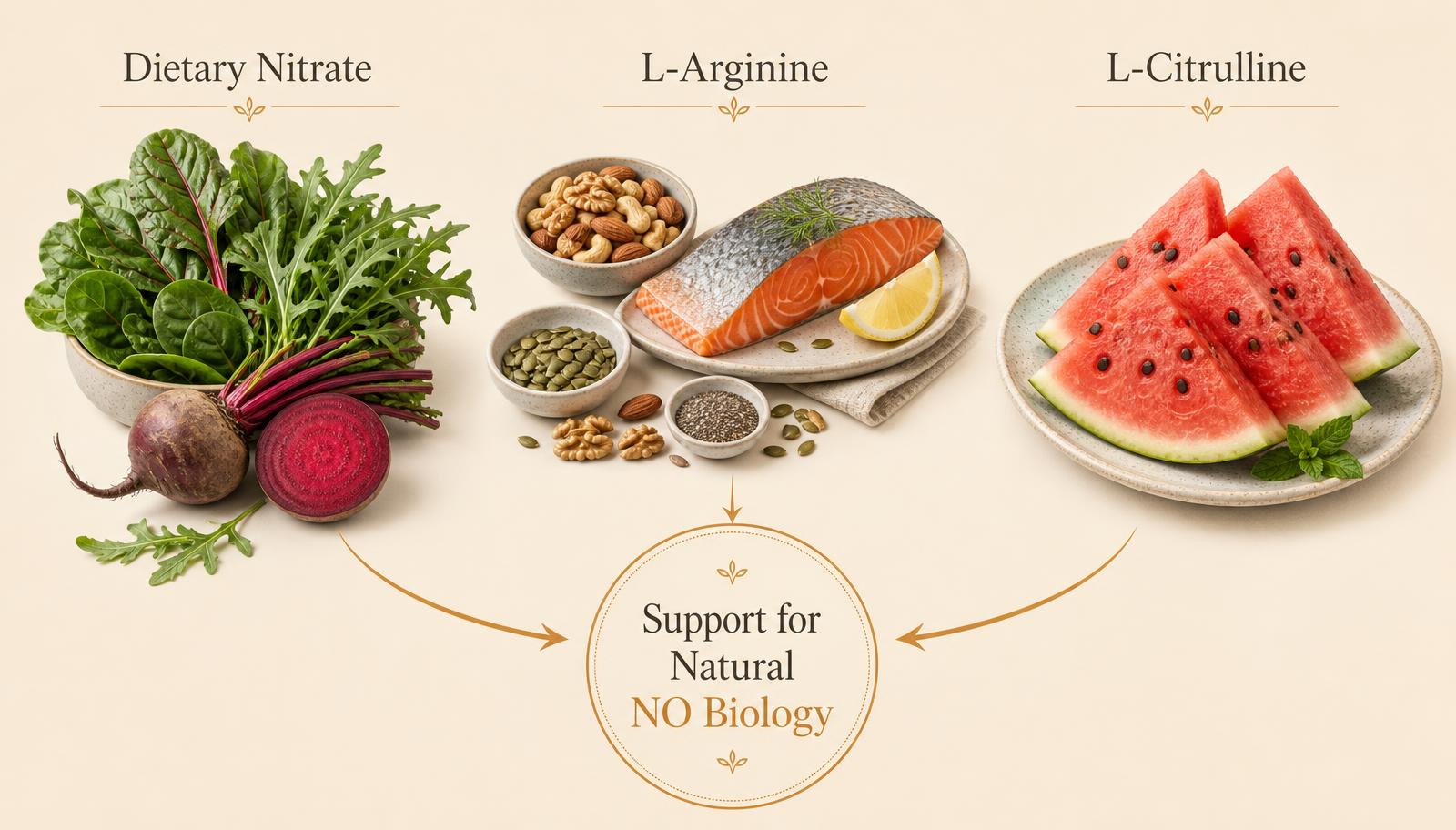
- Protein foods contribute arginine
- Watermelon contributes citrulline
- Vegetables contribute nitrate
Different foods interact with NO biology through different mechanisms. That is a much richer nutritional story than looking for one "nitric oxide food."
Choice #4: Build Meals Around a Pattern, Not a Supplement-Style Ingredient List
Healthy diets rarely succeed because of one individual food. The strongest dietary patterns combine:
- Vegetables
- Fruit
- Nuts and seeds
- Legumes
- Appropriate protein
- Whole or minimally processed foods
- Suitable sources of unsaturated fats
One of the most studied examples is the Mediterranean-style diet. A systematic review and meta-analysis of randomized trials found that Mediterranean dietary interventions improved endothelial function, including flow-mediated dilation [3]. A more recent 2025 review of dietary patterns similarly concluded that healthy dietary patterns can help maintain endothelial integrity, while dietary quality appears closely connected to vascular and cardiometabolic function [2].
This does not mean everyone needs to eat exactly like someone living beside the Mediterranean Sea. The principles matter more than geography.
What Does an NO-Friendly Eating Pattern Actually Look Like?
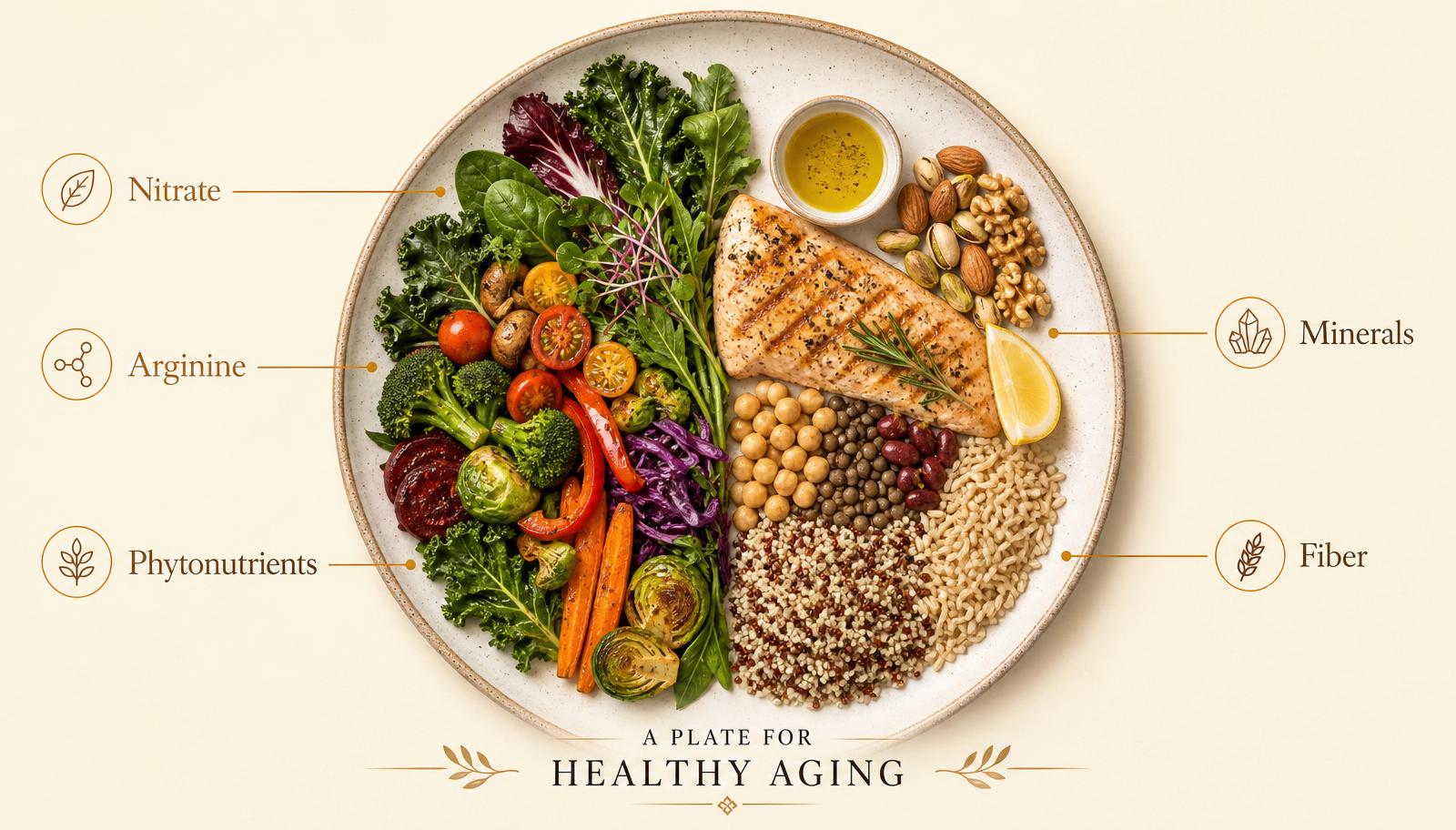
It is surprisingly ordinary. A meal might include:
- A large portion of vegetables
- A good protein source
- Some nuts, seeds or legumes
- A suitable whole-food carbohydrate
- Fruit
- A healthy source of fat
Nothing about that meal needs to say "Nitric Oxide Diet." It is simply good food. And that is the point. The dietary pattern that supports NO biology also tends to support cardiovascular health, metabolic health, healthy aging and overall nutritional quality.
Choice #5: Eat More Color
Colorful plants contain a wide variety of phytonutrients — polyphenols, anthocyanins, flavonoids, carotenoids and vitamin C. These compounds do not all directly manufacture nitric oxide. That distinction is important. Their value is broader.
Nitric oxide exists inside a biochemical environment influenced by oxidative stress, inflammation, endothelial function and metabolic health. Plant-rich nutrition can contribute to that wider environment. The 2025 randomized-trial meta-analysis of whole foods found favorable endothelial effects across several plant-food categories rather than identifying one uniquely powerful food [1]. That supports a simple recommendation: diversity matters.
Why This Makes Australian Superfruits Interesting
This is also where fruits such as Kakadu Plum and Davidson's Plum fit naturally into the story. They should not be described as direct nitric-oxide generators. They are not. Kakadu Plum is especially notable for naturally occurring vitamin C, while both fruits contain plant compounds contributing to their broader phytonutrient profile.
Their value is therefore complementary: they contribute to the nutritional environment surrounding cardiovascular and NO biology rather than replacing the central arginine/eNOS or nitrate pathways. That distinction gives them a credible role.
Choice #6: Don't Treat Dietary Fat as Simply "Good" or "Bad"
Nutrition becomes misleading when one nutrient is made the villain. Fat is a good example. The body needs dietary fats. Some foods naturally rich in fat — including nuts, seeds, olive oil and fish — fit well within dietary patterns associated with cardiovascular benefit. Mediterranean diets incorporating olive oil have shown favorable effects on endothelial and inflammatory markers compared with control diets in clinical trials and meta-analyses [3].
But extremely high-fat challenge meals are different. A large systematic review found that a single high-fat meal could temporarily reduce flow-mediated dilation during the hours after eating [7]. That does not mean "fat destroys nitric oxide." Meal composition, fat type, quantity and the rest of the diet matter. The sensible lesson is that cardiovascular nutrition is about the quality of the whole meal.
Your Blood Vessels Also Have a Post-Meal Period
We usually think: eat → digest → finished. But after a meal, the body enters the postprandial period. For several hours blood lipids may rise, glucose changes, insulin responds, oxidative metabolism shifts and endothelial behavior can change.
If most meals are nutritionally balanced, this is normal physiology. But if someone repeatedly consumes large, highly processed meals that create unfavorable metabolic conditions, the vascular system experiences those conditions repeatedly too.
The endothelium doesn't experience your "average diet." It experiences breakfast. Then lunch. Then dinner. Day after day.
Choice #7: Be Thoughtful About Highly Processed Foods
Not everything processed is unhealthy. Frozen vegetables are processed. Yogurt is processed. Canned beans are processed. The issue is not simply whether humans touched the food. The concern is dietary patterns dominated by ultra-processed foods that can displace nutrient-dense whole foods.
A recent umbrella review found higher ultra-processed-food consumption was associated with increased incidence of cardiovascular disease and type 2 diabetes, among other outcomes, although much of this evidence is observational and cannot prove that every processed food has the same effect.
For NO health, the more immediate issue is opportunity cost. A diet dominated by ultra-processed choices may contain less vegetable nitrate, potassium, fiber, phytonutrients and whole-food nutritional diversity. Instead of obsessing over whether a particular packaged food is "bad," ask: what percentage of my diet is coming from foods that actually contribute something useful?
Choice #8: Pay Attention to Excess Sodium
Sodium is essential. The body needs it for fluid balance, nerve signaling and muscle physiology. So this is not another argument that salt is inherently toxic. But chronically excessive sodium intake can become relevant to vascular health. Research suggests high-sodium diets can impair NO-mediated endothelial function even in some situations where blood pressure does not change substantially [8].
Proposed mechanisms include:
- Greater oxidative stress
- Reduced NO bioavailability
- Changes in endothelial-cell stiffness
- Effects on the endothelial glycocalyx
That creates another practical dietary principle: taste your food — but don't let highly salted processed food become your dietary foundation.
Potassium Is Part of the Other Side of the Story
Potassium-rich foods include many vegetables, fruits, beans, legumes and other whole foods. The balance between dietary sodium and potassium is relevant to cardiovascular physiology. That is another reason whole-food patterns often outperform isolated nutritional rules.
When you eat more vegetables and fruit, you are not merely "adding nitrate." You are simultaneously changing potassium intake, fiber, plant compounds, energy density and overall diet quality. Nutrition works as a system.
Choice #9: Support Metabolic Health With the Way You Eat
Nitric-oxide biology is closely connected to metabolic health. Conditions involving insulin resistance, high blood glucose, excess visceral fat, high blood pressure and oxidative stress can create a less favorable endothelial environment.
That means eating for NO health cannot be separated completely from eating for healthy glucose regulation, healthy body composition and cardiovascular wellness. A healthy dietary pattern does not support nitric oxide because every food directly creates NO. It supports the physiology in which normal NO signaling takes place.
After 50, This Broader Environment Matters More
Aging changes the vascular system. Research identifies declining NO bioavailability as one feature of cardiovascular aging, influenced by reduced NOS activity, oxidative stress, metabolic changes and other factors [9].
That means the diet that seemed "good enough" at 30 may deserve more attention at 50, 60, 70 and beyond. Not because older adults require a bizarre special diet. Quite the opposite — the basics become more important: vegetables, protein, plant variety, appropriate portions, healthy fats, less reliance on highly processed foods, and consistency.
Food Does Not Stop Working After 50
The body does not suddenly lose the ability to obtain nutritional support from food. Nitrate-rich vegetables can still contribute to the nitrate pathway. Protein still supplies amino acids. Citrulline can still become arginine. Plant foods still provide phytonutrients.
But the biological environment in which these nutrients operate changes with age. NO production and bioavailability can become less efficient. Oxidative stress may increase. Endothelial function can decline. So a good diet becomes more valuable, not less.
But Food Intake Is Not Perfectly Consistent
One day you eat leafy greens, quality protein, nuts, fruit and a balanced dinner. The next day you travel. Or eat out. Or skip lunch. Or have little appetite. That is normal. Food is naturally variable. Even the nitrate concentration in two apparently identical vegetables can differ according to soil, growing conditions, season, storage and preparation.
So food should remain the foundation. But expecting food to provide identical amounts of specific NO-supporting nutrients every day is unrealistic. This is where targeted supplementation can complement a good diet.
Choice #10: Don't Let "Healthy Eating" Become So Complicated That You Stop Doing It
Nutrition advice has a tendency to become overwhelming. Count this. Avoid that. Measure this. Never eat that. NO biology does not require that kind of anxiety. A useful everyday framework is much simpler.
- Put plants on the plate — especially vegetables
- Include appropriate protein to provide amino acids and help preserve muscle
- Eat color to increase nutritional variety
- Choose whole foods often, letting minimally processed foods make up much of the diet
- Use healthy fats appropriately — nuts, seeds, olive oil and suitable fish fit naturally
- Don't oversalt everything, particularly when processed foods already provide substantial sodium
- Repeat — the dietary pattern matters more than one perfect meal
A Sample Day Without Calling It an "NO Diet"
Breakfast
Greek yogurt or another suitable protein source with berries, nuts or seeds. Or eggs with vegetables and whole-grain toast.
Lunch
A salad built around spinach, arugula or other leafy greens with vegetables, appropriate protein, legumes or seeds.
Snack
Fruit, nuts, or watermelon when available.
Dinner
Fish, poultry, legumes or another appropriate protein accompanied by several vegetables. Beetroot, leafy greens or other nitrate-containing vegetables can rotate through meals.
Drinks
Water as the everyday foundation, with tea or coffee according to individual preference and tolerance. There is nothing exotic here. That is a strength. A good lifestyle should be livable.
Do Tea, Cocoa and Other Plant Foods Matter?
Interestingly, the 2025 systematic review of randomized trials found favorable FMD results in several categories including tea, cocoa, fruit, vegetables, nuts and seeds [1]. But those findings should not be interpreted as permission to turn tea, dark chocolate or any single food into an NO treatment. Evidence quality varied, and food products differ substantially. The broader lesson is more useful: a varied plant-rich diet repeatedly appears favorable to endothelial function.
Food First Does Not Have to Mean Food Only
People often frame the choice as food OR supplements. That is not how the two need to relate. Food provides energy, protein, fiber, vitamins, minerals, plant compounds and thousands of other components in complex combinations. A targeted supplement can provide specific ingredients in consistent amounts for a particular nutritional purpose. Those roles are different. They can complement one another.
Where ėNOS Fits Into the Diet Story
An important distinction: eNOS is endothelial nitric oxide synthase — the natural enzyme involved in vascular nitric-oxide production. ėNOS is a dietary supplement from Australiana Life, specifically formulated around nitric-oxide science to provide nutritional support for the body's natural NO system, healthy circulation and cardiovascular wellness.
At the center of ėNOS are L-arginine and L-citrulline. Arginine is the direct substrate used by eNOS. Citrulline provides a complementary metabolic route toward replenishing circulating arginine availability. That makes ėNOS particularly relevant as a consistent nutritional complement to a healthy diet, rather than a replacement for one.
Why ėNOS and Good Food Make Sense Together
A plate of leafy vegetables can support the nitrate → nitrite → NO route. Meanwhile, ėNOS provides L-arginine and L-citrulline relevant to the arginine → eNOS → NO route. And plant-rich meals provide the broader nutritional environment in which cardiovascular physiology operates.
There is no reason to choose vegetables or ėNOS. The more logical healthy-aging strategy is good food + active living + targeted nutritional support. Different tools. Different roles. One cardiovascular system.
ėNOS also contains complementary nutrients rather than relying on amino acids alone. Magnesium contributes broadly to normal muscle, nerve, metabolic and cardiovascular physiology. Kakadu Plum and Davidson's Plum contribute plant-derived nutrients and phytonutrients to the wider formula. Again, these ingredients should not all be described as direct NO generators. Their purpose is broader — the formula reflects the same principle as a healthy diet: different nutrients can support different parts of the physiological environment.
Don't Eat for a Molecule. Eat for the System.
Nitric oxide is extremely important. But you do not need to structure every bite around producing more of it. Eat for your heart, your arteries, your muscles, your brain, your metabolism, your gut, your energy and your long-term health.
When you do that well, many of the same food choices naturally support the environment in which healthy NO biology occurs. Leafy greens supply nitrate. Protein supplies amino acids. Watermelon supplies citrulline. Plants supply phytonutrients. Mineral-rich whole foods contribute to normal physiology. And the entire dietary pattern helps influence metabolic and endothelial health.
The Best Diet for Nitric Oxide May Simply Be a Good Diet Repeated Often
There is no need for a branded "nitric oxide diet." There is no single miracle vegetable. There is no food that permanently fills an NO reservoir. Nitric oxide is produced continually according to physiological need. The smarter dietary goal is to give that natural system a favorable environment repeatedly.
Eat vegetables. Eat enough appropriate protein. Eat plant variety. Choose whole foods often. Moderate foods that work against cardiometabolic health when consumed excessively. Stay active. And support the pathways nutritionally when appropriate.
One meal will not define your cardiovascular health. But thousands of meals eventually become your lifestyle. And your lifestyle becomes part of your physiology.
Scientific References
[1] Whole Foods and Dietary Patterns — 2025 Systematic Review
The effects of whole foods and dietary patterns on flow-mediated dilation: a systematic review and meta-analysis of randomized controlled trials. 2025. PMID: 40972869. Analysis of 133 randomized dietary studies reporting favorable endothelial-function findings for several whole-food groups and Mediterranean dietary patterns, while noting moderate-to-low certainty for portions of the evidence.
PubMed / National Library of Medicine →[2] Dietary Patterns and Endothelial Function — 2025 Review
Dietary patterns and endothelium dysfunction: a literature review. Nutrition, Metabolism and Cardiovascular Diseases. 2025. PMID: 41486026. Contemporary review examining dietary patterns and maintenance of endothelial integrity.
PubMed / National Library of Medicine →[3] Mediterranean Diet and Endothelial Function
Mediterranean Diet and its Effect on Endothelial Function: A Meta-analysis and Systematic Review. PMID: 35192097. Meta-analysis of randomized studies finding improvements in flow-mediated dilation and other endothelial outcomes with Mediterranean-style diets.
PubMed / National Library of Medicine →[4] Bondonno CP, Croft KD, Hodgson JM. Dietary Nitrate, Nitric Oxide, and Cardiovascular Health.
Critical Reviews in Food Science and Nutrition. PMID: 25976309. Review describing vegetable-derived nitrate and the complementary nitrate–nitrite–NO pathway.
PubMed / National Library of Medicine →[5] Arginine and Endothelial Function
Arginine and Endothelial Function. PMID: 32781796. Review describing L-arginine's role in nitric-oxide synthesis and regulation of vascular tone.
PubMed / National Library of Medicine →[6] Allerton TD, Proctor DN, Stephens JM, et al. L-Citrulline Supplementation: Impact on Cardiometabolic Health.
Nutrients. 2018;10(7):921. PMID: 30029482. Review describing citrulline absorption, conversion toward arginine and relevance to NO biology.
PubMed / National Library of Medicine →[7] High-Fat Meals and Endothelial Function
A single, high-fat meal adversely affects postprandial endothelial function: a systematic review and meta-analysis. PMID: 35665799. Large meta-analysis showing temporary reductions in flow-mediated dilation after experimental high-fat meal challenges, with considerable heterogeneity among studies.
PubMed / National Library of Medicine →[8] Patik JC, Lennon SL, Farquhar WB, Edwards DG. Mechanisms of Dietary Sodium-Induced Impairments in Endothelial Function and Potential Countermeasures.
Nutrients. 2021;13(1):270. PMID: 33477837. Review describing mechanisms by which excess dietary sodium may impair NO-mediated endothelial function.
PubMed / National Library of Medicine →[9] Cardiovascular Aging and Nitric Oxide
Declining nitric oxide bioavailability in cardiovascular aging: mechanistic insights and emerging interventions. 2025. PMID: 41953454. Review describing impaired NOS activity, oxidative stress and metabolic changes as contributors to declining NO bioavailability with age.
PubMed / National Library of Medicine →
Continue the Lifestyle & Healthy Aging Journey
- LIFESTYLE HABITS THAT SUPPORT HEALTHY NITRIC OXIDE PRODUCTION →
See how diet fits alongside exercise, sleep, oral health and other everyday choices.
- EXERCISE & NITRIC OXIDE: WHY MOVEMENT MATTERS →
Understand how physical activity turns blood flow into an endothelial signal.
- FOODS THAT SUPPORT NATURAL NITRIC OXIDE PRODUCTION →
Take a deeper look at the individual foods connected with nitrate, arginine and citrulline.
- DIETARY NITRATES AND NITRIC OXIDE →
Follow the remarkable nitrate → oral microbiome → nitrite → NO pathway.
DISCOVER HOW ĖNOS COMPLEMENTS A HEALTHY-NO DIET
Your diet does not need to revolve around nitric oxide, but the food choices you make every day help create the environment in which your nitric-oxide system operates. ėNOS by Australiana Life complements a healthy diet by providing L-arginine + L-citrulline and deliberately selected supporting nutrients in a consistent daily formulation designed to support the body's natural nitric-oxide system, healthy circulation and cardiovascular wellness.
EXPLORE ĖNOS →This article is provided for informational purposes only and is not intended as medical advice or to diagnose, treat, cure or prevent disease. Individual nutritional needs vary according to age, health status, medications and other factors. ėNOS is a dietary supplement formulated to support the body's natural nitric-oxide system, healthy circulation and cardiovascular wellness. Dietary supplements should complement, rather than replace, appropriate nutrition, physical activity and medical care.
More in Lifestyle & Healthy Aging
- Nitric Oxide & Exercise Performance
- Nitric Oxide & Exercise Recovery
- Lifestyle Habits That Support Healthy Nitric Oxide Production
- Exercise & Nitric Oxide: Why Movement Matters
- Can a Sedentary Lifestyle Affect Nitric Oxide & Circulation?
- Sleep, Cardiovascular Health & Nitric Oxide: What Do We Know?
- Smoking, Vascular Health & Nitric Oxide
- Nitric Oxide, Energy & Staying Active as We Age
- Nitric Oxide & Men's Sexual Health: The Blood-Flow Connection
- Nitric Oxide & Oral Health: The Surprising Connection
- Nitric Oxide & Aging: What Changes After 40, 50 and Beyond?
- Why Does Nitric Oxide Production Change With Age?
- Healthy Aging: Supporting Circulation, Blood Flow & Nitric Oxide After 50
- Nitric Oxide and Brain Health/Cognition
About Our Health & Science Content
Australiana Life Health & Science articles are based on published scientific research and written to make complex health and nitric oxide science easier to understand. Our educational content undergoes scientific review for accuracy and appropriate interpretation of the evidence and is updated as relevant scientific understanding evolves.