
Exercise and Nitric Oxide: Why Movement Matters
How Walking, Aerobic Exercise, Strength Training and Everyday Activity Help Support Your Body's Natural NO System
Exercise does something remarkable to your blood vessels.
The moment muscles begin working, they ask for more. More oxygen. More nutrients. More blood flow.
The cardiovascular system responds almost immediately. The heart increases its output. Blood-flow patterns change. Vessels supplying active muscles adjust. And the endothelial cells lining those vessels sense the increased movement of blood across their surface.
One of the signaling systems involved in that response is nitric oxide — NO.
This is one reason exercise and nitric oxide are so closely connected. Exercise does not simply burn calories or strengthen muscle. It repeatedly gives your vascular system a biological signal to respond, adapt and remain active.
And as we age — when endothelial function and NO bioavailability tend to become less efficient — that repeated stimulus becomes increasingly valuable.
Movement Is a Message to Your Blood Vessels
Most people think of exercise in terms of muscles. Muscles contract. Muscles get stronger. Muscles use energy.
But every exercising muscle depends upon the cardiovascular system. When a muscle starts working, its metabolic demand rises. It requires additional oxygen and nutrients. The cardiovascular system must therefore increase and redistribute blood flow.
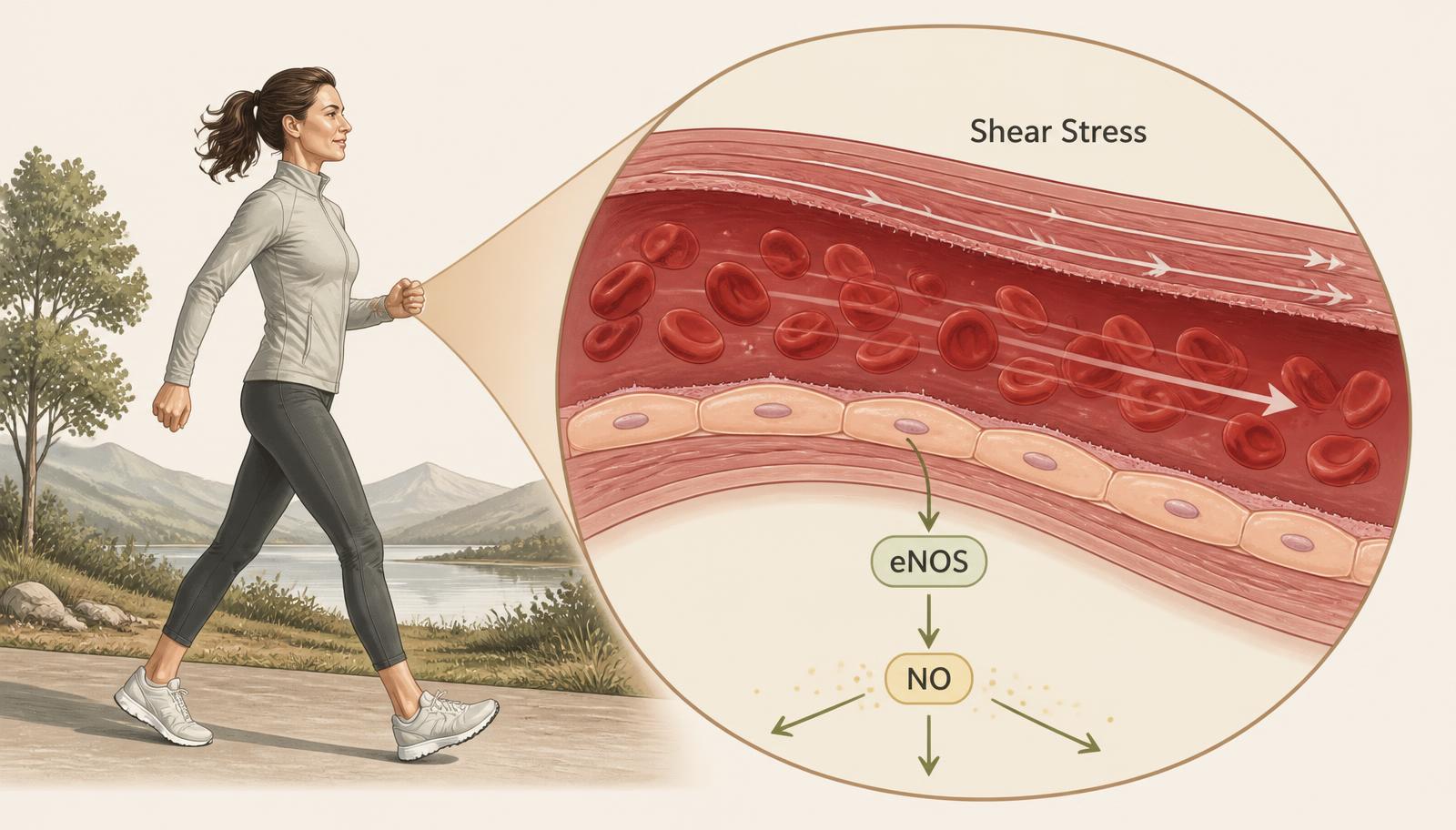
This increase in blood flow produces a physical force against the endothelial lining of blood vessels called shear stress.
Shear stress is not damage. Under normal physiological conditions, it is an important signal that endothelial cells are designed to detect. Current vascular research describes shear stress as a major regulator of endothelial homeostasis and a powerful link between blood flow and vascular-cell behavior. [2]
The Endothelium Can Feel Blood Moving
The endothelium is a single-cell-thick lining covering the inside of blood vessels. These cells are not passive. They contain molecular structures capable of sensing:
- Blood-flow direction
- Blood-flow intensity
- Pressure
- Mechanical stretch
- And chemical signals
When exercise increases healthy forward-flow patterns, endothelial cells detect the change. That mechanical information is converted into biochemical signals through a process called mechanotransduction. [1]
The endothelium has effectively translated movement of blood into cellular chemistry. That is one of the most elegant examples of exercise physiology.
What Is eNOS?
Inside endothelial cells is an enzyme called eNOS — endothelial nitric oxide synthase. eNOS uses the amino acid L-arginine as substrate in the natural production of nitric oxide.
NO can then diffuse toward nearby vascular smooth muscle. There it participates in signaling that helps the muscle relax and allows the blood vessel to adjust its diameter. That is part of how the vascular system responds to changing demand.
Exercise provides one of the physiological signals capable of activating this natural system.
The Exercise–NO Relationship in One Sequence
Why This Is More Than a Temporary "Workout Pump"
Nitric oxide became famous in sports nutrition partly because of the visible muscle "pump" associated with exercise. That can make NO sound like a bodybuilding phenomenon. It isn't.
The workout pump is only one highly visible example of changing blood flow. The much more important story is that exercise repeatedly trains vascular responsiveness. The endothelium experiences changes in flow. The microcirculation adapts. NO-related signaling responds. The cardiovascular system becomes accustomed to matching blood supply with tissue demand.
For healthy aging, that is far more significant than whether your muscles temporarily look fuller after a workout.
One Workout and Regular Training Are Not the Same Thing
A single exercise session produces acute changes. Blood flow rises. Shear stress changes. NO signaling responds. Heart rate increases. Metabolic demand rises.
But repeated exercise can produce longer-term adaptation. With consistent training, research has found:
- Improved endothelial function
- Greater NO-mediated vasodilation
- Reduced oxidative stress
- Improved antioxidant capacity
- And adaptations within the microcirculation
So there are really two NO stories. During exercise, NO participates in the immediate vascular response. With regular exercise, the vascular system can adapt to repeated stimulation. [7] That second effect is one reason consistency matters so much.
Exercise Is Training for Your Arteries Too
We naturally understand progressive training in muscle. Use it regularly and muscle adapts. The same broad principle applies to blood vessels. Regular exercise repeatedly exposes arteries to increased forward blood flow, changing pressure, greater metabolic demand and endothelial shear stress.
Modern research increasingly describes the endothelium as an active participant in exercise adaptation throughout the body rather than merely a passive conduit supplying muscle. So when you exercise, you are not only training your legs, arms, lungs and heart — you are also repeatedly challenging the vascular network connecting them.
Walking Counts
This point is especially important for adults over 50. You do not need high-intensity athletic training to give your circulation a reason to respond.
Walking increases muscular activity and blood flow. Brisk walking increases the cardiovascular demand further. Regular walking also helps preserve mobility, muscle use, metabolic health and cardiovascular capacity.
A 2026 network meta-analysis of randomized trials in adults aged 60 and older evaluated multiple exercise forms — including walking, aerobic activity and resistance training — and found favorable vascular adaptations across several exercise approaches. [9]
Movement does not need to be extreme to be valuable.

Aerobic Exercise Has Particularly Strong Evidence
Aerobic activities repeatedly increase blood flow for sustained periods. Examples include:
- Brisk walking
- Cycling
- Swimming
- Rowing
- Jogging
- Hiking
- And aerobic fitness classes
This creates repeated endothelial shear stress across a large portion of the vascular system. A 2025 network meta-analysis involving 20 randomized controlled trials and 1,123 middle-aged and older participants compared aerobic, resistance, combined and high-intensity interval training. All were evaluated for effects on endothelial function, and aerobic exercise ranked highest for improving flow-mediated dilation in that analysis. [3]
That does not make aerobic exercise the only valuable type of movement. But it reinforces its central role in maintaining vascular health.
What Is Flow-Mediated Dilation?
Flow-mediated dilation — FMD — is a non-invasive method researchers use to assess how well an artery responds to increased blood flow.
So when studies report that exercise improves FMD, they are providing evidence that endothelial responsiveness has improved. It is not simply evidence that someone's muscles became fitter.
Resistance Training Belongs in the Picture Too
Strength training works differently from steady aerobic exercise. Muscles contract more forcefully. Blood pressure and flow patterns change transiently during each effort. The vascular stimulus is therefore different.
But resistance training can still contribute positively to cardiovascular health. A 2024 systematic review and meta-analysis of randomized trials in older adults found that aerobic and combined training improved measures of endothelial function, while the effects differed according to exercise mode and vascular outcome. [4] More recent 2026 evidence also suggests that even isometric exercise training can improve flow-mediated dilation and central arterial-stiffness measures in middle-aged and older adults. [9]
Cardiovascular exercise and strength exercise do not need to compete. They support healthy aging in different but complementary ways.
Why Muscle Matters to Nitric-Oxide Health Indirectly
Strength training also supports NO biology through a broader route. Maintaining muscle helps preserve:
- Mobility
- Glucose disposal
- Exercise tolerance
- Balance
- Physical independence
- And the ability to remain active
What About High-Intensity Interval Training?
High-intensity interval training — HIIT — alternates short periods of higher effort with recovery periods. HIIT can create substantial changes in blood flow, cardiac output, metabolic demand and vascular shear stress. Research suggests HIIT can improve endothelial function in appropriate populations, including middle-aged and older adults. [3]
But HIIT is not automatically better simply because it is harder. The best form of exercise depends upon:
- Fitness
- Health status
- Joint tolerance
- Medications
- Exercise experience
- And personal preference
A form of exercise you can perform safely and consistently is more useful than a theoretically "optimal" workout you rarely do.
Everyday Activity Matters Too
Exercise sessions are only part of your week. What happens during the other hours matters.
Consider two people. Both walk briskly for 30 minutes each morning. One then spends the next ten hours almost continuously seated. The other regularly gets up, walks, uses stairs, performs errands and moves throughout the day. Those lifestyles are not physiologically identical.
Periods of prolonged sitting reduce muscular activity and alter blood-flow patterns, particularly in the legs. A 2024 meta-analysis found that exercise performed before prolonged sitting helped preserve flow-mediated dilation, shear rate and blood flow compared with uninterrupted sedentary behavior. [6] And a 2025 systematic review found that experimentally reducing physical activity generally worsened measures of endothelial or microvascular function, with the effect depending on the severity and duration of inactivity. [5]
Sitting Is Not a Disease — But Your Circulation Was Built for Movement
There is no need to become anxious every time you sit down. Rest is normal. Reading is normal. Watching a movie is normal. Working at a desk may be unavoidable. The issue is chronic prolonged inactivity.
The human cardiovascular system evolved in a body that moves. Muscle contraction. Changing posture. Walking. Carrying. Reaching. Climbing. All of these change blood flow.
The useful lifestyle goal is not "never sit." It is: don't let sitting become your dominant form of physical activity.
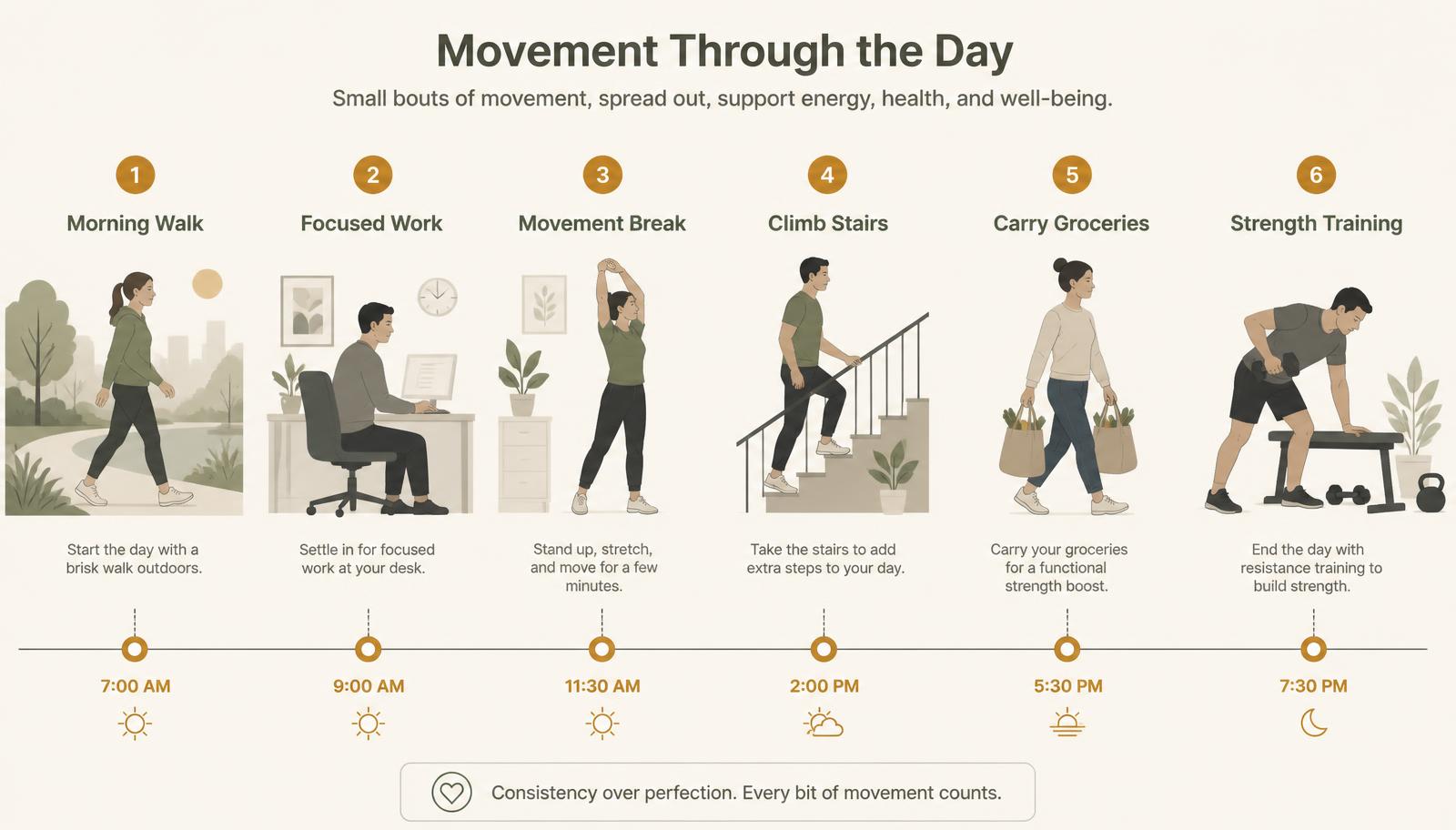
A Five-Minute Movement Break Still Has Value
Not every movement break needs to become a workout.
- Stand
- Walk around the building
- Walk to the mailbox
- Take a flight of stairs
- Do several sit-to-stands
- Carry groceries
- Water the garden
- Walk after lunch
The evidence specifically linking every brief activity break to NO production is not equally strong, and we should not pretend otherwise. But maintaining muscular activity throughout the day supports a broader cardiovascular and metabolic environment — and helps prevent prolonged periods in which blood-flow stimulus is reduced.
Exercise May Help Preserve the NO You Produce
Exercise can influence more than NO production. Oxidative stress is another important part of the equation. Excess superoxide can react with nitric oxide, reducing the amount available for normal signaling.
Regular exercise training can strengthen endogenous antioxidant defenses and improve redox regulation. Recent reviews describe increased NO bioavailability, reduced inflammatory signaling and greater antioxidant capacity among the endothelial adaptations associated with regular physical activity. [7]
Exercise may help from both directions: supporting the signaling that produces NO, and supporting an environment in which NO remains biologically useful.
Exercise Itself Produces Oxidative Stress — Is That a Contradiction?
No. Exercise temporarily increases production of reactive oxygen species. But reactive oxygen species are not inherently bad. In controlled amounts, they function as signaling molecules.
Exercise creates a manageable biological challenge. The body adapts. Antioxidant systems respond. Mitochondria adapt. Muscle adapts. The vascular system adapts. This is one reason trying to eliminate all oxidation is not a sensible goal. Healthy exercise biology depends upon an appropriate balance between challenge and recovery.
Nitric Oxide Also Matters Inside Working Muscle
The exercise–NO relationship extends beyond blood-vessel dilation. Current research is examining eNOS-derived NO in relation to:
- Glucose uptake
- Fat metabolism
- Mitochondrial function
- Metabolic flexibility
- And communication between endothelial cells and surrounding tissues
A 2025 review described eNOS as an important — but context-dependent — participant in several metabolic adaptations to exercise. [8] That is another reason NO should not be reduced to "something that opens blood vessels." It is part of a broader signaling network involved in exercise physiology.
The Microcirculation Adapts Too
Most diagrams of circulation show large arteries. But working muscle depends heavily on tiny resistance vessels and capillaries — the microcirculation.
Exercise training can improve the ability of the microvasculature to regulate blood flow. Contemporary reviews identify increased NO-mediated vasodilation, reduced oxidative stress and changes in endothelial signaling among the adaptations associated with exercise training in the microcirculation. [7]
This means exercise affects not only how strongly the heart pumps — but also how effectively circulation reaches working tissue.
Why Exercise Matters Even More After 50
Aging changes NO biology. With advancing age, research commonly finds:
- Lower endothelial NO bioavailability
- Greater oxidative stress
- Changes in eNOS regulation
- Increasing arterial stiffness
- And reduced endothelial responsiveness
Physical activity also often declines at exactly the same time. That combination matters. Aging creates a biological challenge — and inactivity removes one of the strongest natural stimuli capable of supporting vascular adaptation. That is why movement becomes more important as we age, not less.
Older Blood Vessels Can Still Adapt
Vascular aging does not mean the endothelium stops responding. The 2025 network meta-analysis of middle-aged and older adults found meaningful improvements in endothelial function with several forms of structured exercise. [3] A 2026 analysis in adults 60 and older likewise found favorable effects from multiple exercise modalities rather than identifying one single activity as the only effective approach. [9]
Age changes the vascular system, but the vascular system retains the capacity to train.
You Do Not Need to Exercise Like You Did at 25
Healthy aging is not about pretending you are younger. The objective changes. At 25, performance might mean running faster, lifting heavier or competing. At 65, performance may mean:
- Walking uphill comfortably
- Traveling
- Playing golf
- Gardening
- Keeping up with grandchildren
- Carrying luggage
- Climbing stairs
- Or maintaining independence
All of those depend upon muscle, cardiovascular capacity and circulation. Exercise supports the ability to keep doing them.
What Kind of Exercise Is Best for NO?
There is no single perfect answer. Different forms of activity create different cardiovascular stimuli.
Aerobic movement
Walking, cycling, swimming or similar activities provide sustained increases in blood flow.
Strength training
Supports muscle, mobility and the ability to remain physically active.
Occasional higher-intensity effort
For people for whom it is safe and appropriate, greater intensity can provide an additional cardiovascular challenge.
Everyday movement
Reduces long periods of inactivity and keeps circulation active throughout the day.
The strongest lifestyle strategy is not necessarily to identify one winner. It is to create a pattern of movement you can sustain.
How Much Exercise?
For general health, current public-health guidelines commonly recommend adults accumulate at least:
- 150 minutes per week of moderate-intensity aerobic activity
- Or 75 minutes of vigorous activity, or an equivalent combination
- Plus muscle-strengthening activity on at least two days each week
Older adults are also encouraged to include activities supporting balance when appropriate. These are general population recommendations rather than an NO-specific prescription. You do not need to reach a certain number of minutes before exercise begins to have value. If you are currently inactive, doing more than you do now is already a meaningful direction.
Exercise and Nutrition Work Together
Exercise provides the physiological signal. Nutrition provides the biological materials and environment.
When exercise increases blood flow and stimulates eNOS, the enzyme still needs L-arginine, appropriate cofactors and a favorable cellular environment. Another amino acid — L-citrulline — can also contribute because it is efficiently absorbed and converted into arginine.
Movement tells the endothelial system to work. Nutrition helps provide what that system works with.
Where ėNOS Fits
An important distinction: eNOS is endothelial nitric oxide synthase — the natural enzyme involved in vascular NO production. ėNOS is a dietary supplement from Australiana Life, specifically formulated around the established science of nitric oxide and the nutritional pathways that support the body's natural NO system.
At the center of ėNOS are L-arginine and L-citrulline. Arginine supplies the substrate directly used by eNOS. Citrulline provides a complementary metabolic route toward replenishing circulating arginine availability. That makes ėNOS a natural companion to physical activity: exercise stimulates the physiology, while ėNOS provides targeted nutritional support for the pathway.
The Combination Makes Particular Sense for Active Adults Over 50
As we age, maintaining exercise becomes increasingly valuable. At the same time, the body's NO system can become less efficient. That makes supporting both sides of the equation sensible.
Keep providing the stimulus: walk, cycle, strength train, move throughout the day. Support the nutritional pathway: eat well, include nitrate-rich vegetables, maintain appropriate protein intake, and where appropriate use targeted supplementation to provide consistent arginine and citrulline support.
The objective is not to make a supplement replace exercise. It is to let exercise and nutrition reinforce one another.
ėNOS Is Not an Exercise Shortcut
ėNOS cannot create the cardiovascular adaptations of regular physical activity. It cannot build muscle. It cannot improve fitness simply because you drink it. And it does not need to make those claims to be valuable.
Its role is clearer: provide consistent nutritional support for the body's natural NO-production system and healthy circulation while exercise provides the mechanical and metabolic stimulus that keeps that system active.
The Most Powerful NO Habit May Be Simply Using Your Body
There are sophisticated ways to discuss nitric oxide. eNOS phosphorylation. PI3K/Akt signaling. Mechanotransduction. Endothelial glycocalyx. Redox biology. Microvascular regulation. All of that science matters. But it eventually leads back to something very simple: move.
When you move, muscles ask for blood. When blood flow increases, the endothelium feels it. When the endothelium feels it, biological signaling changes. And when that happens repeatedly, the cardiovascular system adapts.
Exercise is not simply something you do with your cardiovascular system. It is one of the ways you communicate to it.
Use It to Help Preserve It
Healthy aging often gets framed around what we lose: muscle, fitness, flexibility, endothelial function, nitric-oxide availability. But the human body remains remarkably responsive to use. That gives movement an unusually positive role.
Walking today supports your ability to walk tomorrow. Strength work supports the muscle needed to remain active. Aerobic exercise challenges the cardiovascular system to keep responding. And every appropriate increase in blood flow gives the vascular endothelium another opportunity to do what it was designed to do: sense, signal and adapt.
You do not need to chase nitric oxide. Give your body reasons to produce and use it naturally. Movement is one of the best reasons it has.
Scientific References
[1] Niebauer J, Cooke JP. Cardiovascular effects of exercise: role of endothelial shear stress.
Journal of the American College of Cardiology. 1996;28(7):1652–1660. PMID: 8962548. Foundational review describing exercise-induced blood flow and shear stress as stimuli for endothelial NO release and vascular adaptation.
PubMed / National Library of Medicine →[2] Cheng CK, Wang N, Wang L, Huang Y. Biophysical and biochemical roles of shear stress on endothelium: a revisit and new insights.
Circulation Research. 2025;136(7):752–772. PMID: 40146803. Contemporary review of how endothelial cells sense shear stress and translate blood-flow forces into biochemical vascular responses.
PubMed / National Library of Medicine →[3] Chen Q, Gao X, Wang C, Zhang P. Influence of different exercise types on vascular endothelial function in middle-aged and older adults — a systematic review and network meta-analysis.
Archives of Gerontology and Geriatrics. 2025;128:105624. PMID: 39288582. Analysis of 20 randomized trials involving 1,123 participants comparing aerobic, resistance, combined and HIIT exercise for endothelial function.
PubMed / National Library of Medicine →[4] da Silva RSN, da Silva DS, de Oliveira PC, et al. Effects of aerobic, resistance and combined training on endothelial function and arterial stiffness in older adults: a systematic review and meta-analysis.
PLoS ONE. 2024;19. PMID: 39621701. Randomized-trial evidence examining exercise training and vascular function in older adults.
PubMed / National Library of Medicine →[5] Harden JE, Branch JD, Reynolds LJ. Impacts of physical inactivity models on endothelial function: a systematic review.
Sports Medicine. 2025;55:1937–1952. PMID: 40388068. Review demonstrating that experimentally reduced activity can impair endothelial and microvascular function.
PubMed / National Library of Medicine →[6] Effect of exercise prior to sedentary behavior on vascular health parameters: a systematic review and meta-analysis of crossover trials.
2024. PMID: 38853205. Found that exercise before prolonged sitting helped preserve flow-mediated dilation, shear rate and blood flow compared with uninterrupted sedentary behavior.
PubMed / National Library of Medicine →[7] Xu C, Sellke FW, Abid MR, et al. Microvascular function and exercise training: functional implication of nitric oxide signaling and ion channels.
2024. PMID: 38572498. Review describing increased NO-mediated vasodilation and other microvascular adaptations to exercise training.
PubMed / National Library of Medicine →[8] The intersection of exercise, nitric oxide, and metabolism: unraveling the role of eNOS in skeletal muscle and beyond.
Metabolism. 2025. PMID: 40749966. Review examining eNOS-derived NO in metabolic flexibility, mitochondrial function and exercise adaptation.
PubMed / National Library of Medicine →[9] Comparative effectiveness of various exercise modalities on arterial stiffness and endothelial function in older adults: a systematic review and network meta-analysis of randomised controlled trials.
2026. PMID: 42516957. Recent comparison of aerobic, walking, resistance and other training modalities in adults aged 60 years and older.
PubMed / National Library of Medicine →
Continue the Lifestyle & Healthy Aging Journey
- Lifestyle Habits That Support Healthy Nitric Oxide Production →
See how exercise fits alongside food, sleep, oral health and other daily habits.
- Healthy Circulation After 50: Why Blood Flow Matters →
Understand why keeping the circulatory system active becomes increasingly important with age.
- Why Nitric Oxide Production Changes With Age →
Explore the biological reasons NO availability can become more challenging after midlife.
- Nitric Oxide and Exercise Performance →
Go deeper into NO physiology during higher-intensity physical performance.
- Nitric Oxide and Exercise Recovery →
Understand the difference between circulation supporting recovery and the cellular processes that actually rebuild tissue.
KEEP GIVING YOUR VASCULAR SYSTEM A REASON TO RESPOND
Exercise is one of the most powerful natural signals supporting endothelial and cardiovascular function. ėNOS by Australiana Life complements that active lifestyle by providing L-arginine + L-citrulline and deliberately selected supporting nutrients to help support the body's natural nitric-oxide system, healthy circulation and cardiovascular wellness.
EXPLORE ĖNOS →This article is provided for informational purposes only and is not intended as medical advice or to diagnose, treat, cure or prevent disease. Exercise needs vary according to age, fitness, health conditions and medications. People with cardiovascular disease, significant physical limitations or concerns about beginning a new exercise program should seek appropriate professional guidance. ėNOS is a dietary supplement formulated to support the body's natural nitric-oxide system, healthy circulation and cardiovascular wellness and should complement, rather than replace, appropriate nutrition, physical activity and medical care.
More in Lifestyle & Healthy Aging
- Nitric Oxide & Exercise Performance
- Nitric Oxide & Exercise Recovery
- Lifestyle Habits That Support Healthy Nitric Oxide Production
- Can a Sedentary Lifestyle Affect Nitric Oxide & Circulation?
- Diet & Nitric Oxide: How Everyday Food Choices Matter
- Sleep, Cardiovascular Health & Nitric Oxide: What Do We Know?
- Smoking, Vascular Health & Nitric Oxide
- Nitric Oxide, Energy & Staying Active as We Age
- Nitric Oxide & Men's Sexual Health: The Blood-Flow Connection
- Nitric Oxide & Oral Health: The Surprising Connection
- Nitric Oxide & Aging: What Changes After 40, 50 and Beyond?
- Why Does Nitric Oxide Production Change With Age?
- Healthy Aging: Supporting Circulation, Blood Flow & Nitric Oxide After 50
- Nitric Oxide and Brain Health/Cognition
About Our Health & Science Content
Australiana Life Health & Science articles are based on published scientific research and written to make complex health and nitric oxide science easier to understand. Our educational content undergoes scientific review for accuracy and appropriate interpretation of the evidence and is updated as relevant scientific understanding evolves.